Best EMR Software for Optometrists in 2026: 9 Tools Compared
WLWPLegible EditorsLast verified 23 Nov 2026How we rank11 min read
★ Short answer
RevolutionEHR is the best EMR for most optometrists, with exam, optical and billing workflows built for eye care in one cloud system from $455 a month. Pick LiquidEHR if budget decides it, at $199 a month, and Eyefinity Encompass if VSP plans fill most of the schedule.
How we make this list: we compare pricing pages, product documentation and public user reviews, then re-check every price before each update. No product paid for a place. Disclosure.
RevolutionEHR leads for most practices: optometry-built exam, optical and billing tools in one cloud system, Core from $455 a month.
LiquidEHR is the cheapest published price at $199 a month, with the highest rating here at 4.8 out of 5 on Capterra.
Eyefinity Encompass is the pick for VSP-heavy schedules, with eligibility checks up to 7 days ahead, from $340 a month.
EyeCloud Pro charges per location from $259 a month, plus a one-time $1,000 setup fee per location.
Five of the 9 tools publish no base price, so get implementation, training and data migration in writing before you sign.
What an optometrist EMR should cover
An optometrist's EMR has to cover three jobs at once: the exam, the optical sale and the claim. A general medical EHR can chart a visit, but it will not track a frame order, a contact lens trial or a vision-plan authorization in the same record.
Start with the exam workflow, because that is where the doctor lives all day. Templates for refraction, contact lens fittings and medical eye care should match how the practice actually works, and diagnostic devices should feed results into the chart without retyping.
Then follow the money. Claims, eligibility checks, optical point of sale and inventory decide whether the system pays for itself, and most vendors charge extra for setup, data migration and payment processing on top of the monthly price.
Patient records also need strong protection, since exam notes, prescriptions and payment details sit in one system. Our guide on securing a WordPress site covers the same basics, updates, access control and backups, that apply to any system holding patient data.
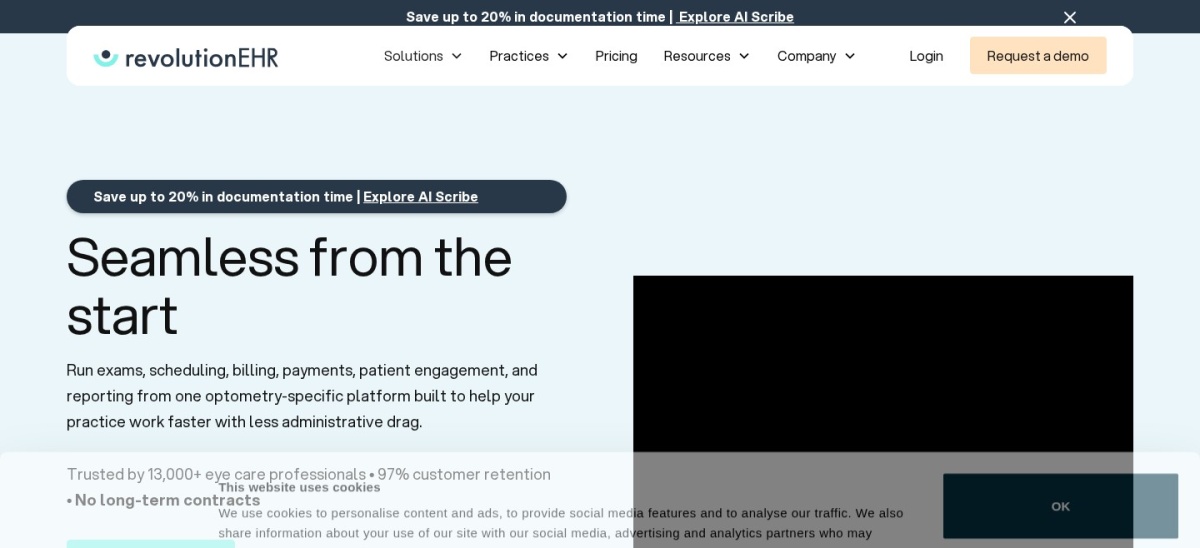
RevolutionEHR is a cloud EHR and practice management platform built only for optometry, used by more than 13,000 eye care professionals. Core costs $455 a month and covers scheduling, exam documentation, optical workflows, claims and patient engagement in one login, with an AI scribe included.
The trade off is that the price grows with the practice. Advanced starts at $660 a month and Premium at $830, and setup and database-conversion fees are extra. It suits independent practices that want one optometry-built system instead of stitching several tools together.
What we like
Optometry-only exam, optical and billing workflows
LiquidEHR is a simple optometry EHR and practice management system with flat pricing and no contract. The in-office setup costs $199 a month and the cloud setup $299, both with free setup, all modules, unlimited doctors and unlimited workstations. It is rated 4.8 out of 5 on Capterra from 56 reviews.
The trade off is polish and reach. The interface looks dated next to cloud-first rivals, and the integration catalog is thinner, so practices with many diagnostic devices should check each connection. It suits solo optometrists and small practices that want a low, fixed monthly cost.
Eyefinity Encompass is the cloud platform from Eyefinity, a VSP Vision company, that combines practice management, EHR, patient engagement and analytics in one login. Essential costs $340 a month and includes VSP eligibility checks, an iPad exam app, a patient portal and online scheduling.
The trade off is the fine print. The $340 rate covers one location and one doctor in the first year of a one-year contract, requires EncompassPay, and excludes onboarding fees. It suits practices where VSP plans dominate the schedule and the VSP workflow saves the front desk real time.
What we like
Deepest VSP integration in this list
Eligibility checks up to 7 days ahead
Practice management, EHR and engagement in one login
SOC 2 Type 2 certified
Watch out for
Lowest Capterra rating in this list at 3.7
$340 covers one location and one doctor only
Requires EncompassPay and excludes onboarding fees
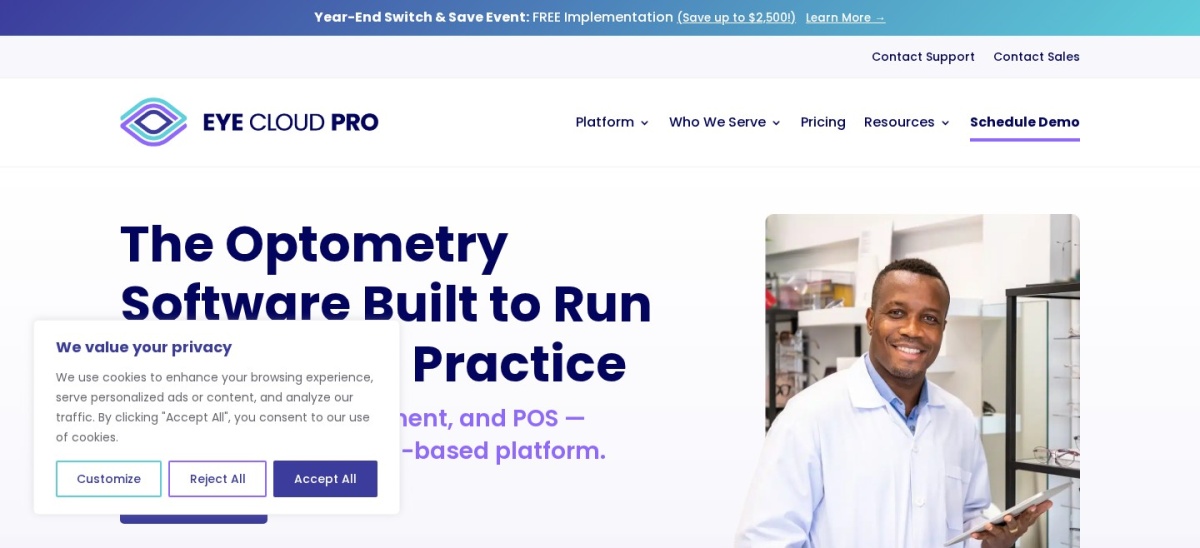
Eye Cloud Pro is a cloud platform built only for optometry, used by more than 1,000 independent practices. Plans start at $259 a month per location and cover the EHR, optical point of sale, billing, inventory, scheduling and payments, with human support included in every plan.
The trade off is that the starting price is only part of the cost. A one-time $1,000 setup fee applies per location, and exact plan prices are given during a demo. It suits single-location practices that want per-location pricing instead of paying per user.
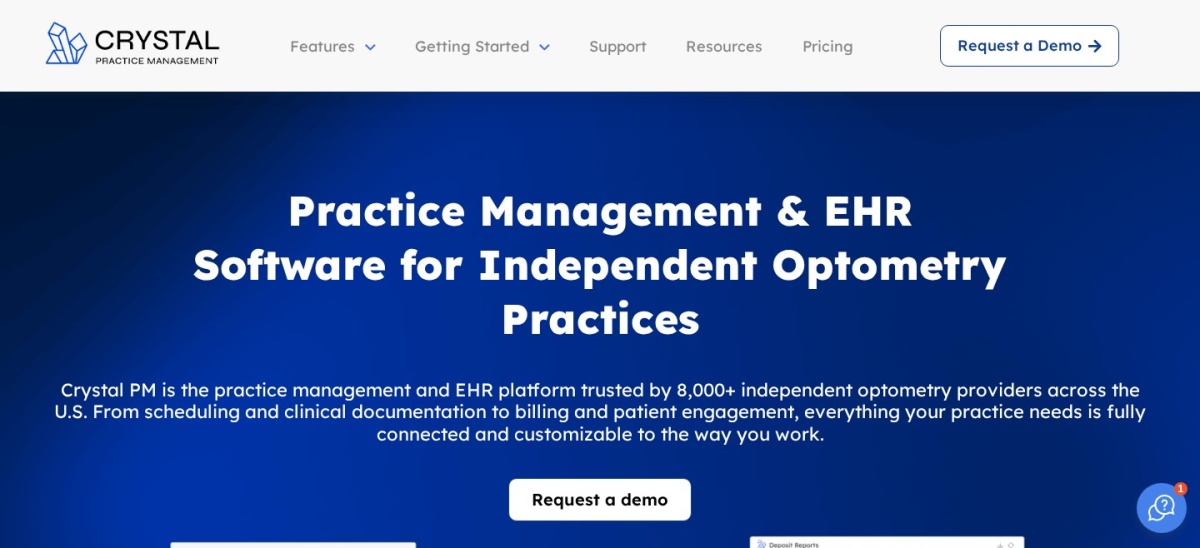
Crystal PM is a practice management and EHR platform for eye care, used by more than 8,000 independent providers. It covers scheduling, clinical documentation, billing, inventory and patient communication, runs in the cloud or in the office, and offers more than 55 integrations.
The trade off is price transparency. The base price needs a sales call, and some reviewers call the interface awkward to learn, so budget time for training. It suits independent practices that want the system shaped around their own workflow.
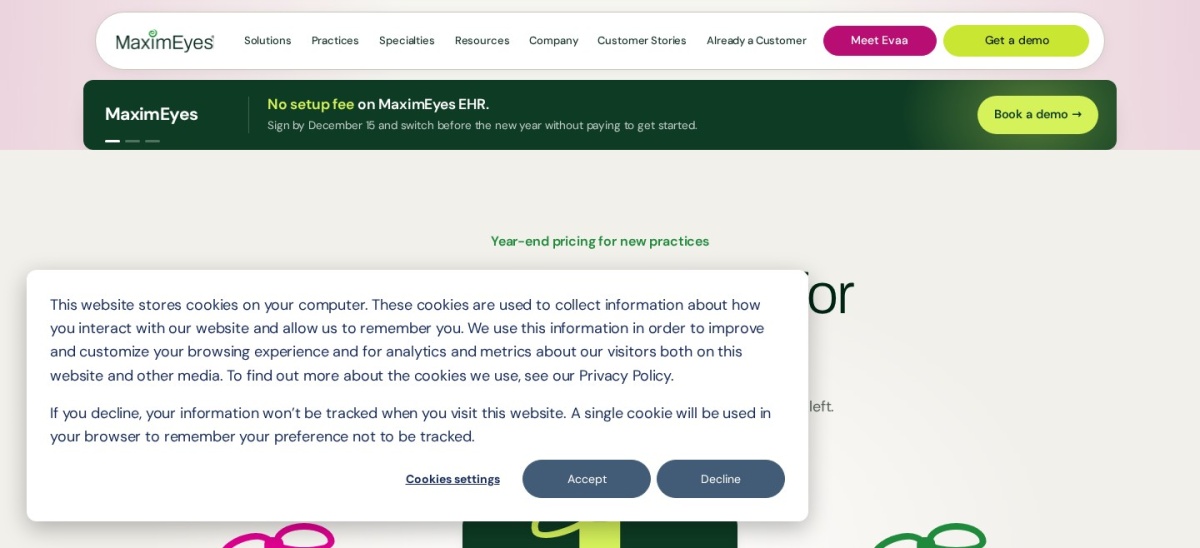
MaximEyes is an all-in-one EHR and practice management system from First Insight, built for optometry and ophthalmology. It covers charting, scheduling, billing, optical point of sale and image management, with more than 270 integrations for diagnostic devices and an AI scribe that drafts exam notes.
The trade off is that pricing is by quote only, with a one-time implementation fee on top, and the depth of the system means a long onboarding. It suits multi-location eye care groups that want deep customization and device data flowing into the chart.
Compulink Advantage is an all-in-one EHR and practice management system on a single database, built for specialty practices including optometry and ophthalmology. Its OneTab charting holds the full exam on one screen, and optical point of sale, inventory, lab orders and an online store sit in the same record.
The trade off is scale. It is more system than a one-doctor practice needs, pricing is by quote only, and implementation is a serious project. It suits large groups and multi-specialty practices that want exam, billing, optical and surgery-center work in one system.
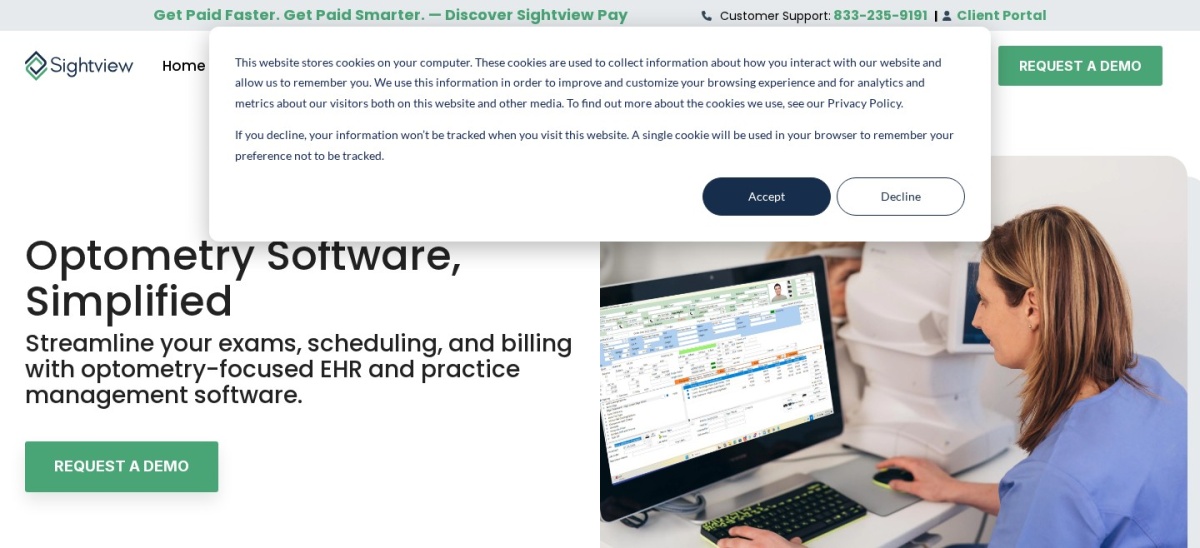
My Vision Express is Sightview's optometry EHR and practice management system, used by more than 15,000 eye care professionals. It combines exams, scheduling, billing and optical point of sale, with customizable templates, image integration, MIPS reporting and e-prescribing.
The trade off is the rating. It scores 3.3 out of 5 on G2 from 14 reviews, the lowest here, and reviewers report slow support and glitches, so check the current roadmap after the Sightview move. It suits multi-location optical retail groups that want a simpler system.
Best iPad-first EHR for tech-comfortable practices
Entry planQuote only
PlatformiPad-first, web and mobile
PlansFoundation, Growth, Premium
G2 rating3.3/5, 45 reviews
drchrono.com
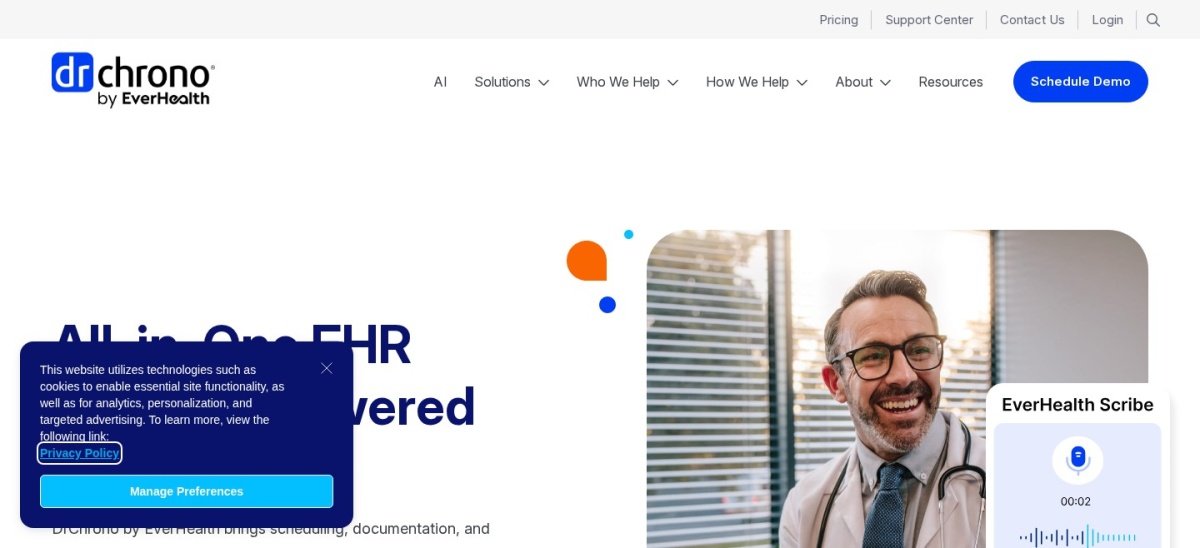
DrChrono homepage, captured Nov 2026.
DrChrono is a general EHR and practice management system from EverHealth, built around iPad-first charting. It covers customizable exam notes, scheduling, billing and e-prescribing, with an open API, and it is rated 3.3 out of 5 on G2 from 45 reviews.
The trade off is that it is not built for optometry. There is no optical point of sale or eye care template set, and pricing is by quote only. It suits tech-comfortable practices that want iPad charting and API flexibility more than optometry-specific workflows.
Setup and data migration are the first extra cost. EyeCloud Pro states its $1,000 setup fee per location openly, while RevolutionEHR charges setup and database-conversion fees that vary by practice.
Per-doctor and per-location pricing change the total fast. A $455 plan that covers one doctor costs more in a three-doctor office, and a per-location plan doubles when a second office opens.
Add-ons add up too. E-prescribing, text messaging and device integrations are extra on some plans, so ask each vendor for the full first-year total in writing before you sign.
How we chose
We started from the EMR systems most often named for optometry in 2026 comparisons, then kept 9 established products with a public review footprint on G2 or Capterra.
Prices were checked on 23 November 2026. RevolutionEHR Core at $455 a month and LiquidEHR at $199 a month were read on their official pricing pages, and EyeCloud Pro's $259 starting price was too. Eyefinity's $340 Essential price was read on the vendor pricing page, which would not load in a direct fetch but was verified through a search crawl of the same page.
We left out tools with no verifiable rating and thin review counts, including Uprise, which has only 3 Capterra reviews. No vendor paid for a place, and we do not claim hands-on testing for this list.
How to choose an EMR for your optometry practice
Match the system to the exam room first, then check the price model and the contract.
Demo the exam workflow with real visit types. Use refraction, contact lens and medical visits from your own schedule. If charting feels slow in the demo, it will feel worse on a busy day.
List every device and confirm the integration. OCT, fundus cameras, visual fields and autorefractors should send results into the chart on their own. Manual entry from each device is a daily cost.
Get the full first-year cost in writing. Ask for setup, data migration, training, clearinghouse and payment processing fees as separate lines, not one monthly figure.
Talk to two reference practices of your size. Ask how long implementation took, how support responds, and what the second year cost. A short call beats a sales demo for those answers.
FAQ
What is the best EMR software for optometrists?
RevolutionEHR is the best pick for most practices. It is built only for optometry, covers exams, optical sales and billing in one cloud system, and is rated 4.5 out of 5 on Capterra from 205 reviews. Core costs $455 a month.
What is the cheapest EMR for optometrists?
LiquidEHR has the lowest published price here at $199 a month for an in-office setup, or $299 a month for cloud, with free setup and no contract. It is also the highest rated tool here at 4.8 out of 5 on Capterra.
Is Eyefinity Encompass worth it for VSP practices?
Yes, if VSP plans fill much of the schedule. Its eligibility checks run up to 7 days ahead of the visit, and claims and ordering run through the same system. Essential costs $340 a month for one location and one doctor in the first year.
Do optometry EMRs include optical point of sale?
Most of the tools here do. RevolutionEHR, EyeCloud Pro, Crystal PM, MaximEyes, Compulink and My Vision Express all combine optical sales with the exam record. DrChrono does not, since it is a general EHR without an optical module.
Why do so many optometry EMRs hide their prices?
Most vendors price by quote, based on doctors, locations and modules. Only LiquidEHR, RevolutionEHR, Eyefinity Encompass and EyeCloud Pro publish a starting price, so get the rest in writing before you budget.
Can I switch EMR systems without losing patient records?
Yes, but plan for it. Vendors charge for data migration, and some records need manual cleanup. Ask for the migration scope, timeline and cost in the contract, and keep the old system readable until the move is checked.