Best Embedded Payments Software in 2026: 9 Tools Compared
WLWPLegible EditorsLast verified 23 Nov 2026How we rank8 min read
★ Short answer
Stripe Connect is the best embedded payments software for most platforms, with no platform fee on its Stripe-priced model and card payments from 2.9% plus 30 cents. Pick Adyen for global enterprise volume and Finix if you plan to run your own PayFac.
How we make this list: we compare pricing pages, product documentation and public user reviews, then re-check every price before each update. No product paid for a place. Disclosure.
Stripe Connect charges no platform fee when Stripe prices your users, with card payments from 2.9% plus 30 cents.
Adyen's interchange-plus rate of $0.13 plus 0.60% beats flat rates at enterprise volume, but it is sales-led with a minimum invoice.
Finix and Stax publish their pricing: Finix from $250 a month, Stax from $99 a month with interchange at cost.
Checkout.com, Rapyd and Payrix publish no platform rates, so get a written quote before you compare them.
Braintree is the only pick with native PayPal and Venmo acceptance, but it holds the lowest G2 rating here at 3.4 out of 5.
What embedded payments software does
Embedded payments let a software platform take card payments inside its own product, without each customer setting up a separate merchant account. The platform boards its users, sets their prices and takes a share of the processing margin.
There are two shapes. Connect-style providers such as Stripe and Adyen stay on the acquiring program and handle compliance, while PayFac-as-a-service providers such as Finix, Stax and Payrix let the platform keep more margin and, in some cases, grow into its own facilitator.
Price is mostly per transaction, not per seat. Compare the card rate, the monthly fee or minimum, payout fees and dispute fees together, since the headline rate hides most of the bill. Our guide on what a payment gateway is explains the roles each part plays.
Watch the review base too. Embedded payments is a thin-review category: most providers here have under 100 G2 or Capterra reviews, so a high rating on a dozen reviews means less than the same score on hundreds.
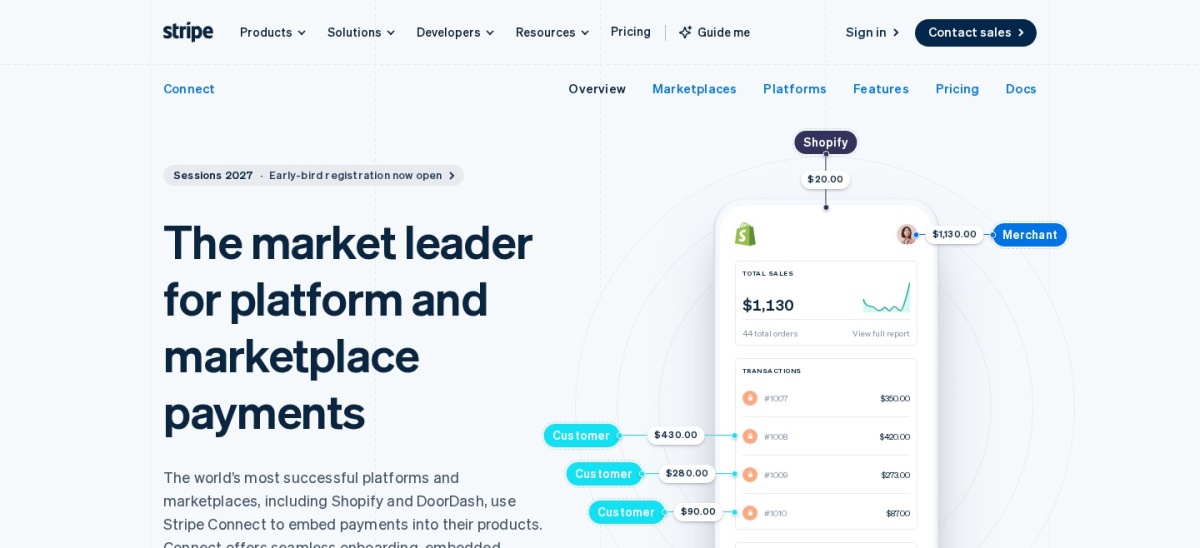
Stripe Connect is the embedded payments product for platforms and marketplaces, used by Shopify, Lyft and Substack. The Stripe-priced model charges no platform fee, and card payments start at 2.9% plus 30 cents per successful domestic charge. It includes hosted onboarding, split payments and an embedded dashboard for your users.
The trade off is cost at volume. The flat 2.9% plus 30 cents rate costs more than interchange-plus pricing once volume grows, and setting your own prices adds $2 per monthly active account plus 0.25% plus 25 cents per payout. It suits platforms that want the fastest launch with published pricing.
What we like
No platform fee on the Stripe-priced model
Published pricing for both models
Embedded onboarding, payouts and dashboard
Largest ecosystem of prebuilt components
Watch out for
Flat rate costs more than interchange-plus at volume
Self-priced model adds account and payout fees
Dispute fee of $15 per dispute
Self-priced Connect adds $2 per active account a monthVisit stripe.com
02
Adyen
4/5on G2 (44 reviews, checked Nov 2026)
PricingCustom/mo
Best for global enterprise platforms
Card rate$0.13 + IC++ + 0.60%
Monthly feeNone, minimum invoice applies
Payment methods150+ currencies
CoverageOnline and in-person
adyen.com
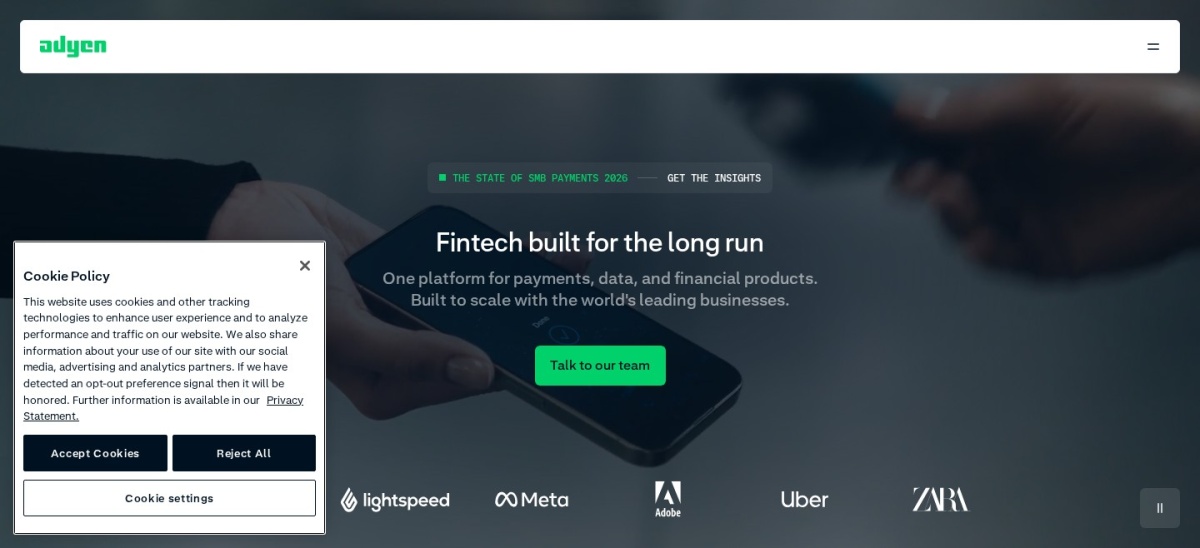
Adyen homepage, captured Nov 2026.
Adyen is the enterprise payments platform behind large global merchants and marketplaces. Its published US card rate is $0.13 per transaction plus interchange and scheme fees passed through with a 0.60% markup, with no setup or monthly fee. It covers online and in-person payments on one contract.
The trade off is access. Adyen is sales-led, applies a minimum monthly invoice by industry, and the platform fees are quoted per merchant rather than published. It suits enterprise platforms with serious volume across several countries that want one acquirer.
Square is the payments and point-of-sale system for small sellers that also offers APIs for platforms. Its Online API charges 2.9% plus 30 cents per payment, in-person sales cost 2.6% plus 15 cents, and Square Free costs $0 a month. It includes invoicing, payment links and next-business-day payouts.
The trade off is scope. Square is built for sellers, not for platforms that need white-label merchant onboarding, split payouts or PayFac economics. It suits small businesses and apps whose users mostly sell in person or through a simple online checkout.
What we like
No monthly fee on Square Free
Same account covers online and in-person
Fast setup with no contract
Invoicing and payment links included
Watch out for
Not a white-label platform product
No PayFac path for software platforms
Online rate on Square Free is 3.3% + 30¢ outside the API
Square Plus at $49 a month cuts the online rate to 2.9% + 30¢Visit squareup.com
04
Checkout.com
4.6/5on G2 (70 reviews, checked Nov 2026)
PricingCustom/mo
Best for global online checkout
Rate modelCustom quote
Monthly feeNone stated
Coverage150+ countries
PayoutsT+2 business days
checkout.com
Checkout.com homepage, captured Nov 2026.
Checkout.com is an online payments platform for global merchants and software platforms. It accepts cards, wallets, bank transfers and local payment methods across 150+ countries, with local acquiring in 57 domestic markets. It states there are no setup, account maintenance or surprise fees.
The trade off is transparency. Checkout.com publishes no rates, so every merchant gets a custom Interchange++ or flat-rate quote based on profile and volume. It suits mid-market and enterprise platforms that sell across borders and will negotiate their rates.
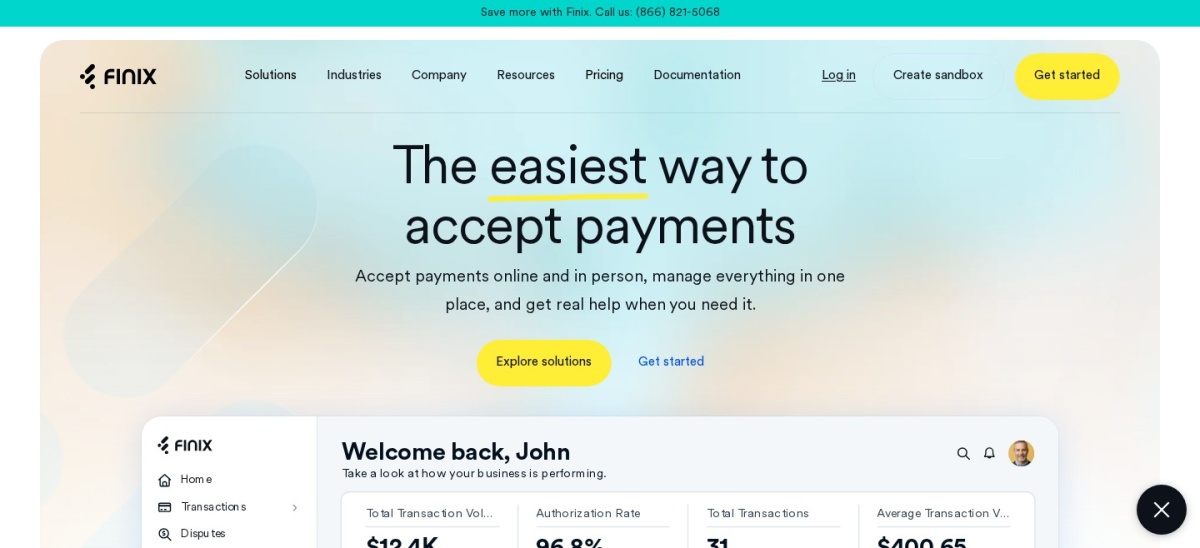
Finix is a full-stack payment processor that lets software platforms embed payments and later graduate to their own payment facilitator registration on the same API. Its starter plan costs $250 a month for businesses under $1 million in annual volume, with interchange-plus pricing and a dedicated merchant account.
The trade off is the monthly floor. The $250 membership makes Finix poor value for low-volume platforms, and it operates in the US and Canada only. It suits vertical SaaS platforms with serious volume that want more of the payments margin.
What we like
Published interchange-plus rate card
Path from managed PayFac to your own registration
Dedicated merchant account
Rated 4.7 out of 5 on Capterra
Watch out for
$250 monthly floor is steep at low volume
US and Canada only
PayFac pricing is custom
Platform pricing is custom above the starter planVisit finix.com
06
Stax Connect
4.9/5on G2 (12 reviews, checked Nov 2026)
Starts at$99/mo
Best for predictable subscription pricing
Starting plan$99/mo Basic
Online card rateInterchange + 15¢
ACH1%, capped at $10
ContractMonth to month
staxpayments.com
Stax Connect homepage, captured Nov 2026.
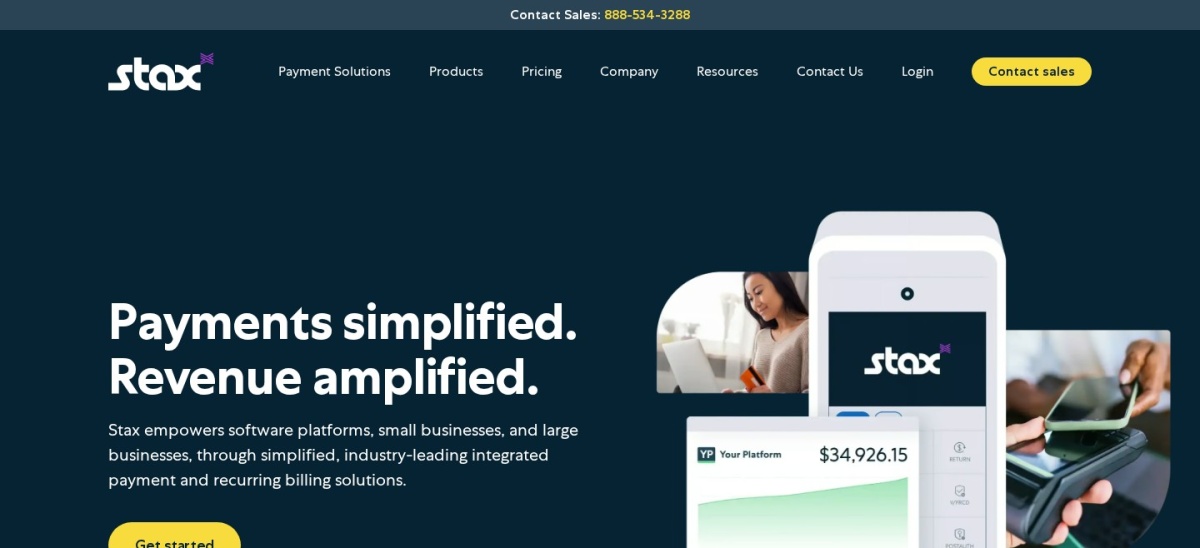
Stax Connect is the embedded payments product from Stax for ISVs and SaaS platforms. Its Basic plan costs $99 a month, passes interchange through at cost with no percentage markup, and adds 15 cents per online card payment. It targets platforms with steady, predictable volume.
The trade off is the flat fee. At low volume the $99 a month costs more than pay-as-you-go pricing, and the G2 review base is small at 12 reviews. It suits platforms with steady high-ticket volume that want a fixed monthly cost.
Braintree is the PayPal-owned payment gateway for online businesses that want cards, PayPal and Venmo in one integration. Its standard card rate is 2.59% plus 49 cents per transaction with no monthly fee, and it includes a single vault, drop-in UI and ACH at 0.75% capped at $5.
The trade off is support and account risk. Braintree holds a 3.4 out of 5 G2 rating from 91 reviews, with slow support and frozen funds among the common complaints. It suits businesses where PayPal and Venmo acceptance matters more than the lowest rate.
Rapyd is a fintech-as-a-service platform for platforms and marketplaces that need to collect and pay out across many markets. Its network covers 190+ markets and 150+ currencies, with local payment methods, card payouts, bank transfers and wallet disbursements through one API.
The trade off is price clarity. Rapyd publishes interchange and scheme fee ranges but quotes its own acquirer fee per merchant, and its G2 base is only 2 reviews. It suits marketplaces with gig or cross-border payouts that Stripe and Adyen do not cover well.
Payrix is a PayFac-as-a-service product for software companies, now sold as Global Payments for Platforms. It offers white-label merchant onboarding, underwriting, risk management, settlement and payouts, with three tiers from managed PayFac to a developer path that runs facilitation in-house.
The trade off is opacity. Payrix publishes no rates, platform fees or revenue terms, and every tier starts with a demo or sales conversation. It suits large vertical software vendors that want a white-label payments program backed by a major acquirer.
Flat-rate pricing charges one percentage plus a fixed fee on every sale. Stripe, Square and Braintree use it, and it is simple to forecast at low volume.
Interchange-plus passes the card network cost through and adds a small markup. Adyen, Finix and Stax use it, and it usually wins once monthly volume passes a few hundred thousand dollars.
Do the math on your own mix before you sign. A low-ticket store pays more in fixed fees, while a high-volume platform pays more in percentage points. Our WooCommerce gateway fee comparison shows the same rates worked out per order.
How we chose
We started from the embedded payments providers named most often in platform comparisons, then kept nine established tools with published pricing pages or documented rate cards and a public review listing.
Prices come from each vendor's pricing page or published rate card, checked on 23 November 2026. Ratings come from G2 or Capterra on the same day. Where a vendor shows no public rate, the list says so instead of guessing one.
We left out providers with no public review listing, such as Rainforest, Tilled and Moov, and providers that only sell through a quote with no published rate card. No vendor paid for a place, and we do not claim hands-on testing for this list.
How to choose embedded payments software
Start with your volume and your users, then match the pricing model to both.
Work out your monthly volume first. Flat rates win below roughly $100,000 a month, while interchange-plus usually wins above it. Ask each vendor to price your own ticket size and card mix.
Decide how much of payments you want to own. A Connect-style provider handles compliance for you. A PayFac-as-a-service provider keeps more margin with you but needs more work from your team.
Check payouts and onboarding, not just the card rate. Ask how fast users get paid, what onboarding looks like for them, and what happens when a payment is disputed.
Get every quote in writing. Three providers here publish no rates at all. Ask for the full fee schedule, including payout, dispute and minimum fees, before you sign.
FAQ
What is the best embedded payments software?
Stripe Connect is the best pick for most platforms. It charges no platform fee when Stripe prices your users, card payments start at 2.9% plus 30 cents, and it includes hosted onboarding, split payments and an embedded dashboard.
How much does embedded payments software cost?
Most providers charge per transaction, not per seat. Stripe and Square start at 2.9% plus 30 cents per card sale with no monthly fee, Adyen charges $0.13 plus interchange and a 0.60% markup, and Finix starts at $250 a month.
What is the difference between Stripe Connect and a PayFac?
Stripe Connect keeps Stripe on the acquiring program while your platform embeds payments. A PayFac-as-a-service provider such as Finix or Payrix makes the provider the facilitator, and your platform can later take over that registration itself.
Do I need a monthly plan to embed payments?
No. Stripe, Square, Adyen, Checkout.com and Braintree charge no monthly fee, and you pay only per transaction. Finix starts at $250 a month and Stax at $99 a month, so check whether your volume covers that fixed cost.
Which embedded payments tool is best for a marketplace?
Stripe Connect fits most marketplaces, with split payments and hosted onboarding for sellers. Adyen fits global marketplaces with high volume, and Rapyd fits marketplaces that pay out across many countries.
Why do some providers publish no prices?
Enterprise providers such as Adyen, Checkout.com and Payrix quote per merchant, based on volume, industry and risk. Ask for a written quote that lists payout, dispute and minimum fees, and compare it against a published rate card.