Best Content Marketing Automation Tools in 2026: 7 Tools Compared
WLWPLegible EditorsLast verified 22 Nov 2026How we rank13 min read
★ Short answer
ContentStudio is our top content marketing automation pick for teams managing content discovery, AI creation and multichannel publishing, with 5 social accounts on its entry plan. SocialBee is better for recycling evergreen content, while Buffer offers a free plan with 3 channels and 10 scheduled posts per channel.
How we make this list: we compare pricing pages, product documentation and public user reviews, then re-check every price before each update. No product paid for a place. Disclosure.
ContentStudio combines content discovery, AI creation and publishing, with 5 social accounts on Standard at a regular $29/month.
SocialBee starts at a regular $29/month and supports 5 social profiles with category-based scheduling and evergreen content recycling.
Buffer offers 3 channels and 10 scheduled posts per channel for free; Essentials costs $5/month per channel when billed annually.
Metricool includes 20 scheduled posts per month on its free plan, while paid Starter begins at $20/month with annual billing.
Mailchimp starts at $13/month for Essentials, making it a useful option for automated email distribution rather than social publishing.
CoSchedule includes automated evergreen resharing through ReQueue, with Starter at $29/month billed annually.
What to look for in content marketing automation software
Content marketing automation handles repetitive work between creating an idea and getting it in front of an audience. Common tasks include scheduling posts, distributing articles, recycling evergreen content, managing approvals and sending automated emails.
Start by identifying which stage consumes the most time. A publishing tool may be enough for social distribution, while a content operations platform makes more sense when editorial planning, collaboration and publishing all need coordination.
Look beyond AI writing. RSS automation, recurring queues, content libraries, approval workflows and analytics can save more recurring work than generating another draft. Check which features actually appear in the entry plan.
Compare the full cost for your required channels, users and content volume. Some providers charge per social channel, others by brand or workspace, and email platforms typically scale with audience size.
Best for content discovery and multichannel automation
Entry planStandard
Social accounts5
Workspaces1
AI creationText, images and video
contentstudio.io
ContentStudio homepage, captured Nov 2026.
ContentStudio is a content marketing platform combining content discovery, AI-assisted creation, scheduling and publishing. Standard supports 5 social accounts, unlimited posting, 1 workspace and 1 user, with AI text, image and video credits.
The trade off is that Standard's regular price is $29 per month, and approval workflows, the social inbox and competitor analytics require Advanced. The pricing page also advertises a lower annual-billing offer, but that promotional figure is excluded here. It suits marketers who want content research and distribution in the same workspace.
What we like
Combines content discovery and publishing
AI-assisted text, image and video creation
Supports social publishing and blog distribution
Content library and visual planning calendar
API and automation integrations
Watch out for
No permanent free subscription
Approvals require a higher plan
Advanced features increase ongoing costs
Advanced adds approval workflows, social inbox and competitor analytics.Visit contentstudio.io
02
SocialBee
4.7/5on G2 (479 reviews, checked Nov 2026)
Starts at$29/mo
Best for evergreen content recycling
Entry planBootstrap
Social profiles5
Workspaces1
Free trial14 days
socialbee.com
SocialBee homepage, captured Nov 2026.
SocialBee is a social content automation platform built around categories, recurring schedules and evergreen post recycling. Bootstrap supports 5 social profiles in 1 workspace and includes AI-assisted content generation, making it useful for maintaining an organized publishing queue.
The trade off is the $29 monthly regular price and the absence of a permanent free plan. Its November promotion advertises reduced prices, but those discounts are temporary and are not used in this comparison. It suits small teams with evergreen articles, tips and promotions they want to redistribute.
What we like
Category-based publishing queues
Evergreen content recycling
AI caption and content assistance
Supports several social networks
Content customization by platform
Watch out for
No permanent free plan
Entry plan has profile limits
Not a complete editorial CMS
Higher plans expand profile capacity and support more advanced team workflows.Visit socialbee.com
03
Buffer
4.3/5on G2 (1,043 reviews, checked Nov 2026)
Paid from$5/mo
Best free content scheduling automation
Free channels3
Free scheduled posts10 per channel
Paid entryEssentials
Paid pricingPer channel
buffer.com
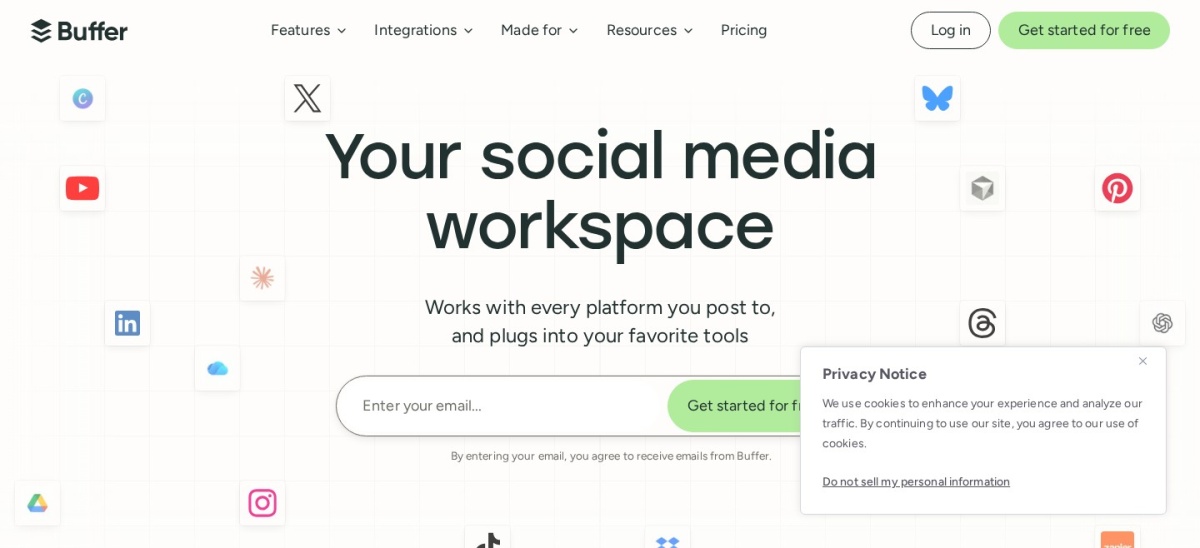
Buffer homepage, captured Nov 2026.
Buffer is a social media publishing platform with a free plan covering 3 channels and 10 scheduled posts per channel. The free tier includes an AI assistant, ideas library, basic insights, a community inbox and API access.
The trade off is that Essentials costs $5 per month per channel with annual billing, so costs increase as more channels are connected. Essentials removes the scheduled-post limit and adds advanced analytics and first-comment scheduling. It suits creators and small teams that prioritize straightforward distribution over complex content operations.
What we like
Useful free plan for small publishers
AI assistant available without payment
Simple scheduling and content queue
API and automation integrations
Paid plan includes unlimited scheduled posts
Watch out for
Paid pricing grows per connected channel
Team approval workflows require Team
Limited editorial production features
Essentials adds unlimited scheduling, advanced analytics and first-comment scheduling.Visit buffer.com
04
Metricool
4.4/5on G2 (112 reviews, checked Nov 2026)
Paid from$20/mo
Best for automated reporting and analytics
Free brands1
Free scheduled posts20 per month
Paid entryStarter
Competitor analysisUp to 100 on Starter
metricool.com
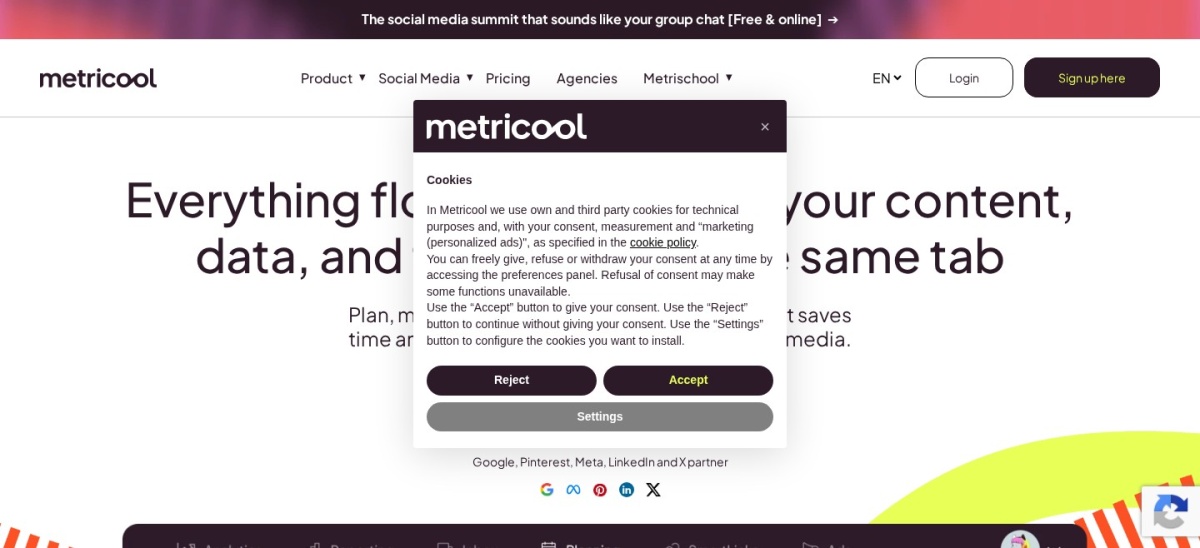
Metricool homepage, captured Nov 2026.
Metricool is a social publishing and analytics platform with scheduling, competitor tracking and performance reporting. Its free plan supports 1 brand, 20 scheduled posts per month, 5 competitor profiles and 30 days of analytics history.
The trade off is that Starter begins at $20 per month with annual billing, while advanced team management and approvals belong to a higher tier. The free plan also excludes LinkedIn and X connections. It suits marketers who want automated distribution alongside social analytics and campaign reporting.
What we like
Free scheduling and analytics
Competitor tracking
Social and advertising performance views
Automated reporting options
AI social media assistance
Watch out for
Free publishing has a monthly limit
Approval workflows require Advanced
Some integrations and analytics need add-ons
Starter adds broader publishing, more brands, reports and longer analytics history.Visit metricool.com
05
CoSchedule
4.4/5on G2 (226 reviews, checked Nov 2026)
Starts at$29/mo
Best for calendar-driven content campaigns
Entry planStarter
Social profiles3
Included seats1
AutomationReQueue
coschedule.com
CoSchedule homepage, captured Nov 2026.
CoSchedule is a calendar-centered social marketing platform for organizing campaigns and automating publishing. Starter includes 1 user seat, 3 social profiles, unlimited scheduling, ReQueue evergreen automation, social reporting and an AI social assistant.
The trade off is its $29 monthly price when billed annually, with additional profiles costing extra and approvals reserved for Professional. It suits marketers who manage recurring promotions and want scheduling organized around a drag-and-drop calendar.
What we like
Visual drag-and-drop calendar
ReQueue republishes evergreen content
Unlimited scheduling on Starter
Built-in analytics and reports
AI assistance for social campaigns
Watch out for
No permanent free plan
Entry plan includes one user
Approval workflows require Professional
Professional adds more profiles, team seats, approvals and advanced reporting.Visit coschedule.com
06
Mailchimp
4.4/5on G2 (5,445 reviews, checked Nov 2026)
Paid from$13/mo
Best for automated email content distribution
Free contacts250
Entry planEssentials
Email campaignsYes
Advanced automationStandard and above
mailchimp.com
Mailchimp homepage, captured Nov 2026.
Mailchimp is an email marketing and automation platform for distributing newsletters, promotions and other content to subscribers. Its free plan supports up to 250 contacts, while Essentials starts at $13 per month and adds scheduling and testing features.
The trade off is that Essentials is not the full advanced automation package; broader automation and personalization features are positioned in Standard, starting at $20 per month. Pricing also varies with contact volume. It suits content teams that rely on subscriber emails more than social scheduling.
What we like
Free entry plan for email campaigns
Email templates and scheduling
Audience segmentation options
Campaign reporting
Large integration ecosystem
Watch out for
Advanced automation requires higher plans
Costs increase with contact volume
Not designed for multichannel social scheduling
Essentials adds email scheduling and testing; Standard expands automation.Visit mailchimp.com
07
Later
4.5/5on G2 (389 reviews, checked Nov 2026)
Starts at$25/mo
Best for visual social content planning
Entry planStarter
Social profiles8 per social set
Included users1
Scheduling limit30 posts per profile
later.com
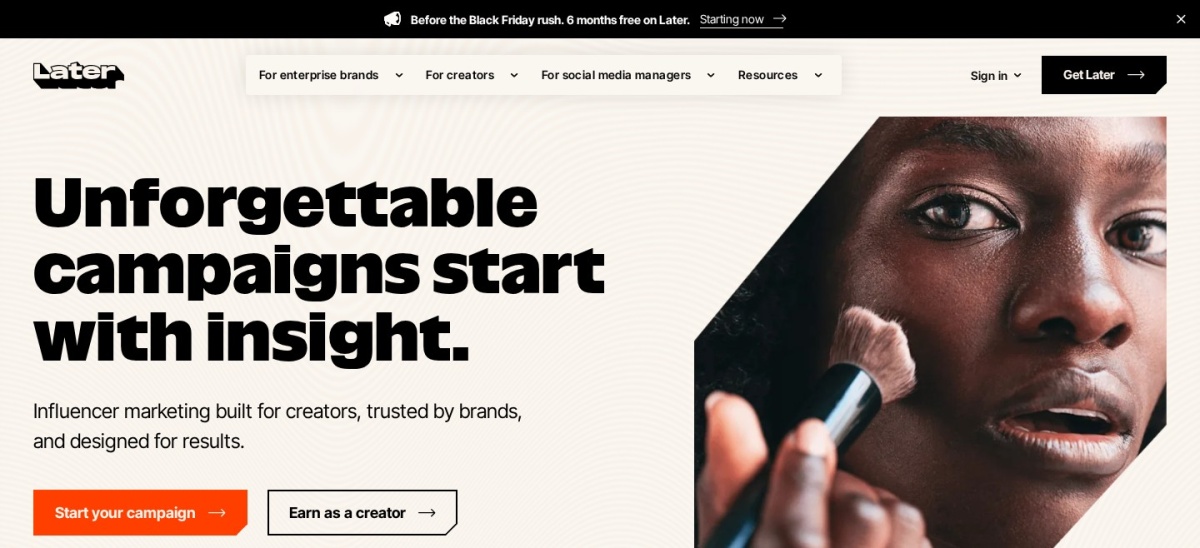
Later homepage, captured Nov 2026.
Later is a social content planning and scheduling platform focused on visual publishing workflows. Starter supports 1 social set containing 8 profiles, 1 user and up to 30 scheduled posts per profile, with tools for planning and identifying suitable posting times.
The trade off is that Starter normally costs $25 per month, while annual billing is advertised at $18.75 per month. The lower figure reflects an annual discount rather than the regular monthly rate. It suits visual content teams that want to organize posts before publication.
What we like
Visual content planning
Publishing across major social networks
Posting-time suggestions
Link-in-bio capabilities
AI-assisted social content tools
Watch out for
No permanent free plan
Starter limits scheduled posts per profile
Advanced collaboration costs more
Higher plans expand publishing allowances, analytics and collaboration tools.Visit later.com
Content marketing workflows worth automating
A practical workflow starts when a new article is published. Automation can create a social draft, place it into a publishing queue and prepare variations for distribution. Keep a review stage before anything goes live.
Evergreen recycling is another useful workflow. SocialBee and CoSchedule can help redistribute reusable articles and tips through recurring schedules, reducing the need to manually rebuild promotion calendars.
Email distribution needs different automation. Mailchimp can manage newsletter scheduling and, on suitable plans, subscriber-based journeys. Match the automation to your audience rather than sending every new article to every contact.
Reporting should close the loop. Review engagement, clicks and campaign performance regularly, then revise future publishing schedules. Automated output without performance checks can simply produce more low-value content.
What entry-plan prices do not always include
Published starting prices rarely represent the cost of an entire content team. Buffer charges by channel, Mailchimp pricing depends on audience size, and several social platforms reserve approvals or additional workspaces for higher plans.
Check billing terms carefully. Annual billing discounts are different from temporary sales, and promotional prices should not be treated as regular subscription rates.
The annual price ladder compares entry-level purchasing costs rather than equal capacity. A single social channel, a collection of profiles and an email contact allowance are different units and should be evaluated against your requirements.
How we chose
We selected established content marketing platforms that automate meaningful parts of the content workflow, including discovery, creation, scheduling, distribution, recycling, email marketing and reporting. We prioritized tools with visible product documentation and substantial public review histories.
Pricing pages and G2 review profiles were consulted on 23 Nov 2026 for this article dated 22 Nov 2026. Regular monthly prices were favored over temporary promotional offers; where an established annual-billing price was used, that billing condition is disclosed. Ratings and review counts reflect the publicly displayed G2 figures.
We excluded tools without accessible pricing, products that required an unverified currency conversion, and platforms whose main features did not fit content marketing automation. No vendor paid for a place, and we do not claim testing for this list.
How to choose content marketing automation software
Map your content process before comparing subscriptions. The right tool should remove a recurring bottleneck without creating an expensive or difficult new workflow.
Identify your biggest repetitive task. Separate content production, social scheduling, evergreen promotion, email distribution and reporting. If publishing is the problem, prioritize a scheduling platform. If research and content distribution both consume time, consider ContentStudio.
Calculate the cost for your real workload. Count connected social profiles, collaborators, brands, email contacts and publishing volume. Compare the regular subscription cost at that capacity rather than relying only on the advertised starting price.
Check automation and approval controls. Verify RSS workflows, recurring queues, API connections and publishing permissions. Teams with compliance or client review requirements should confirm that drafts can be approved before publication.
Measure the output and adjust. Choose a platform that makes engagement, traffic or campaign results visible. Review which automated content actually performs, remove stale posts from recycling queues and update your publishing strategy regularly.
FAQ
What is the best content marketing automation tool in 2026?
ContentStudio is our top overall choice because it combines content discovery, AI creation and multichannel distribution. Its Standard plan supports 5 social accounts at a regular $29 monthly price. Teams focused primarily on evergreen recycling may prefer SocialBee.
Can I automate content marketing for free?
Yes. Buffer has a permanent free plan with 3 channels and 10 scheduled posts per channel. Metricool offers 20 scheduled posts per month on its free plan, while Mailchimp provides a limited free email marketing option for up to 250 contacts.
What is the difference between content automation and marketing automation?
Content automation focuses on producing, organizing, repurposing and distributing content. Marketing automation is broader and can include email journeys, lead nurturing, segmentation and customer behavior triggers. Some products overlap, but their publishing and audience automation features are not interchangeable.
Which tool is best for automatically recycling blog content?
SocialBee is a strong option because its content categories and recurring schedules help redistribute evergreen material. CoSchedule is another choice through its ReQueue feature. Review recycled posts regularly so expired offers, outdated information and repeated messages do not reach audiences.
Which content marketing automation tool is best for small businesses?
Buffer is a practical starting point for businesses with limited channels because its free plan covers basic scheduling and AI assistance. SocialBee may be more suitable when recurring content needs organization, while Metricool adds a useful combination of free publishing and performance analytics.
Can content marketing automation tools publish to WordPress?
Some platforms support WordPress publishing or integrations. ContentStudio includes blog publishing capabilities, while other tools concentrate on distributing links to articles through social channels. Verify whether a product creates WordPress posts directly or only schedules promotional messages before choosing it.
Can AI completely automate content marketing?
AI can help draft captions, suggest ideas, adapt content and prepare publishing schedules, but complete automation is not always desirable. Editorial review remains important for factual accuracy, brand voice, originality and campaign timing. Publishing more content does not guarantee better traffic or conversions.
How much do content marketing automation tools cost?
Costs vary by channels, seats, brands and audience size. Buffer Essentials is $5 monthly per channel with annual billing, Mailchimp Essentials starts at $13 monthly, and SocialBee Bootstrap lists a regular $29 monthly rate. Advanced collaboration and larger workloads can require higher subscriptions.
Which tool is best for automating content performance reports?
Metricool is a good choice when analytics and scheduled content management need to work together. Its free plan includes limited reporting history, while paid Starter expands analytics access and reporting options. CoSchedule and ContentStudio also offer reporting, with capabilities depending on subscription level.