Portainer is the best container management software for most teams, rated 4.8 out of 5 on G2, with a free plan covering 3 nodes. Pick Docker Desktop for local development and Red Hat OpenShift for enterprise Kubernetes with built-in security.
How we make this list: we compare pricing pages, product documentation and public user reviews, then re-check every price before each update. No product paid for a place. Disclosure.
Portainer is the highest-rated tool here at 4.8/5 on G2, and its free plan covers 3 nodes with the full Business feature set.
Docker Desktop is the default for local work: Pro costs $9 a user a month on annual billing, and Personal is free for small companies.
Managed Kubernetes from AWS, Google and Azure all charge about $0.10 per cluster per hour, and AKS and GKE both offer a free tier or credit.
Rancher and Nomad are free to run yourself; paid support for both is quote-based, so budget for a sales conversation.
OpenShift is the priciest managed option in practice, with reserved instances from $0.076 an hour and self-managed editions quoted by Red Hat.
What container management software does
Container management software is the control layer over Docker or Kubernetes. It gives teams a dashboard for starting and stopping containers, viewing logs, managing images and setting who can do what.
The tools split into two groups. Desktop and single-host tools such as Docker Desktop and Portainer cover local development and small fleets, while managed Kubernetes services such as EKS, GKE and AKS run production clusters in the cloud.
Price is hard to compare directly. Some tools charge per user, some per node, and the cloud services charge per cluster hour plus the cost of the machines underneath. When you move from local containers to a live service, the deployment step matters too: our guide to deploying WordPress with GitHub Actions walks through a working pipeline.
Start with where your containers run. Local development needs a desktop tool, a small fleet needs a web console such as Portainer or Rancher, and production Kubernetes usually means a managed service from a cloud provider.
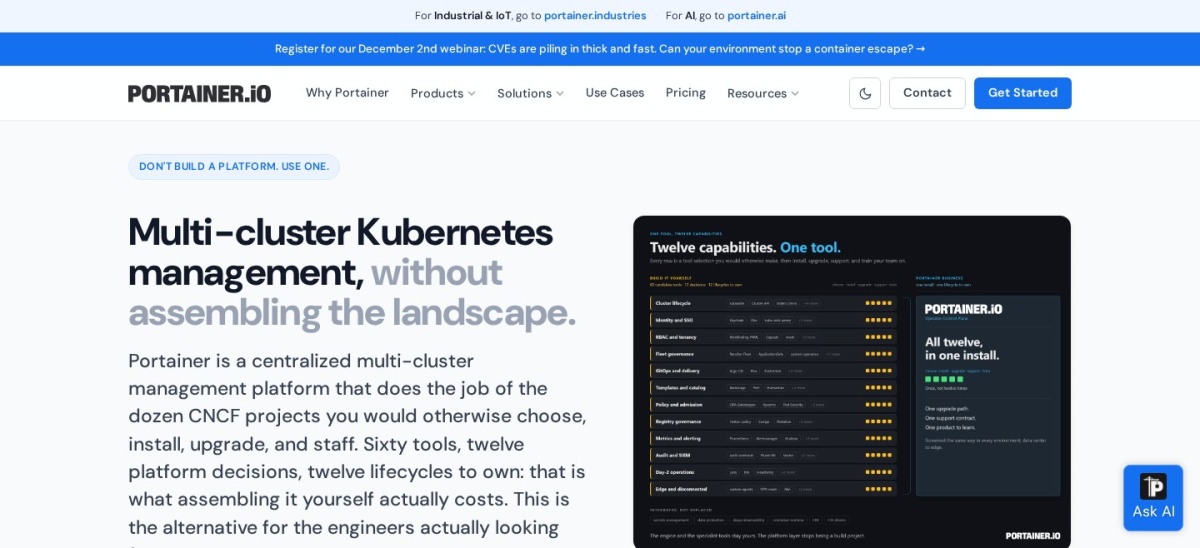
Portainer is a web console that manages Docker, Swarm, Podman and Kubernetes from one dashboard. The free Business Edition covers 3 nodes with the full feature set, including role-based access control, stack management and GitOps deployments, and the open-source Community Edition is free without a node limit.
The trade off is price once you pass 3 nodes. Starter starts at $1,045 a year for 5 to 15 nodes, which is steep for a home lab but fair for a small business. It suits teams that want one console for Docker hosts and Kubernetes clusters without learning kubectl.
What we like
Free plan covers 3 nodes with full Business features
One console for Docker, Swarm and Kubernetes
Rated 4.8 out of 5, the highest score here
Simple setup with no cluster of its own to run
Watch out for
Paid plans start at $1,045 a year
Advanced Kubernetes work still needs kubectl at times
Docker Desktop is the standard way to run containers on a Mac or Windows machine, with the Docker Engine, Compose and a built-in single-node Kubernetes cluster in one install. Personal is free for individuals and companies with fewer than 250 employees and under $10 million in annual revenue.
The trade off is licensing. Larger companies must pay, and Pro costs $9 a user a month on annual billing, or $11 month to month. It suits developers who build and test containers locally before shipping them to a server or a managed cluster.
What we like
The default local container setup
Compose and Kubernetes built in
Free for small companies and individuals
Watch out for
Paid seats required above the size and revenue limits
Red Hat OpenShift is an enterprise Kubernetes platform with a developer console, built-in CI/CD, image scanning and stricter security defaults than plain Kubernetes. Managed reserved instances start at $0.076 an hour for a 4 vCPU worker on a three-year term, and a free Developer Sandbox is available for trying it out.
The trade off is cost and weight. Self-managed editions are quoted by Red Hat by cores or nodes, and OpenShift needs more resources than a plain cluster. It suits regulated industries and large teams that want Kubernetes with support, security controls and a supported upgrade path.
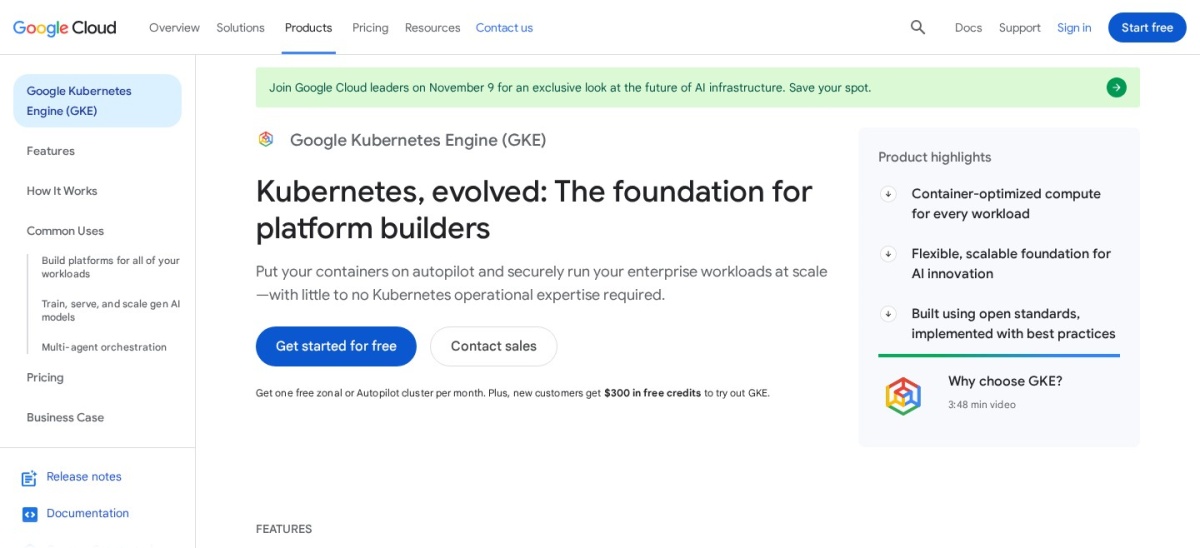
Google Kubernetes Engine homepage, captured Nov 2026.
Google Kubernetes Engine is Google's managed Kubernetes service, and it runs the platform Kubernetes was built on. Standard clusters cost $0.10 per cluster per hour, but Google applies a $74.40 monthly credit per billing account, which covers the fee for one cluster.
The trade off is that the fee is only the start. Node machines, storage and network traffic are billed separately at Compute Engine rates, so a busy cluster costs far more than $0.10 an hour. It suits teams already on Google Cloud that want mature autoscaling and upgrades.
What we like
Most mature autoscaling and auto-upgrade
One cluster effectively free with the monthly credit
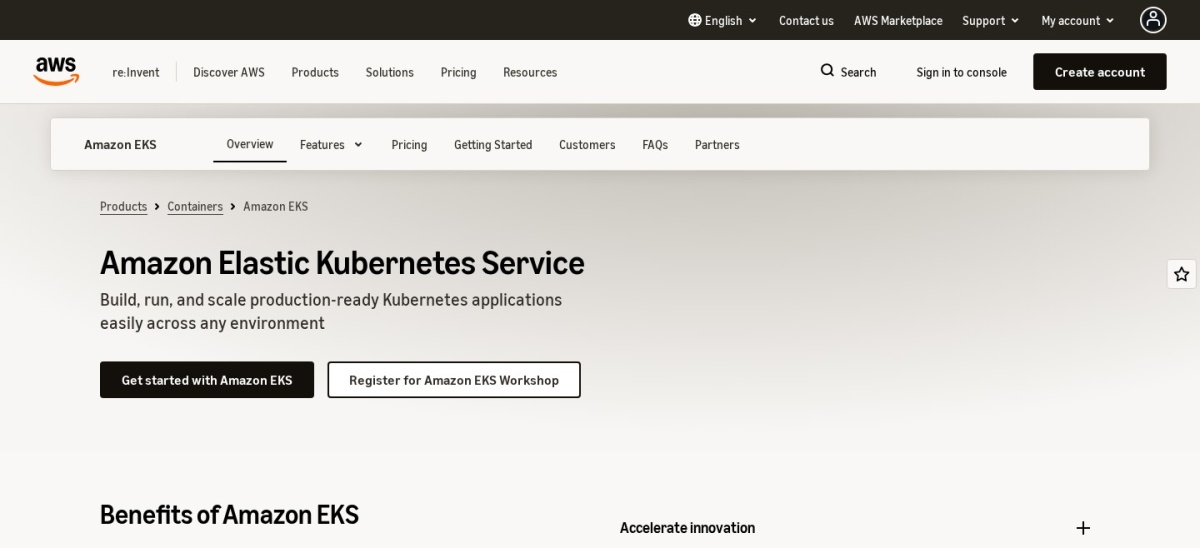
Amazon EKS is Amazon's managed Kubernetes service, and it runs clusters inside your own AWS account with IAM for access control. Each cluster costs $0.10 an hour, and nodes, storage and load balancers are billed separately at normal AWS rates.
The trade off is that EKS is only the control plane. You still pay for every EC2 instance or Fargate task that runs your containers, and the bill is hard to predict without cost monitoring. It suits teams already running on AWS that want Kubernetes with native IAM and VPC networking.
Rancher is an open-source platform from SUSE that manages many Kubernetes clusters from one console, on any cloud or on premises. It provisions RKE2 and K3s clusters, handles upgrades, and adds centralized access control and Fleet for GitOps deployments across the whole fleet.
The trade off is running it yourself. Rancher needs its own server and operator knowledge, and paid Rancher Prime support is quote-based rather than list-priced. It suits platform teams running five or more clusters across clouds who want one pane of glass.
Azure Kubernetes Service homepage, captured Nov 2026.
Azure Kubernetes Service is Microsoft's managed Kubernetes, and its free tier charges nothing for the control plane — you pay only for the nodes underneath. The standard tier costs $0.10 per cluster per hour and adds an uptime SLA and more features.
The trade off is the usual cloud bill. Node VMs, disks and load balancers are billed separately, so the free control plane does not mean a free cluster. It suits teams already on Microsoft 365 or Azure that want Kubernetes tied to Entra ID.
Amazon ECS is Amazon's own container service, and there is no extra charge for ECS itself — you pay only for the EC2 instances or Fargate tasks that run your containers. It schedules Docker containers, handles rolling updates and service discovery, and plugs into IAM and CloudWatch.
The trade off is lock-in and scope. ECS is not Kubernetes, so tools and skills built for Kubernetes do not transfer, and Fargate pricing can surprise teams with steady workloads. It suits AWS teams that want simple container hosting without running Kubernetes at all.
HashiCorp Nomad is a workload scheduler that runs containers, virtual machines and plain binaries under one system, without requiring Kubernetes. The community edition is free, job specs are short HCL files, and it pairs with Consul for discovery and Vault for secrets.
The trade off is a smaller ecosystem. Nomad has fewer integrations and specialists than Kubernetes, and Enterprise features such as namespaces and multi-region federation are quote-based. It suits teams that find Kubernetes too heavy and want one scheduler for mixed workloads.
Self-hosted tools such as Portainer, Rancher and Nomad cost nothing in licence fees, but you run the control plane yourself and pay for the machines underneath.
Managed services such as EKS, GKE and AKS charge about $0.10 per cluster per hour and remove upgrades and patching, but the node bill is always extra.
For a single developer, Docker Desktop or a free Portainer install is enough. For production, compare the managed fee plus node costs against the time your team would spend running a cluster.
How we chose
We started from the best-known container platforms: desktop tools, web consoles and managed Kubernetes services from the major clouds, then kept nine with solid public ratings.
Prices come from each vendor's pricing page, checked on 24 November 2026. Ratings come from G2 on the same day. Where a vendor shows a sale, the list shows the regular price.
We left out tools with no public G2 rating, including Podman Desktop. No vendor paid for a place, and we do not claim hands-on testing for this list.
How to choose container management software
Start with where your containers will run, then match the tool to that home.
Decide where containers run. Local development, a small server fleet and production Kubernetes need different tools. Pick the home first.
Count the real monthly cost. Add the licence or seat price to the node and traffic bill. A $0.10-an-hour cluster fee is small next to the machines underneath.
Check the free tier limits. Portainer covers 3 nodes free, AKS has a free tier and GKE credits one cluster. Make sure your fleet fits before you commit.
Match the tool to your team's skills. Kubernetes tools need Kubernetes knowledge. If your team knows Docker only, start with Portainer or ECS.
FAQ
What is the best container management software?
Portainer is the best overall pick, rated 4.8 out of 5 on G2 from 298 reviews, with a free plan covering 3 nodes. Docker Desktop is best for local development, and Red Hat OpenShift is best for enterprise Kubernetes.
Is Docker Desktop still free?
Personal is free for individuals and companies with fewer than 250 employees and under $10 million in annual revenue. Larger companies need a paid plan, starting with Pro at $9 a user a month on annual billing.
What is the cheapest way to run Kubernetes?
The AKS free tier and the GKE $74.40 monthly credit both cover the control-plane fee for one small cluster, but you still pay for the nodes underneath. Rancher and Portainer are free to self-host if you run your own machines.
Do I need Kubernetes to manage containers?
No. Docker Desktop, Portainer and Amazon ECS manage containers without Kubernetes. Kubernetes pays off when you run many services that need autoscaling, rolling updates and service discovery across machines.
How much does managed Kubernetes cost per month?
EKS, GKE and AKS each charge about $0.10 per cluster per hour, which is roughly $73 a month per cluster, plus nodes, storage and traffic. The AKS free tier and the GKE monthly credit can cover the cluster fee for one small cluster.
What is the difference between Portainer and Rancher?
Portainer is a lighter web console for Docker and Kubernetes, free for 3 nodes and paid from $1,045 a year. Rancher is a heavier multi-cluster platform, free and open source, aimed at platform teams running many clusters.
SaaS SEO and WordPress specialist with about 8 years of experience. Rakib compares WordPress plugins, themes, hosting and software using public pricing, documentation and user reviews. See how we rank.