Best Compensation Management Software in 2026: 7 Tools Compared
WLWPLegible EditorsLast verified 22 Nov 2026How we rank12 min read
★ Short answer
Lattice is our top pick for compensation management, with global salary benchmarks, pay bands, review cycles and approval workflows available through its $6 per seat/month Compensation add-on. BambooHR is better for teams wanting compensation planning inside an HR platform, while Deel suits businesses managing salary reviews and workforce planning across distributed teams.
How we make this list: we compare pricing pages, product documentation and public user reviews, then re-check every price before each update. No product paid for a place. Disclosure.
Lattice offers Compensation for an additional $6 per seat/month, with its Performance base product starting at $10 per seat/month.
BambooHR starts at $10 per employee/month, but compensation planning, salary bands and Mercer benchmarks require Elite at $25.
Deel HR starts at $5 per person/month, while Elite at $29 includes compensation reviews, pay bands and headcount planning.
PerformYard lists Talent Development at $5–$15 per person/month, including compensation, competencies and coaching.
PeopleForce Core HR starts at $2.50 per employee/month with billing starting at 50 employees; Professional costs $3.
QuotaPath Growth costs $525/month as a platform fee covering the first 5 users, with additional users priced at $35/month.
What should compensation management software include?
Compensation management software helps HR and finance teams make consistent decisions about employee pay. It replaces disconnected spreadsheets with structured workflows for salary reviews, merit increases, bonuses and compensation reporting.
The most important features are salary bands, compensation review cycles, approval workflows and budget controls. These help managers recommend changes while giving HR and finance visibility into proposed spending.
Salary benchmarking is another major consideration. Platforms with market compensation data help employers compare existing salaries against comparable roles. However, benchmarking, payroll administration and compensation planning are different capabilities, and not every tool includes all of them.
Pricing can be difficult to compare because some vendors charge per employee, others charge per administrator, and several require additional modules. The cheapest plan may only provide basic HR records rather than complete compensation planning.
This guide includes dedicated compensation products and broader HR platforms with compensation-related features. We distinguish entry-level pricing from the cost of accessing salary reviews, compensation bands and approval workflows.
Lattice is a talent management platform connecting employee performance with compensation decisions. Its Performance product starts at $10 per seat/month, while Compensation adds $6 per seat/month. The add-on includes global benchmarks, salary bands, compensation cycles, analytics, employee statements and multi-chain approvals.
The trade off is that compensation management cannot be purchased at the $6 add-on rate alone. Combining Performance and Compensation produces a published component rate of $16 per seat/month before any contractual minimums. It suits HR teams that want consistent salary decisions linked to employee performance and structured approval workflows.
What we like
Dedicated compensation review cycle management
Global salary benchmarking included in the add-on
Customizable compensation bands
Multi-chain approval workflows
Connects compensation with performance management
Watch out for
Compensation requires an additional paid module
Published seat rates may not reflect contractual minimums
Not a standalone payroll processing platform
The $6 Compensation add-on adds benchmarks, pay bands, review cycles and statements.Visit lattice.com
02
BambooHR
4.6/5on Capterra (3,653 reviews, checked Nov 2026)
Starts at$10/mo
Best for compensation planning within an HR system
Entry planCore, $10/employee/mo
Compensation planElite, $25/employee/mo
Market benchmarksMercer integration
Review workflowsBudgets and worksheets
bamboohr.com
BambooHR homepage, captured Nov 2026.
BambooHR is an HR management platform that centralizes employee records, hiring, onboarding and compensation information. Core starts at $10 per employee/month and includes employee data, reporting and Total Rewards visibility. Elite adds compensation planning, collaborative worksheets, salary bands, budget management and Mercer salary benchmarks.
The trade off is that full compensation management requires Elite at $25 per employee/month rather than Core. Pro, priced at $17 per employee/month, adds performance management but does not include Elite compensation planning. It suits growing businesses that want HR administration and structured pay reviews within the same system.
What we like
Compensation planning integrated with employee records
Mercer salary benchmarking on Elite
Collaborative worksheets and budget controls
Customizable job levels and salary bands
Performance and HR management in the same platform
4.8/5on Capterra (4,322 reviews, checked Nov 2026)
Starts at$5/mo
Best for compensation planning across distributed workforces
Entry planHR Core, $5/person/mo
Compensation planHR Elite, $29/person/mo
Performance managementAdvanced and Elite
Pay planningBands and review cycles
deel.com
Deel homepage, captured Nov 2026.
Deel is an HR platform combining workforce records, payroll-related workflows and compensation management. HR Core costs $5 per person/month and includes employee profiles, documents, time off and approvals. Elite costs $29 per person/month and adds compensation management, salary bands, compensation review cycles and headcount planning.
The trade off is that the $5 Core plan does not include the compensation planning capabilities featured here. Advanced costs $19 per person/month and adds performance, learning and engagement, while Elite is required for pay bands and review cycles. It suits organizations managing compensation alongside distributed employee records and workforce planning.
What we like
Compensation planning integrated with workforce data
Supports pay bands and structured review cycles
Headcount planning included on Elite
Performance management available on higher tiers
Payroll and HR services available within the same ecosystem
Watch out for
Core lacks dedicated compensation planning
Elite is substantially more expensive than Core
Additional employment and payroll services have separate charges
Best for linking performance and compensation decisions
Entry pricingFrom $5/person/mo
Talent DevelopmentCompensation and coaching
PerformanceReviews, goals and feedback
Pricing structurePublished range $5–$15
performyard.com
PerformYard homepage, captured Nov 2026.
PerformYard is a performance and talent management platform that connects employee evaluations with development and reward decisions. Its Performance offering includes reviews, goals, feedback and engagement tools. Talent Development is advertised from $5 to $15 per person/month and includes compensation, competencies, coaching and succession planning.
The trade off is that PerformYard publishes a $5–$15 per person/month range rather than one guaranteed compensation package price. The exact subscription depends on selected products and contract requirements. It suits organizations that want to incorporate performance assessments, coaching and competency information into employee compensation decisions.
What we like
Combines performance management and compensation-related workflows
Supports competency and succession planning
Published starting rate of $5 per person/month
Includes coaching and career development capabilities
Integrates with established HR and payroll platforms
Additional products may increase subscription costs
Talent Development adds compensation, competencies, coaching and succession planning.Visit performyard.com
05
PeopleForce
4.6/5on Capterra (50 reviews, checked Nov 2026)
Starts at$2.50/mo
Best for basic compensation records and HR administration
Entry planCore HR Standard
Entry rate$2.50/employee/mo
Minimum billing50 employees
Professional plan$3/employee/mo
peopleforce.io
PeopleForce homepage, captured Nov 2026.
PeopleForce is an HR management platform for employee data, organizational records and administrative workflows. Core HR Standard costs $2.50 per employee/month, with billing starting at 50 employees. It includes employee profiles, document management, onboarding, HR reports and basic automation, while salary-change requests can be managed through broader HR workflows.
The trade off is that PeopleForce is better suited to basic compensation administration than specialized salary benchmarking or enterprise merit planning. Professional costs $3 per employee/month and adds advanced automation, request forms and electronic signatures. It suits HR teams that first need organized employee records and controlled salary-change administration.
What we like
Low published per-employee entry rate
Centralized employee and organizational records
Basic HR automation included
Professional adds employee change request workflows
Additional recruiting and performance modules available
Watch out for
Billing starts at 50 employees
Not a dedicated compensation benchmarking platform
Advanced compensation planning capabilities are limited
Professional adds advanced automation, employee change requests and eSignatures.Visit peopleforce.io
06
Gusto
4.6/5on Capterra (4,232 reviews, checked Nov 2026)
Starts at$49/mo
Best for compensation administration tied to payroll
Entry planSimple
Base subscription$49/month
Employee charge$6/person/month
Payroll runsUnlimited
gusto.com
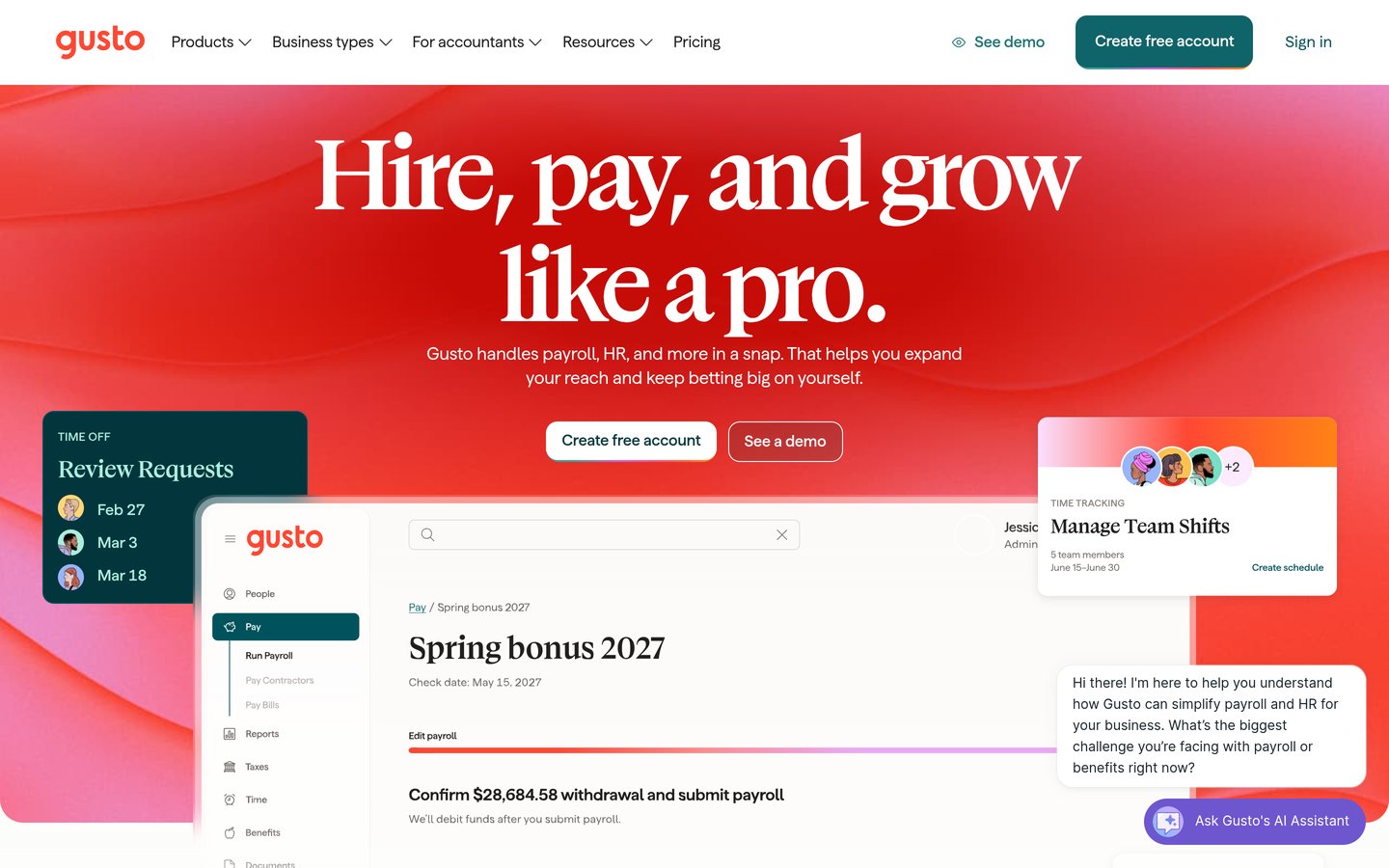
Gusto homepage, captured Nov 2026.
Gusto is a payroll and HR platform that helps businesses administer employee wages, benefits and related compensation records. Simple costs $49/month plus $6 per person/month and includes unlimited payroll runs, tax filings and basic paid-time-off policies. Higher plans add workforce management and HR support capabilities.
The trade off is that Gusto concentrates on payroll execution rather than specialist salary benchmarking and merit review cycles. Plus costs $80/month plus $12 per person/month, while Premium costs $180/month plus $22 per person/month. It suits small businesses whose main compensation requirement is managing payroll and employee pay information.
What we like
Payroll and employee compensation records together
Unlimited payroll runs on Simple
Clear published subscription pricing
Benefits and HR administration available
Large public review base
Watch out for
Base fee is separate from employee charges
Not designed primarily for salary benchmarking
Specialized compensation review features are limited
Plus adds time tracking and scheduling; Premium adds enhanced HR support.Visit gusto.com
07
QuotaPath
4.5/5on Capterra (123 reviews, checked Nov 2026)
Starts at$525/mo
Best for sales commission and incentive compensation
Entry planGrowth
Platform fee$525/month
Included usersFirst 5
Additional user rate$35/user/month
quotapath.com
QuotaPath homepage, captured Nov 2026.
QuotaPath is a compensation management platform focused on sales commissions and incentive programs. Growth has a $525 monthly platform fee covering the first 5 users, with additional users priced at $35 each per month on annual billing. It includes an AI-assisted compensation plan builder, custom plans, commission forecasting and approval-to-payout workflows.
The trade off is that QuotaPath specializes in revenue-team compensation rather than company-wide salary bands or standard merit increases. Growth requires a platform subscription, and Premium adds more advanced compensation planning controls. It suits sales organizations replacing spreadsheet-based commission calculations with configurable incentive plans and payout tracking.
What we like
Specialized sales compensation plan builder
Unlimited custom compensation plans on Growth
Commission forecasting and payout workflows
Integrations with CRM and spreadsheet tools
Platform fee includes implementation and support
Watch out for
High minimum subscription compared with general HR tools
Focused on sales incentives rather than base salaries
Additional users increase recurring costs
Average implementation takes 45–60 days
Premium adds advanced plan modeling, approval controls and integrations.Visit quotapath.com
Compensation management vs payroll software
Compensation management and payroll software handle different stages of employee pay. Compensation management helps a business decide what employees should earn, while payroll software calculates and distributes the amounts owed.
Compensation platforms typically include salary bands, market comparisons, merit increase planning, budget allocations and approval workflows. Payroll systems focus on recurring pay calculations, deductions, tax filings and payment records.
Lattice emphasizes compensation decisions and performance-related pay reviews. Gusto focuses on payroll administration, while BambooHR and Deel offer compensation capabilities within broader HR ecosystems.
Organizations with complex pay structures may need both systems. Before choosing, check whether approved compensation changes can be transferred into payroll automatically or require manual updates.
How much does compensation management software cost?
Pricing varies because the products cover different functions. Basic HR administration may cost a few dollars per employee monthly, while compensation planning, benchmarking and approval workflows may require a higher subscription tier.
Lattice publishes a $10 per seat/month Performance base product and a $6 per seat/month Compensation add-on. BambooHR offers its compensation management features in Elite at $25 per employee/month, while Deel includes compensation in its $29 Elite tier.
Some vendors use a range or a platform minimum instead of one flat rate. PerformYard advertises $5–$15 per person/month, while QuotaPath Growth has a $525 monthly platform fee covering the first 5 users.
Calculate the complete annual cost using your actual employee count, required modules and administrative users. Ask about implementation charges, minimum contracts, benchmark data access and integrations before making a final decision.
How we chose
We selected established HR, talent management, payroll and incentive compensation platforms with documented features relevant to employee pay. The comparison considers salary reviews, benchmarking, compensation bands, approval workflows, incentive calculations, HR integration and public user feedback.
Official vendor pricing pages and Capterra product profiles were opened and checked on 23 November 2026 for this article's requested 22 November 2026 editorial date. Published starting prices, billing structures and review figures were compared against those sources. Where compensation features require higher tiers or additional modules, those restrictions are explained.
We excluded specialist platforms without a publicly confirmable paid price, products lacking sufficient public review evidence and tools whose current pricing could not be verified. General HR and payroll tools are included only where they support a meaningful part of compensation administration. No vendor paid for a place, and we do not claim testing for this list.
How to choose compensation management software
Define your compensation process before comparing software, then identify which features need to be available immediately.
Identify the compensation decisions you need to manage. Determine whether your organization needs salary benchmarking, salary bands, annual merit reviews, bonus allocation, sales commissions or simple payroll administration. Choose products designed around those workflows rather than assuming every HR platform provides complete compensation management.
Check salary data and approval capabilities. If market competitiveness matters, prioritize products with integrated salary benchmarks and job-level comparisons. For annual pay reviews, look for budget controls, manager worksheets, approval chains, compensation statements and reporting that explains proposed changes.
Calculate the price of the required plan. Compare the actual subscription that contains your needed compensation features. Factor in employee count, administrator seats, modules, minimum commitments and platform fees. A low entry rate does not necessarily mean the full compensation workflow is available at that price.
Verify HR integrations and data security. Confirm whether the software connects with your HRIS, payroll provider and performance management platform. Sensitive salary information should have role-based access, controlled approvals and an audit trail. Review implementation requirements before migrating employee compensation records.
FAQ
What is the best compensation management software in 2026?
Lattice is our top choice for organizations needing structured salary reviews, compensation bands, benchmarking and approvals. Its Compensation module costs an additional $6 per seat/month on top of an eligible base product. BambooHR and Deel are strong alternatives for companies wanting compensation management integrated into broader HR systems.
What does compensation management software do?
Compensation management software organizes decisions about employee salaries, merit increases, bonuses and incentives. Depending on the platform, it may also provide salary benchmarks, pay ranges, budget planning, approval workflows and employee compensation statements. Its primary role is making pay decisions consistent and easier to administer.
How much does compensation management software cost?
Pricing depends on employee count and functionality. Lattice lists a $6 per seat/month Compensation add-on, BambooHR includes compensation planning in its $25 per employee/month Elite plan, and Deel includes compensation management in its $29 per person/month Elite tier. Additional modules and contract minimums may affect total costs.
Can small businesses use compensation management software?
Yes. Small businesses can begin with basic employee pay records and structured approval processes rather than enterprise compensation programs. PeopleForce offers low-cost HR administration, while BambooHR combines compensation with employee management on its higher tier. Choose according to the complexity of your pay decisions.
What is the difference between compensation management and payroll?
Compensation management determines appropriate salaries, bonuses, pay ranges and compensation changes. Payroll calculates and processes employee payments based on those decisions. Some HR platforms connect both functions, but businesses with formal salary review cycles often need dedicated planning and approval capabilities.
Does compensation management software include salary benchmarking?
Not always. Lattice includes global benchmarks in its Compensation add-on, and BambooHR Elite provides integrated Mercer salary data. Other products focus mainly on pay records, review workflows or commissions. Check whether benchmarking is included, how frequently the data is updated and whether it covers your required roles.
Which compensation software is best for employee performance reviews?
Lattice is well suited to organizations linking performance evaluations with compensation decisions because it provides both product areas within its talent management platform. PerformYard is another option focused on performance, competencies and employee development, with compensation capabilities available through its Talent Development offering.
Which tool is best for managing sales commissions?
QuotaPath is the most specialized sales compensation option in this comparison. It supports custom incentive plans, commission forecasts, approval-to-payout workflows and integrations with sales systems. Growth has a $525 monthly platform fee covering the first 5 users, with additional users charged separately.
What should HR teams check before purchasing compensation software?
Check salary benchmarking coverage, employee and manager access controls, review-cycle flexibility, approval workflows, budget limits and HRIS integrations. Confirm the price of the plan containing those features, not merely the entry package. Also review implementation support, data security and compensation history reporting.