Best Cloud Security DAST Software in 2026: 9 Tools Compared
WLWPLegible EditorsLast verified 24 Nov 2026How we rank12 min read
★ Short answer
Invicti is the best cloud security DAST software for most teams, with proof-based scanning that re-checks findings to cut false positives, rated 4.5 out of 5 on G2. Pick Burp Suite Professional for manual penetration testing at $499 per user a year, or OWASP ZAP if you need a free scanner.
How we make this list: we compare pricing pages, product documentation and public user reviews, then re-check every price before each update. No product paid for a place. Disclosure.
Invicti leads with proof-based scanning that re-checks findings, rated 4.5 out of 5 from 72 G2 reviews.
Burp Suite Professional is the highest rated tool here at 4.8 out of 5 from 129 reviews, at $499 per user a year.
StackHawk now starts at $10 per user a month for its Wingman plan, with 50 scans per user a month.
OWASP ZAP is the only fully free tool in the list, rated 4.7 out of 5, and it plugs into CI pipelines.
Six of the nine tools publish no list price, so expect a sales quote for Invicti, Bright Security, Detectify, Qualys WAS, InsightAppSec and HCL AppScan.
What cloud DAST software should do
DAST, dynamic application security testing, probes a running web application the way an attacker would. It sends crafted requests, tests logins and session handling, and crawls every page it can reach, all without reading your source code.
That fits cloud-hosted apps well. If the app answers HTTP requests, a DAST scanner can test it, whatever language it is written in or wherever it is hosted.
The features that matter most are authenticated scanning, API coverage and CI/CD integration. Most real flaws sit behind a login, so a scanner that only tests public pages will miss them. Our guide on running a WordPress security audit shows the same idea: check what an attacker can actually reach.
False positives are the other cost. Every scanner cries wolf sometimes, and triage time adds up. Proof-based re-checking and AI validation are the two features that cut that work down.
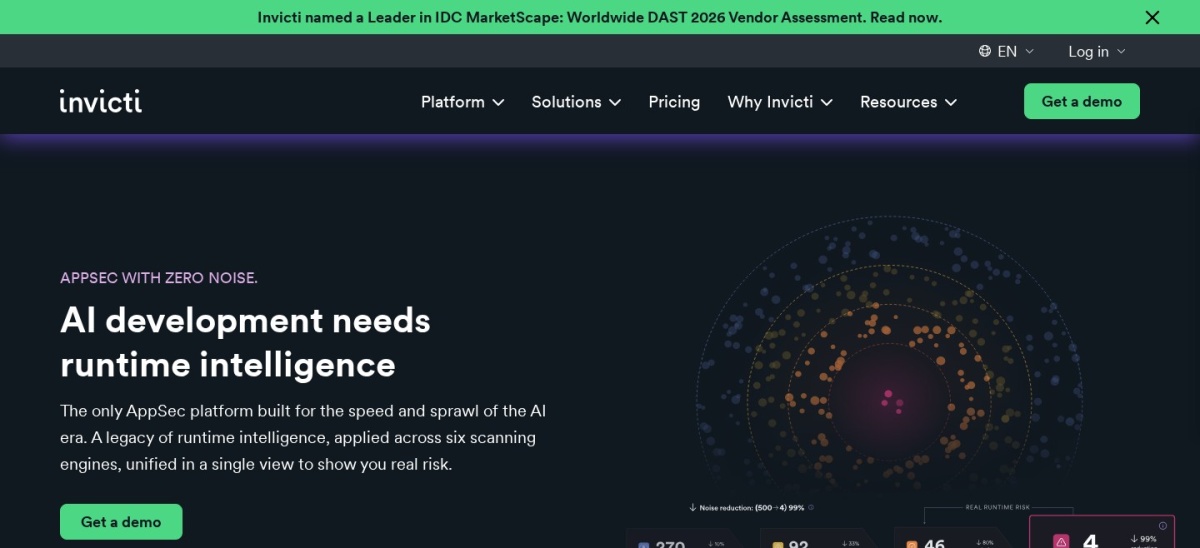
Invicti is an enterprise DAST platform that scans running web applications and APIs, then re-checks each finding with proof-based scanning to confirm it is really exploitable. Its homepage cites more than 5,000 customers and over 1 million apps and APIs secured, and it covers single-page apps, authenticated areas and API discovery in one platform.
The trade off is price and buying effort. Invicti publishes no list price, and third-party estimates put entry contracts near $37,000 a year for 50 targets, so small teams will find it out of reach. It suits security teams with a large application portfolio and dedicated AppSec staff.
What we like
Proof-based scanning cuts false positives
Covers web apps and APIs in one platform
Strong authenticated scanning for complex logins
Watch out for
Quote-based pricing with no public list price
More platform than a small team needs
Paid plans are quote-based; ask for a price per target countVisit invicti.com
02
Burp Suite
4.8/5on G2 (129 reviews, checked Nov 2026)
Paid from$499/yr
Best for manual penetration testing
Automated scannerYes, Pro
Manual proxy toolsYes
Free planCommunity
Paid planPro, $499/user/yr
portswigger.net
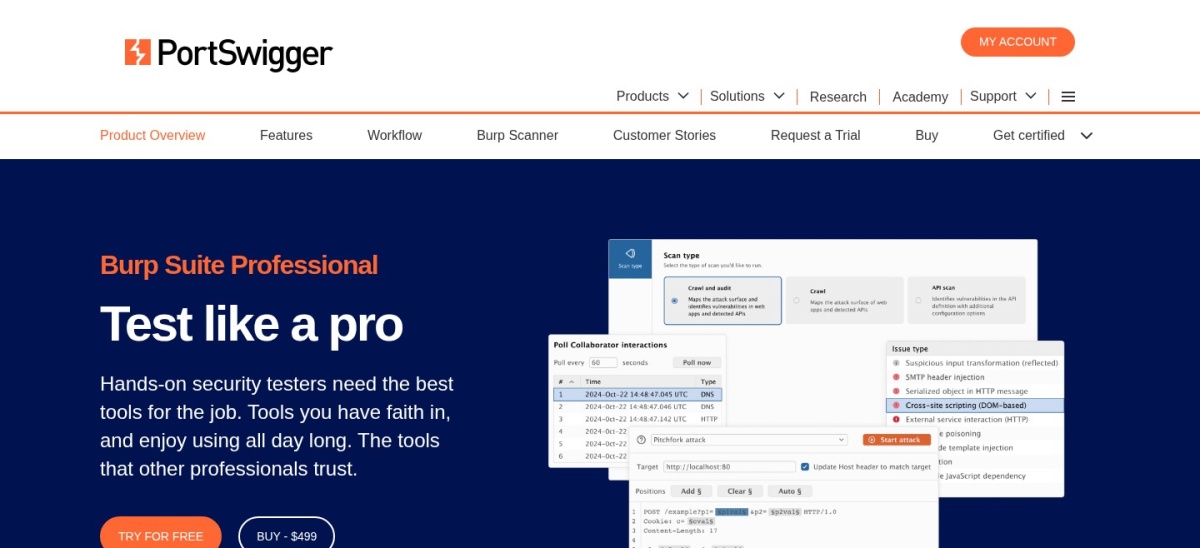
Burp Suite homepage, captured Nov 2026.
Burp Suite is the workbench professional penetration testers live in, from PortSwigger. Its proxy intercepts traffic between browser and app, the repeater lets you tweak requests by hand, and the intruder automates custom attack patterns. Professional adds the full automated scanner, Burp AI and the extension store, and the free Community Edition covers the manual tools.
The trade off is that it is a person-driven tool, not a scheduled scanner. Professional costs $499 per user a year, up from $449 in January 2026, and every user needs a licence. It suits testers and security engineers who validate findings by hand, not teams wanting push-button scans.
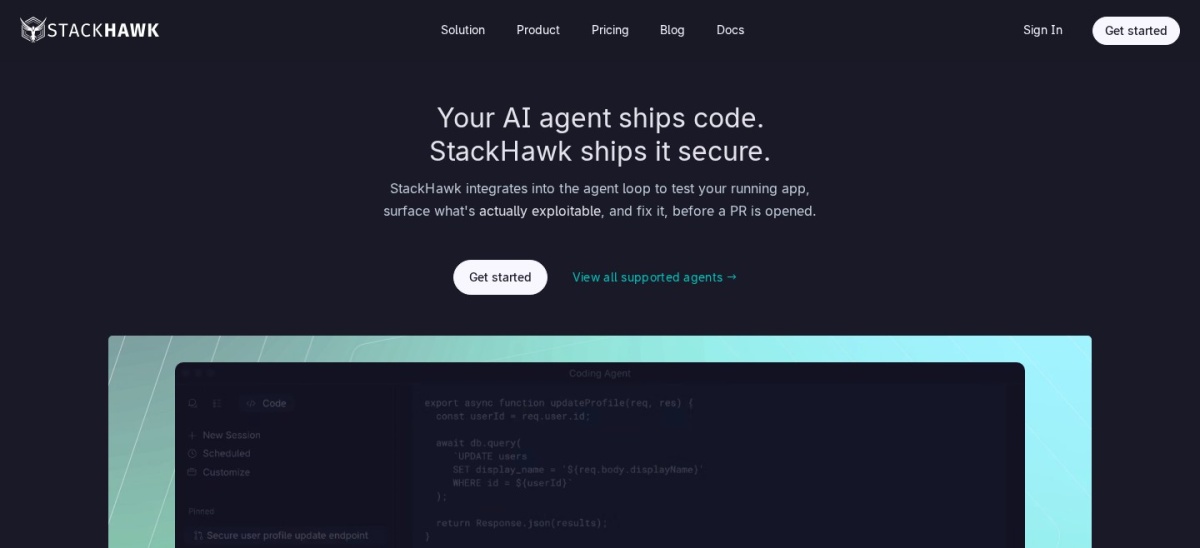
StackHawk is a developer-first DAST tool that runs scans inside the build pipeline, so findings reach developers before code merges. Its Wingman plan works inside AI coding agents such as Claude Code, Cursor and Copilot, tests the running app, and reports fixes in developer terms. It supports REST, GraphQL and gRPC APIs with unlimited apps per user.
The trade off is depth and a changed product. StackHawk repositioned around AI coding agents in 2026, and its Wingman plan caps scans at 50 per user a month. It suits modern engineering teams that deploy often and want security feedback at pull-request speed.
What we like
Built for pipelines, not separate security gates
Findings explain the fix in developer terms
Lowest published starting price in this list
Watch out for
Less depth than enterprise scanners on complex apps
Scan cap of 50 per user a month on Wingman
Older $39 and $59 tiers no longer on the pricing page
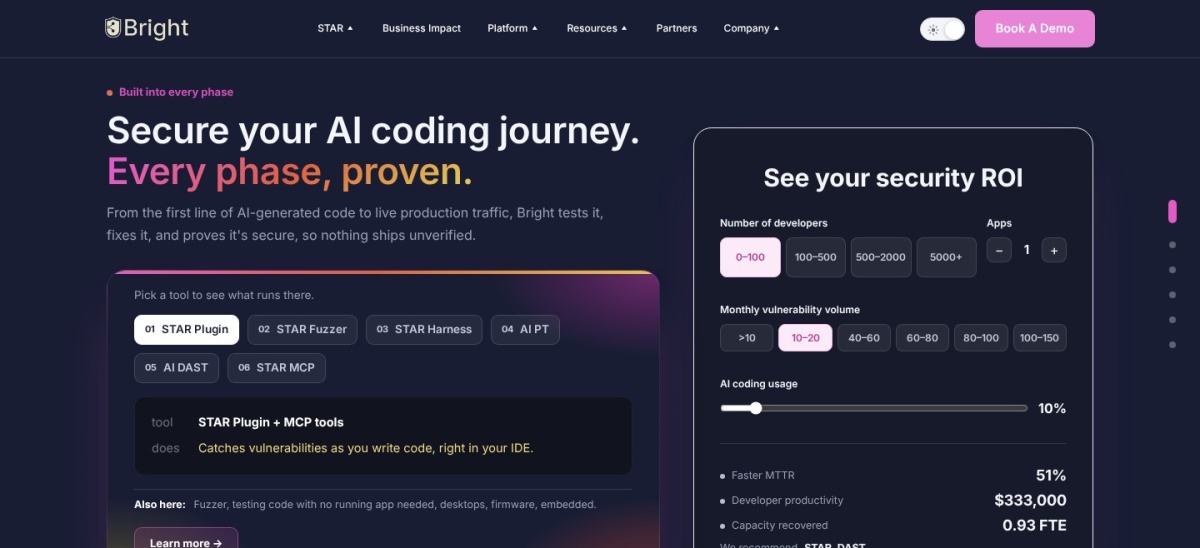
Bright Security is a developer-led DAST platform that tests running web applications and APIs, with an AI layer that validates findings and explains fixes in context. It handles modern single-page apps, authenticated multi-user flows and business-logic flaws such as broken object-level authorization, and it plugs into CI systems and ticketing tools.
The trade off is pricing transparency. Bright sells tailored subscription plans with no public rate card, so small teams should request a clear price for their target count and scan frequency. It suits development teams that want a scanner developers will actually use on every release.
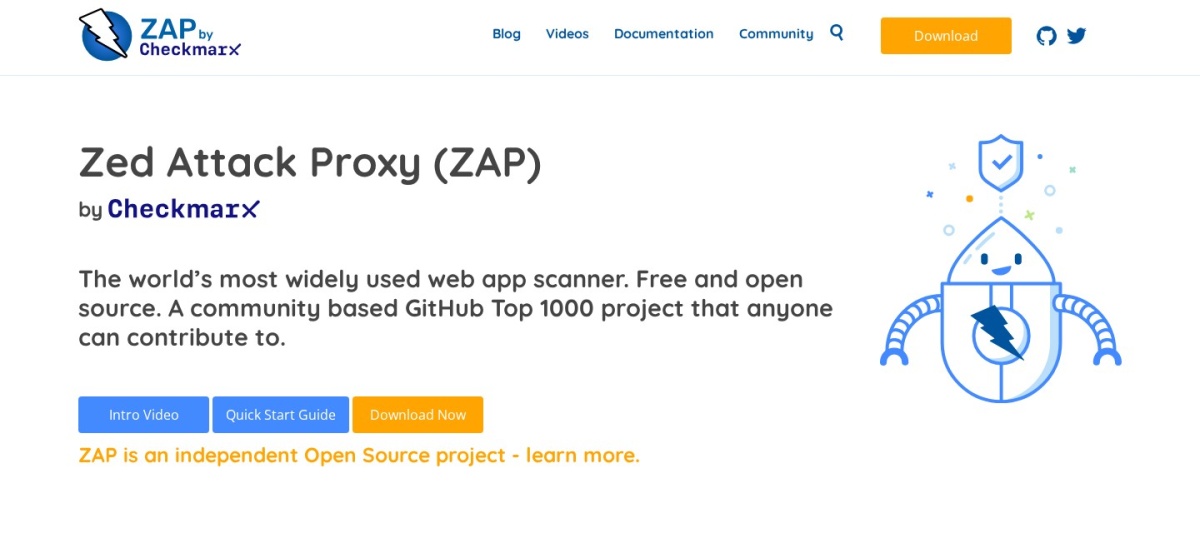
OWASP ZAP is the free, open-source standard for dynamic testing, maintained by a global community under the OWASP umbrella and funded by Checkmarx since 2024. It spiders web applications, runs active attacks against the pages it finds, and plugs into CI servers through its automation framework, so every build can get a baseline scan with no licence cost.
The trade off is expertise. ZAP reports what it finds, but tuning scan policies, handling authentication and separating signal from noise takes someone who understands web security. It suits startups, small teams and learners, and it works well as the always-on baseline beside a commercial scanner.
What we like
Completely free with no scan limits
Active community and regular releases
Automation framework built for pipelines
Watch out for
Findings need more human triage than paid tools
Interface feels dated next to commercial tools
No vendor support included
Free forever; paid support comes from third parties, not the projectVisit zaproxy.org
06
Detectify
4.5/5on G2 (51 reviews, checked Nov 2026)
PricingCustom/yr
Best for attack-surface discovery plus scans
Attack-surface discoveryYes
Crowdsourced payloadsYes
API scanningYes
Free trialYes
detectify.com
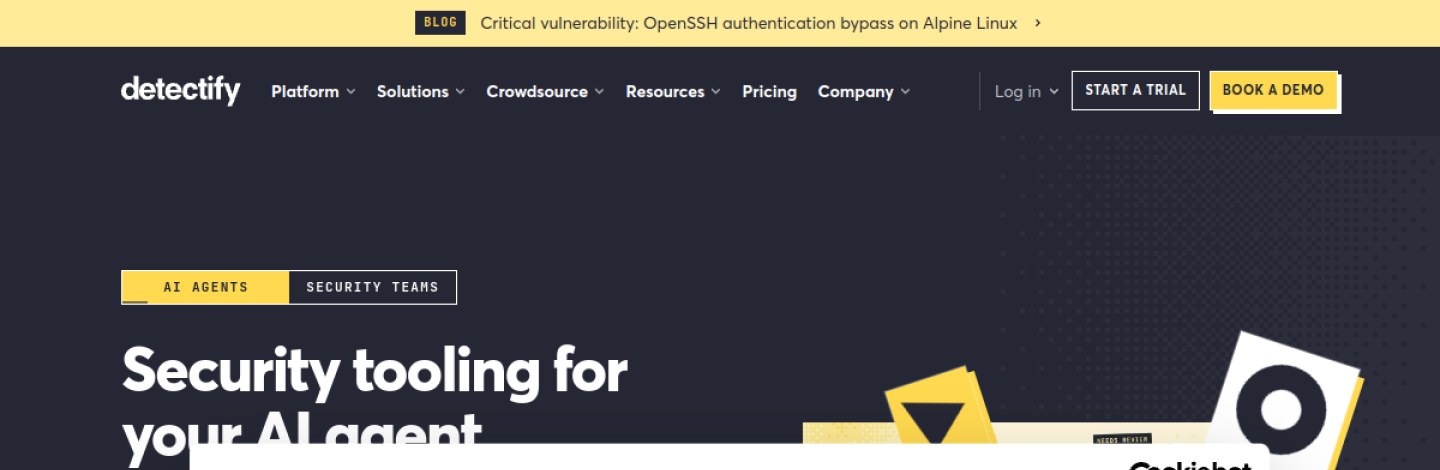
Detectify homepage, captured Nov 2026.
Detectify is a cloud DAST tool with a different angle: its researcher community submits attack payloads, which get rolled into the scanning engine, so tests reflect what attackers are trying now. It also discovers your external attack surface, subdomains and exposed services you forgot about, then scans the applications it finds. Setup is fast and it is built for teams without a dedicated AppSec engineer.
The trade off is depth. For thorough testing of complex authenticated applications, Invicti or Burp Suite go further, and pricing is quote-based and can climb with asset counts. It suits small and mid-size companies with cloud-hosted apps and lean security staffing.
Qualys WAS is the DAST module of the Qualys cloud platform, and it makes most sense for organizations already scanning infrastructure with Qualys. Findings land in the same dashboards, asset inventory stays unified, and compliance reports cover apps and servers together. It offers authenticated crawling, API support and progressive scanning across large app counts.
The trade off is that it is less exciting as a standalone purchase. The interface reflects its enterprise heritage, pricing is a custom quote per target, and modern single-page apps can need manual tuning. It suits Qualys customers extending web scanning, not buyers choosing a first DAST tool.
What we like
Lives inside the Qualys platform teams already know
Strong compliance reporting
Scales across large app counts
Watch out for
Dated interface next to developer-focused tools
Quote-based pricing with no public list price
Weakest as a standalone DAST purchase
Pricing is a custom quote, usually bundled with other Qualys appsVisit qualys.com
08
Rapid7 InsightAppSec
3.9/5on G2 (10 reviews, checked Nov 2026)
PricingCustom/yr
Best DAST for Rapid7 customers
Cloud scanningYes
Attack replayYes
Pairs with InsightVMYes
Free trialYes, 30 days
rapid7.com
Rapid7 InsightAppSec homepage, captured Nov 2026.
Rapid7 InsightAppSec is a cloud DAST offering whose main selling point is convenience for existing Rapid7 customers. Scans run from Rapid7's cloud, results flow into the same console as infrastructure vulnerability data, and remediation tracking stays in one place. Its attack replay feature re-runs exploits to confirm vulnerabilities, which keeps false positives down.
The trade off is value outside the Rapid7 ecosystem. Pricing is quote-based and charged by application, so dozens of small internal apps can add up fast, and its G2 rating rests on only 10 reviews. It suits teams that already pay for InsightVM and want application scanning in the same console.
What we like
Cloud scanning with no infrastructure to maintain
Pairs with Rapid7 vulnerability management
Attack replay confirms findings
Watch out for
Only 10 G2 reviews, the thinnest base in this list
HCL AppScan is an enterprise application security testing suite that covers DAST alongside static analysis, interactive testing and software composition analysis. It handles web and API scanning with multi-step authentication, AI-assisted finding triage and compliance reporting, and it deploys in the cloud, on-premises or in air-gapped environments.
The trade off is cost and complexity. Reviewers describe it as a substantial enterprise investment with rigid scaling, and smaller teams report a steep learning curve. It suits large organizations that want one vendor for the whole AppSec program rather than a standalone scanner.
Authenticated scanning comes first. Most serious flaws sit behind a login, so ask how the scanner handles your authentication: recorded login sequences, form-based auth, single sign-on or API tokens.
CI/CD integration decides whether scans stay current. If you deploy weekly or faster, point-in-time scans go stale within days. Look for pipeline plugins and APIs that run on builds and fail the build on critical findings.
False positive handling is where the tools differ most. Proof-based re-testing, like Invicti's, and AI validation, like Bright's, cut triage time. Ask vendors how findings get confirmed before you buy.
Pricing model matters as much as the headline number. Some vendors charge per application, others per user and others by scan volume. Count your applications honestly, including staging environments and internal tools, because per-app pricing can double the quote.
How we chose
We started from the DAST tools security teams shortlist most, then kept nine established products with a public G2 rating and a current homepage and pricing page.
Prices and ratings were checked on 24 November 2026. Ratings and review counts come from G2 on that date, and prices come from each vendor's own pricing page where one is published. Where a vendor shows no list price, the list shows Custom instead of guessing.
We left out tools with no verifiable G2 rating for DAST, and Acunetix, which is now sold as Invicti Web + API under the same vendor as our top pick. No vendor paid for a place, and we do not claim to have used these tools ourselves.
How to choose a cloud security DAST tool
Start with how often you deploy, then match the scanner to the team that will read its findings.
Count your applications and APIs. Per-app pricing punishes large portfolios, while per-user pricing punishes large teams. List production, staging and internal apps before you ask for quotes.
Check authenticated scanning first. Run a trial against an app behind a login. If the scanner cannot handle your auth flow, its coverage numbers mean little.
Test the CI/CD fit on a real build. Wire the scanner into one pipeline and see how findings reach developers. Our guide on scanning WordPress for malware shows the same triage habit: scan, confirm, then fix.
Compare the trial findings, not the brochures. Run two shortlisted tools against the same app and compare false positives. The tool with fewer findings to chase wins, even at a higher price.
FAQ
What is the best cloud security DAST software?
Invicti is the best pick for most teams, with proof-based scanning that re-checks findings to cut false positives, rated 4.5 out of 5 on G2. Burp Suite Professional suits manual testing, and OWASP ZAP is the best free option.
What is DAST in cloud security?
DAST, dynamic application security testing, probes a running web application by sending it crafted requests and watching the responses, the same way an attacker would. It needs no source code, so it fits cloud-hosted apps, third-party software and APIs.
Can DAST replace penetration testing?
No. DAST finds known vulnerability patterns across your whole application on a schedule. A penetration tester thinks creatively, chains small weaknesses together and tests business logic no scanner understands. Use DAST for continuous coverage and pen tests for depth.
How much does DAST software cost?
It ranges from free with OWASP ZAP to quote-based enterprise contracts. Published starting prices in this list are $10 per user a month for StackHawk and $499 per user a year for Burp Suite Professional. Six of the nine tools publish no list price.
Does DAST work on APIs?
Yes. Modern DAST tools accept API definitions such as OpenAPI or Swagger files and test endpoints directly, including authenticated ones. API coverage varies by product, so verify support for REST, GraphQL or gRPC before you buy.
What causes false positives in DAST?
Scanners infer vulnerabilities from application responses, and unusual but harmless behavior can look like a flaw. Tools with proof-based re-testing or AI validation cut the noise substantially. Expect to spend some triage time on any scanner, and budget for it in the first month.