Fivetran is the best cloud ETL tool for most teams, with 700+ managed connectors, a free plan to 500,000 monthly active rows, and a 4.3 out of 5 G2 rating from 830 reviews. Pick Airbyte for the lowest managed start at $20 a month, or Hevo for no-code pipelines with real-time change data capture.
How we make this list: we compare pricing pages, product documentation and public user reviews, then re-check every price before each update. No product paid for a place. Disclosure.
Fivetran leads on managed reliability: 700+ connectors, 4.3/5 on G2 from 830 reviews, and a free plan to 500,000 monthly active rows.
Airbyte is the cheapest managed start at $20 a month, with a free self-hosted edition for teams that want control.
Hevo starts at $265 a month for 5 million events, with a free plan to 1 million events and no-code pipelines.
Stitch and Weld both start at $99-$100 a month, but Stitch caps Standard at 1 destination and 10 sources.
Usage bills differ sharply: Fivetran counts rows per connection, Airbyte counts credits, Hevo counts events, so price the same workload on each before choosing.
What to look for in a cloud ETL tool
Cloud ETL tools move data from apps and databases into a warehouse or lake, then keep it fresh on a schedule. The best ones handle schema changes, retries, and monitoring so a failed sync does not sit unnoticed.
Pricing is the hardest part to compare. Fivetran bills monthly active rows per connection, Airbyte sells credits, Hevo counts events, and Estuary charges per gigabyte, so the same workload can cost very different amounts on each tool.
Sync speed matters when reports must be fresh. Some tools in this list sync every 15 minutes or faster on paid plans, while entry plans may run hourly or once a day.
If you are moving data out of WordPress, start by exporting the content itself. Our guide on exporting and importing WordPress content shows what moves with a standard export and what stays behind.
Fivetran is a managed ELT service with 700+ fully managed connectors that move data from SaaS apps and databases into a warehouse with little upkeep. The free plan covers 500,000 monthly active rows, and paid connections start with a $5 monthly base charge per connection plus usage by monthly active rows.
The trade off is price at volume. Monthly active rows are billed per connection, so costs rise with each new source, and transformations are metered separately by model runs. It suits teams that want reliable, hands-off pipelines and can pay for the widest connector catalog.
What we like
700+ managed connectors
Free plan to 500,000 monthly active rows
15-minute syncs on Standard
dbt Core integration included
Watch out for
Monthly active rows billed per connection
Transformations metered separately
Costs rise fast at high volume
Paid plans add faster syncs, enterprise connectors, and higher support tiersVisit fivetran.com
02
Airbyte
4.4/5on G2 (78 reviews, checked Nov 2026)
Paid from$20/mo
Best for the lowest managed start
Connectors700+
Free planCore, self-hosted
Fastest sync1 hour (Standard)
BillingCredits, $5 each
airbyte.com
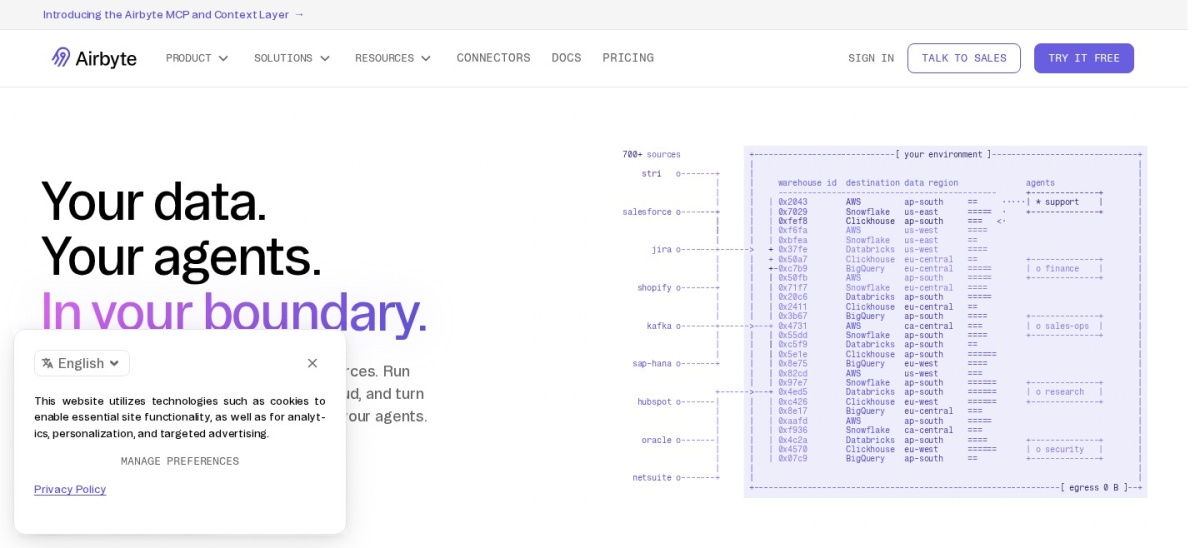
Airbyte homepage, captured Nov 2026.
Airbyte is an open-source data integration platform with 700+ connectors, offered as free self-hosted Core or managed Airbyte Cloud. Standard on Cloud starts at $20 a month with 5 credits included, and each extra credit costs $5, with 6 credits per million API rows and 4 per gigabyte from databases.
The trade off is the credit meter. Full-refresh syncs bill every row moved, so a wide table can cost more than expected, and the fastest syncs need the Plus plan from $189 a month. It suits engineering-led teams that want control, custom connectors, and a free self-hosted fallback.
What we like
Free self-hosted Core edition
Cheapest managed start at $20 a month
700+ connectors
Custom connector builder
Watch out for
Credit meter is hard to forecast
Hourly syncs only on Standard
Plus needed for 15-minute syncs
Plus adds 15-minute syncs, SSO, and credit packages from $189 a monthVisit airbyte.com
03
Hevo Data
4.4/5on G2 (292 reviews, checked Nov 2026)
Paid from$265/mo
Best no-code ETL pick
Connectors210+
Free plan1M events/mo
Fastest sync1 hour (Starter)
BillingEvents per month
hevodata.com
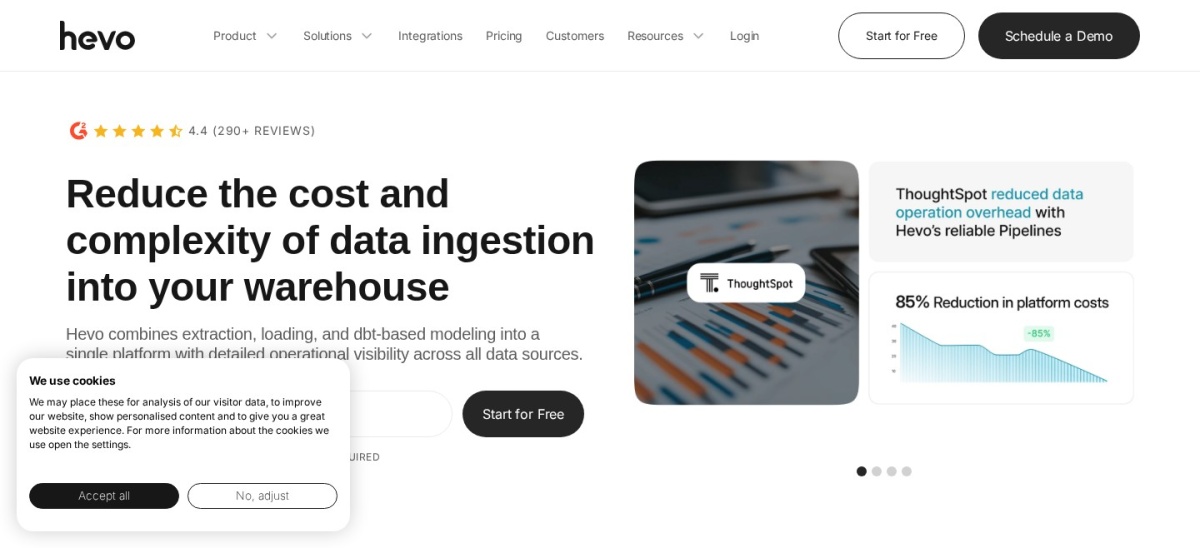
Hevo Data homepage, captured Nov 2026.
Hevo Data is a no-code ELT platform with 210+ sources that loads data into a warehouse and models it with dbt. The free plan covers 1 million events a month, and Starter starts at $265 a month for 5 million events, with hourly scheduling and up to 10 users.
The trade off is the event meter. Every record inserted, updated, or deleted counts as one event, so busy sources use the quota fast, and streaming pipelines need a higher plan. It suits small teams that want fixed tiers, predictable bills, and pipelines without code.
What we like
No-code pipelines
Free plan to 1 million events a month
Real-time change data capture
dbt integration included
Watch out for
Event meter counts deletes too
Streaming needs a higher plan
Starter limited to 10 users
Professional adds unlimited users, APIs, and streaming pipelines from $750 a monthVisit hevodata.com
04
Stitch
4.4/5on G2 (68 reviews, checked Nov 2026)
Starts at$100/mo
Best for simple loads to one warehouse
Connectors140+
Free plan14-day trial only
Fastest sync30 minutes
BillingRows per month
stitchdata.com
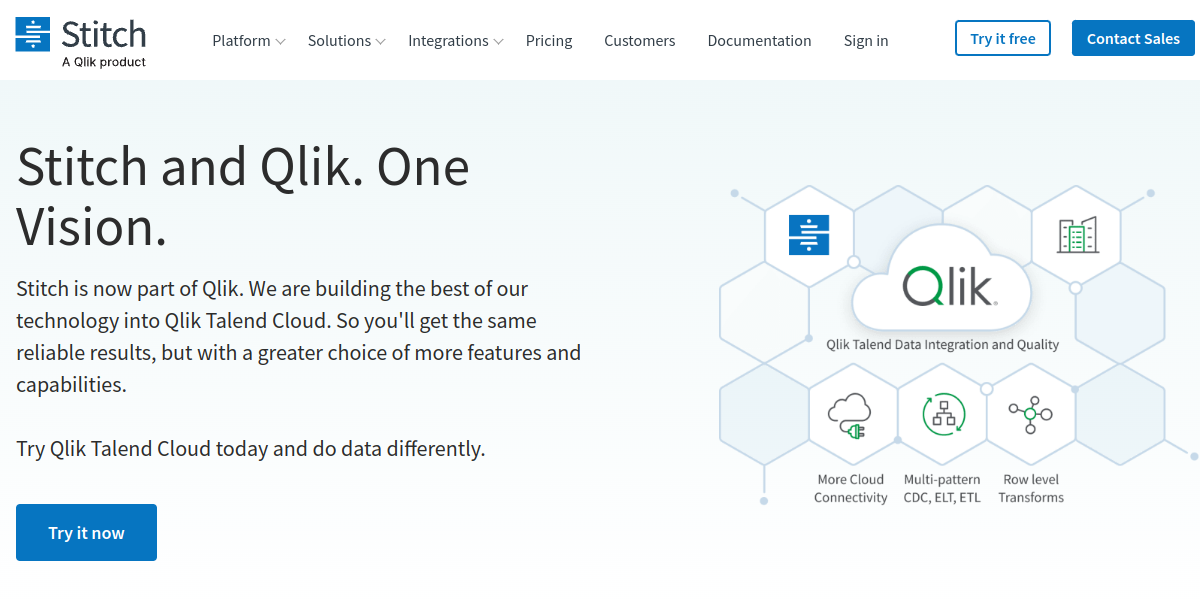
Stitch homepage, captured Nov 2026.
Stitch is a cloud ELT service from Qlik that loads data from 140+ sources into a warehouse using the open Singer standard. Standard starts at $100 a month for 5 million rows, with 1 destination, 10 standard sources, and 5 users.
The trade off is scope. Stitch only extracts and loads, so transformation needs another tool, and the site now points new buyers toward Qlik Talend Cloud. It suits teams with simple needs, one warehouse, and a small set of sources.
What we like
Simple row-based pricing
Open Singer standard
Log-based replication for major databases
14-day free trial
Watch out for
1 destination on Standard
No transformation built in
New buyers pointed to Qlik Talend Cloud
Advanced adds unlimited sources and 3 destinations at $1,500 a month billed annuallyVisit stitchdata.com
05
Skyvia
4.8/5on G2 (321 reviews, checked Nov 2026)
Paid from$99/mo
Best no-code pick without a data engineer
Connectors200+
Free plan10,000 records/mo
Fastest syncDaily (Basic)
BillingRecords per month
skyvia.com
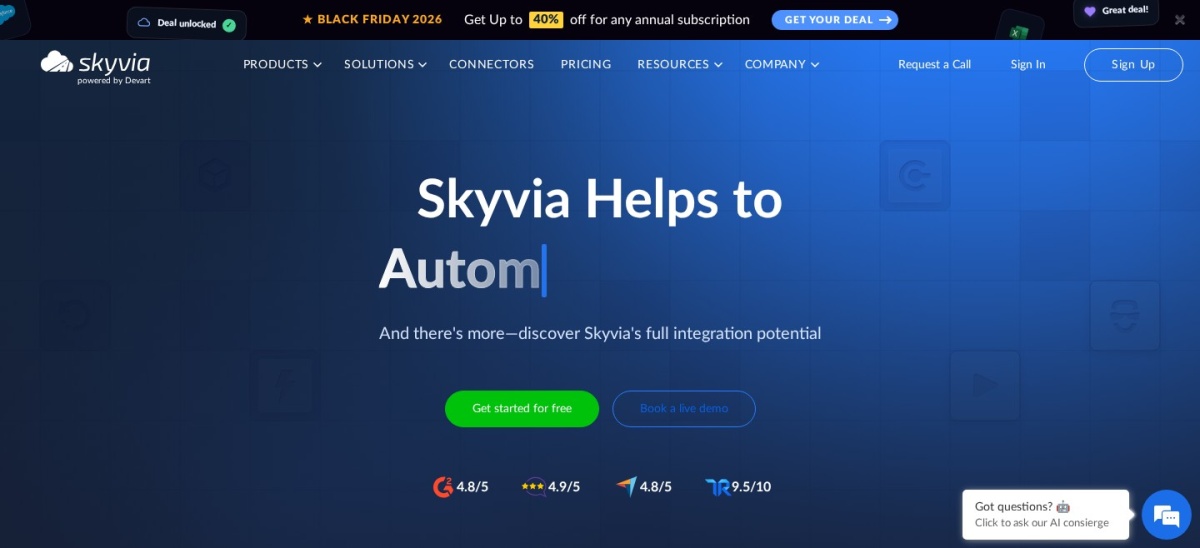
Skyvia homepage, captured Nov 2026.
Skyvia is a no-code cloud data platform with 200+ connectors for replication, import, export, and two-way sync. The free plan covers 10,000 records a month, and Data Integration Basic starts at $99 a month for 5 million records with daily runs.
The trade off is speed on the entry plan. Basic runs once a day, so hourly syncs need Standard from $99 a month at the 500,000-record tier, and per-record overage adds up. It suits teams without a data engineer that want visual mapping and published prices.
What we like
No-code visual mapping
Free plan with 10,000 records a month
Published prices on every plan
Reverse ETL included
Watch out for
Basic runs once a day
Runs pause at the record limit
Modules priced separately
Standard adds hourly runs and Data Flow from $99 a month at the 500,000-record tierVisit skyvia.com
06
Rivery
4.7/5on G2 (120 reviews, checked Nov 2026)
PriceFree
Best for ELT with code steps
Connectors200+
Free plan14-day trial only
Fastest sync60 minutes (Base)
BillingBDU credits
rivery.io
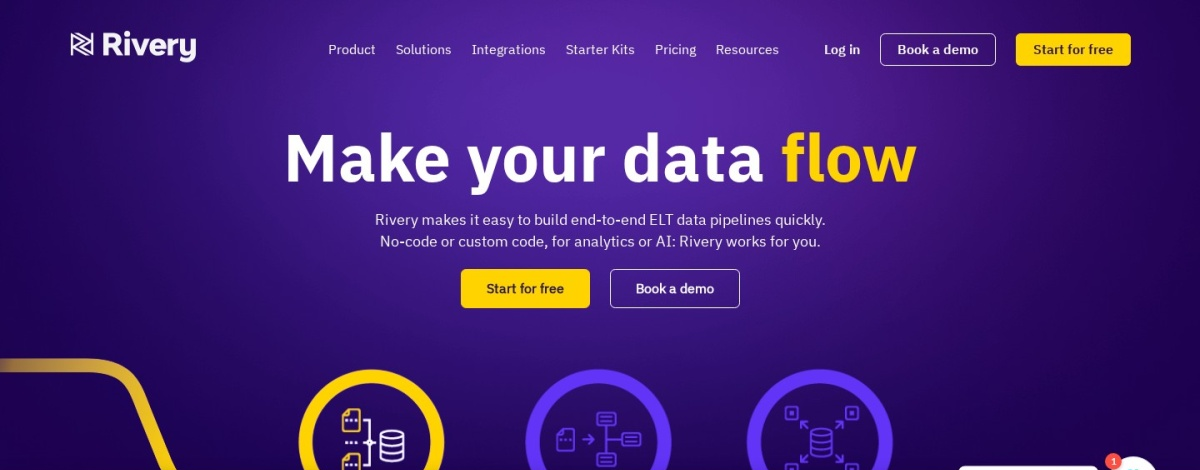
Rivery homepage, captured Nov 2026.
Rivery is a cloud ELT platform, now sold by Boomi as Boomi Data Integration, with 200+ connectors and SQL and Python steps for transformation. Base costs $0.90 per BDU credit on monthly billing, with 1 environment, 2 users, and a 60-minute minimum sync.
The trade off is the credit bill. Database replication costs 1 credit per 100 MB, while API tables cost 0.5 credit per table on every run, so frequent API syncs add up fast. It suits teams that want orchestration and code steps on the same meter as ingestion.
What we like
SQL and Python transformation steps
Orchestration built in
200+ connectors
Pay-as-you-go Base plan
Watch out for
API tables billed per run
Base limited to 2 users
Higher plans have no published price
Professional adds Python steps, a second environment, and 15-minute syncs, with no published priceVisit rivery.io
07
Integrate.io
4.3/5on G2 (208 reviews, checked Nov 2026)
Starts at$1,999/mo
Best for one flat predictable bill
Connectors200+
Free plan14-day trial only
Fastest sync60 seconds
BillingFlat $1,999/mo
integrate.io
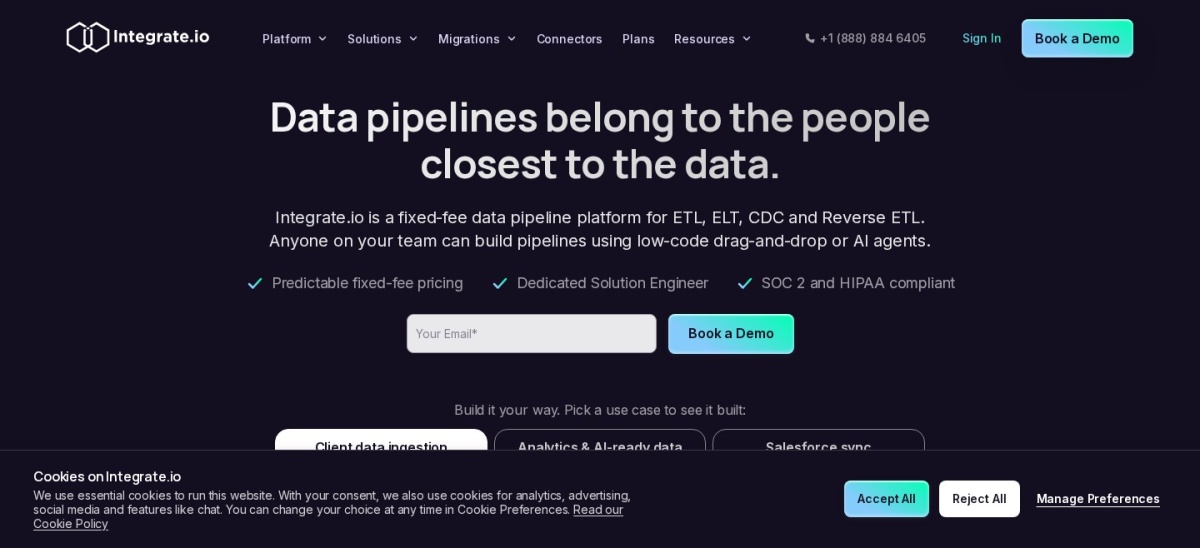
Integrate.io homepage, captured Nov 2026.
Integrate.io is a low-code data pipeline platform with 200+ connectors for ETL, ELT, change data capture, and reverse ETL. Core costs a flat $1,999 a month with unlimited data volume, pipelines, and connectors, and pipelines can run as often as every 60 seconds.
The trade off is the entry price. There is no low-cost tier, so small teams pay the full flat fee even for a few pipelines, and the platform is built for business users rather than heavy custom code. It suits mid-size teams that want one fixed bill and no overage charges.
What we like
Flat $1,999 a month, no overages
Unlimited volume and pipelines
60-second pipeline frequency
Reverse ETL included
Watch out for
No low-cost tier
Built for business users, less custom code
14-day trial only, no free plan
The flat Core plan already includes unlimited volume, pipelines, and connectorsVisit integrate.io
08
Estuary
4.7/5on G2 (35 reviews, checked Nov 2026)
PriceFree
Best for real-time database replication
Connectors200+
Free plan10 GB/mo
Fastest syncReal-time CDC
Billing$0.50 per GB
estuary.dev
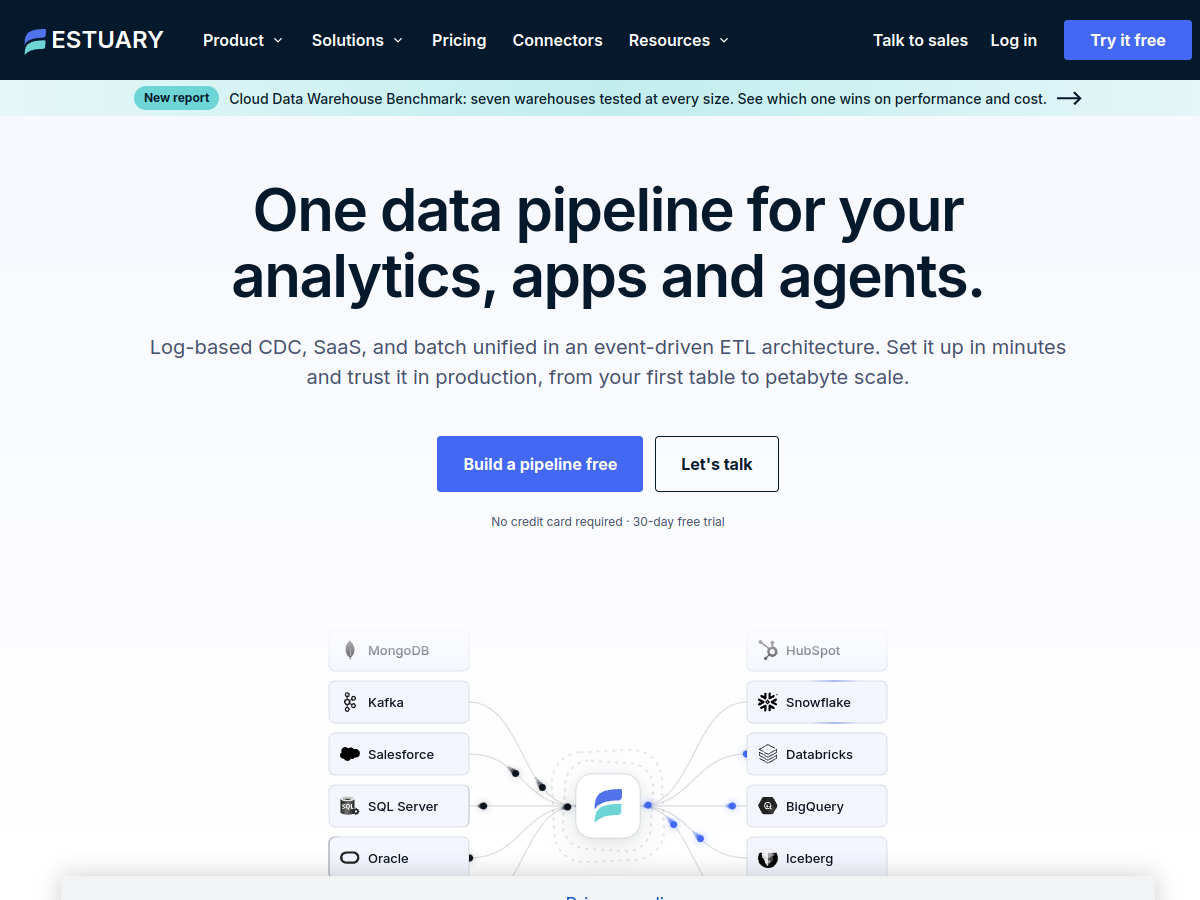
Estuary homepage, captured Nov 2026.
Estuary is a real-time data platform with 200+ connectors that combines log-based change data capture with batch pipelines. The free Developer plan covers 10 GB a month and 2 connectors, and Cloud costs $0.50 per gigabyte moved plus $100 a month per connector instance for the first six.
The trade off is double metering. The gigabyte rate applies at capture and again at each materialization, so one destination bills roughly twice the changed data. It suits teams that need sub-minute database replication without running Kafka themselves.
What we like
Real-time log-based CDC
Free 10 GB a month Developer plan
Transparent per-gigabyte price
No Kafka to run
Watch out for
Gigabytes billed at capture and materialization
200+ connectors, smaller catalog
$100 per connector instance adds up
Cloud removes the 10 GB cap and adds a 99.9% uptime SLAVisit estuary.dev
09
Weld
4.8/5on G2 (110 reviews, checked Nov 2026)
Starts at$99/mo
Best for ELT, modeling, and reverse ETL in one
Connectors300+
Free plan14-day trial only
Fastest syncDaily (Basic)
BillingMAR tiers
weld.app
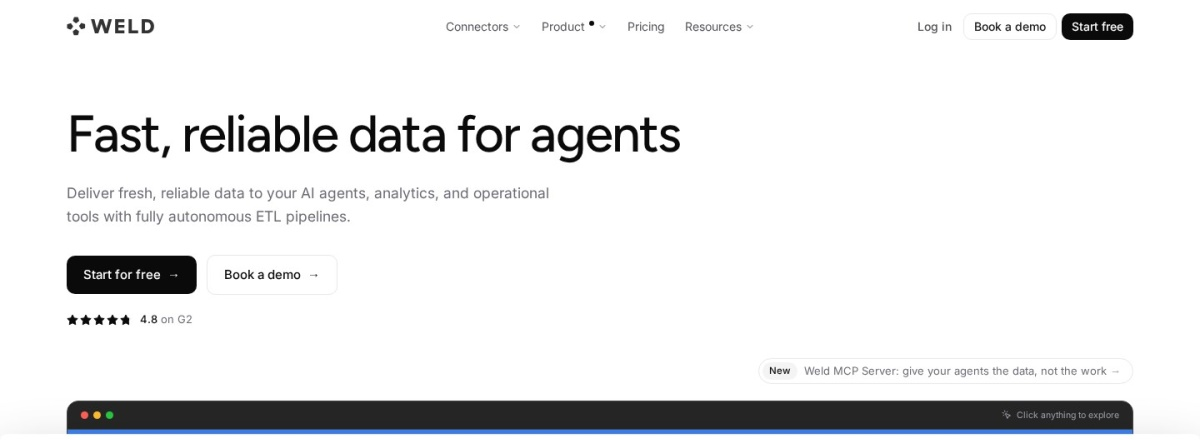
Weld homepage, captured Nov 2026.
Weld is a cloud ELT platform with 300+ connectors that moves data into a warehouse, models it with SQL or dbt, and syncs results back to business tools. Basic starts at $99 a month billed annually for 5 million monthly active rows, with 1 user, 2 connectors, and daily syncs.
The trade off is the entry tier. Basic allows only 2 connector types and 1 destination, so most teams need Premium from $389 a month billed annually for hourly syncs. It suits small data teams that want ELT, modeling, and reverse ETL in one place.
What we like
ELT, modeling, and reverse ETL in one tool
Flat monthly active row tiers
4.8/5 on G2 from 110 reviews
dbt integration included
Watch out for
Basic allows 2 connectors and daily syncs only
$99 a month billed annually
Cloud-only, no self-hosted option
Premium adds hourly syncs, 6 connectors, and dbt from $389 a month billed annuallyVisit weld.app
Usage-based pricing: what to watch
Every tool here meters something different, so compare them on your own workload, not on the headline price. Count your sources, rows changed per month, and how often each source must sync.
Watch for meters that count the same data twice. Fivetran bills rows per connection, Estuary bills gigabytes at capture and again at each destination, and Hevo counts deletes as events.
Free plans help you test a real pipeline, but check the limits first. Several free plans cap volume, sources, or sync speed, and some tools offer only a 14-day trial.
How we chose
We started from the established cloud ETL tools with public pricing pages and G2 ratings, then kept nine that cover managed ELT, open-source, no-code, and real-time replication.
Prices come from each vendor's pricing page, checked on 24 November 2026. Ratings come from G2 on the same day. Where a vendor shows a sale, the list shows the regular price.
We left out tools with no published price, such as Matillion and Talend, because their costs need a sales quote. No vendor paid for a place, and we do not claim hands-on testing for this list.
How to choose a cloud ETL tool
List your sources and destinations first, then match the meter to your workload.
Count your sources and destinations. A tool that caps sources or destinations at 10 will force an upgrade fast. Check the limit on the entry plan before you commit.
Price the same workload on each meter. Take one month of changed rows, events, or gigabytes and run it through each vendor's meter. The cheapest headline price is rarely the cheapest bill.
Check the sync speed you need. Daily syncs suit weekly reports, but dashboards need hourly or faster. Entry plans often run slower than the headline speed.
Try the free plan or trial on a real pipeline. Load one live source, watch a schema change, and check the first bill. That shows the true cost and the real setup effort.
FAQ
What is the best cloud ETL tool?
Fivetran is the best cloud ETL tool for most teams. It has 700+ managed connectors, a free plan to 500,000 monthly active rows, and a 4.3/5 G2 rating from 830 reviews, with 15-minute syncs on the Standard plan.
What is the cheapest cloud ETL tool?
Airbyte is the cheapest managed start at $20 a month for Standard, and its open-source Core edition is free to self-host. Fivetran's free plan covers 500,000 monthly active rows, and Estuary's free Developer plan covers 10 GB a month.
How is cloud ETL pricing calculated?
Each vendor meters something different. Fivetran counts monthly active rows per connection, Airbyte sells credits, Hevo counts events, Stitch counts rows, and Estuary charges per gigabyte, so price the same workload on each before choosing.
Do I need a data engineer to use a cloud ETL tool?
No, not for most tools in this list. Hevo, Skyvia, Stitch, and Integrate.io are built for no-code or low-code setup, while Airbyte and Fivetran suit teams with an engineer for custom connectors.
What is the difference between ETL and ELT?
ETL transforms data before loading it, while ELT loads raw data into the warehouse first and transforms it there. Most tools in this list are ELT tools, which suits cloud warehouses that can run the transformation work.
Can I try a cloud ETL tool for free?
Yes, most tools here offer a free plan or a trial. Fivetran, Airbyte, Hevo, Skyvia, and Estuary have free plans, while Stitch, Rivery, Integrate.io, and Weld offer 14-day trials.
SaaS SEO and WordPress specialist with about 8 years of experience. Rakib compares WordPress plugins, themes, hosting and software using public pricing, documentation and user reviews. See how we rank.