Sectigo Certificate Manager is the best certificate lifecycle management software for most teams, with SCM Pro from $25 a month for up to three domains and a 4.5 out of 5 G2 rating from 199 reviews. Pick AppViewX for the broadest automation across network devices, or ZeroSSL for the cheapest way to manage a few public certificates.
How we make this list: we compare pricing pages, product documentation and public user reviews, then re-check every price before each update. No product paid for a place. Disclosure.
Sectigo is the only top pick with a published starter price: SCM Pro from $25 a month for up to three domains.
AppViewX documents connectors for 19 certificate authorities and 200+ integrations, the widest reach in this list.
Keyfactor pairs Command with EJBCA and holds FedRAMP Moderate authorization for its government service.
DigiCert Essentials lists at $40 per seat with a 25-seat minimum, so the entry cost is $1,000 a year.
Public certificates now last at most 200 days, fall to 100 days in March 2027 and to 47 days in March 2029.
AWS Certificate Manager issues free public certificates, but only for services integrated with AWS.
What certificate lifecycle management software should cover
A certificate expires, a renewal is missed, and a site or service goes down. Lifecycle management software exists to stop that sequence by finding every certificate, tracking its expiry and renewing it before the deadline.
Discovery matters most. Certificates hide on load balancers, in Java keystores, in Kubernetes secrets and in cloud accounts, so a tool that only tracks the certificates it issued will miss the ones that cause outages.
Automation is the second test. Most load balancers and firewalls do not run an ACME client, so the platform has to install the new certificate, update the binding and confirm traffic uses it.
Shorter lifetimes raise the stakes. Public certificates are capped at 200 days today, and our guide on Let's Encrypt vs paid SSL explains how free 90-day certificates already force frequent renewals.
Price is the hardest part of this market to compare. Most enterprise platforms in this list are sold by quote, so the ladder below shows the cheapest published plan where one exists and marks the rest as quote only.
The 9 best certificate lifecycle management software tools
01
Sectigo Certificate Manager
4.5/5on G2 (199 reviews, checked Nov 2026)
Starts at$25/mo
Best certificate lifecycle management software overall
Cheapest paid planSCM Pro, $25/mo
SCM Pro coversUp to 3 domains
Trial30 days, 5 free DV certificates
Integrations50+ listed
sectigo.com
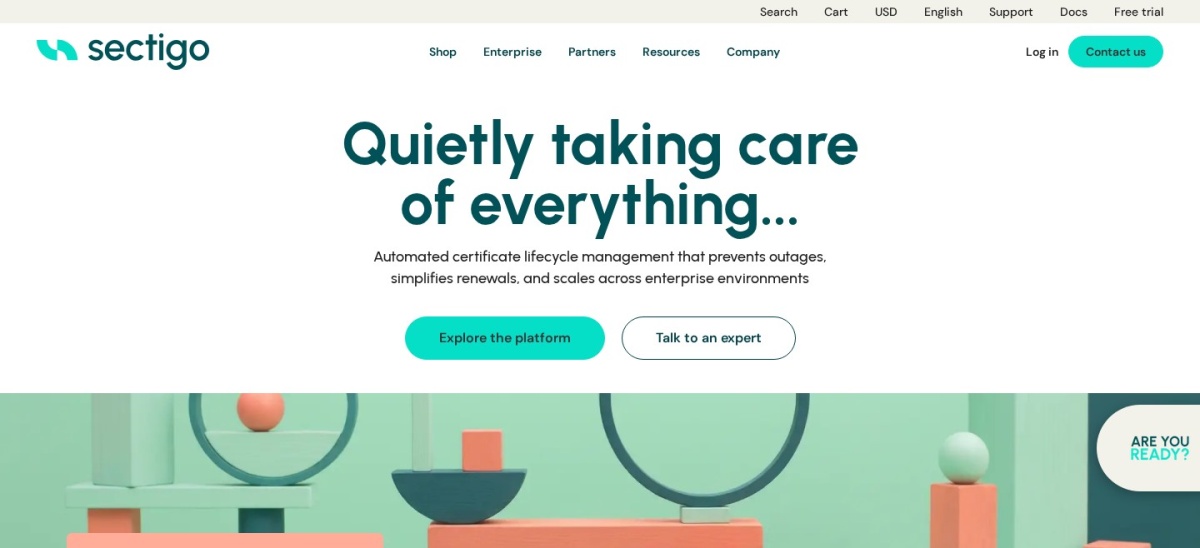
Sectigo Certificate Manager homepage, captured Nov 2026.
Sectigo Certificate Manager is a cloud-native platform that discovers, issues, renews and revokes public and private certificates from one console. Discovery covers a network agent, external scans, Active Directory and cloud keystores, and the Orchestration Gateway installs certificates on IIS, Apache, Tomcat, F5, NGINX and Citrix.
The trade off is that the full enterprise platform is sold by quote, and some integrations are paid add-ons. The published route in is SCM Pro, which starts at $25 a month for up to three domains with a 30-day trial. It suits teams that want a fast SaaS rollout and a price they can budget without a sales call.
What we like
Highest G2 review count in this list at 199 reviews
Published starter price, rare in this market
30-day trial with 5 free DV certificates
50+ integrations listed
Watch out for
Enterprise SCM pricing is quote only
Some integrations are paid add-ons
Reviewers mention a dated interface
Enterprise SCM adds multi-CA support and deeper automationVisit sectigo.com
02
AppViewX AVX ONE CLM
4.5/5on G2 (44 reviews, checked Nov 2026)
PricingCustom/yr
Best for broad automation across network devices
Cheapest paid planQuote only
CA connectors19 named providers
Integrations200+ listed
DeploymentSaaS, on-premises, hybrid
appviewx.com
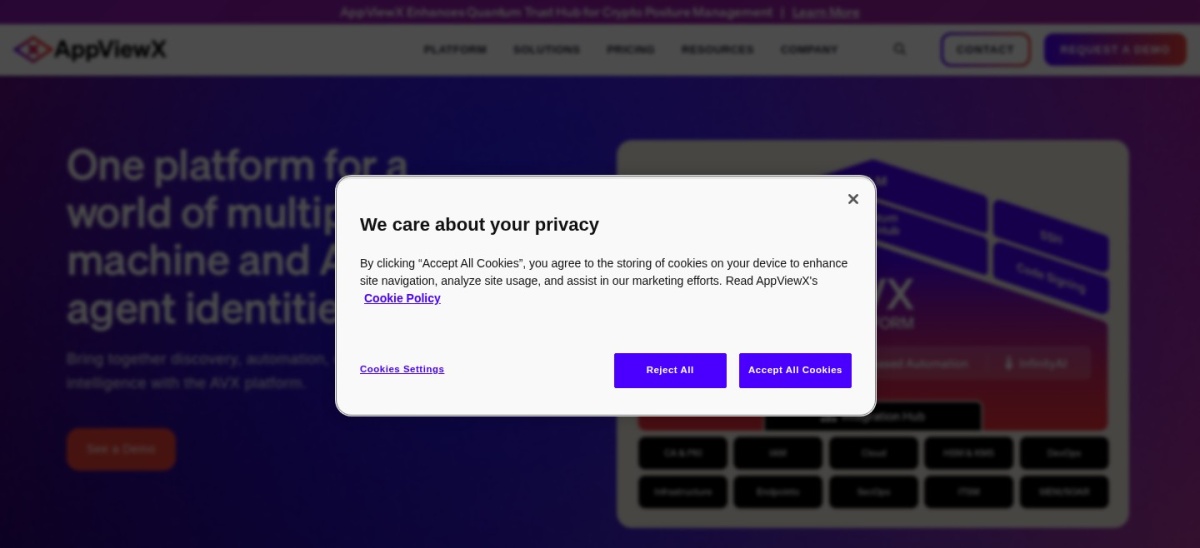
AppViewX AVX ONE CLM homepage, captured Nov 2026.
AppViewX AVX ONE CLM is a certificate lifecycle platform that runs discovery, private PKI, SSH key management, code signing and Kubernetes certificates from one system. Its documentation names connectors for 19 certificate authorities, the most in this list, and automation reaches load balancers, firewalls, HSMs and ITSM tools through 200+ integrations.
The trade off is price and size. AppViewX sells by quote with no public list price, and G2 users report an average implementation of four months. It suits large hybrid estates with many CAs, network appliances and a post-quantum plan, since its PKI issues ML-DSA, SLH-DSA and hybrid certificates.
What we like
Broadest CA support in this list at 19 connectors
200+ integrations, including load balancers and firewalls
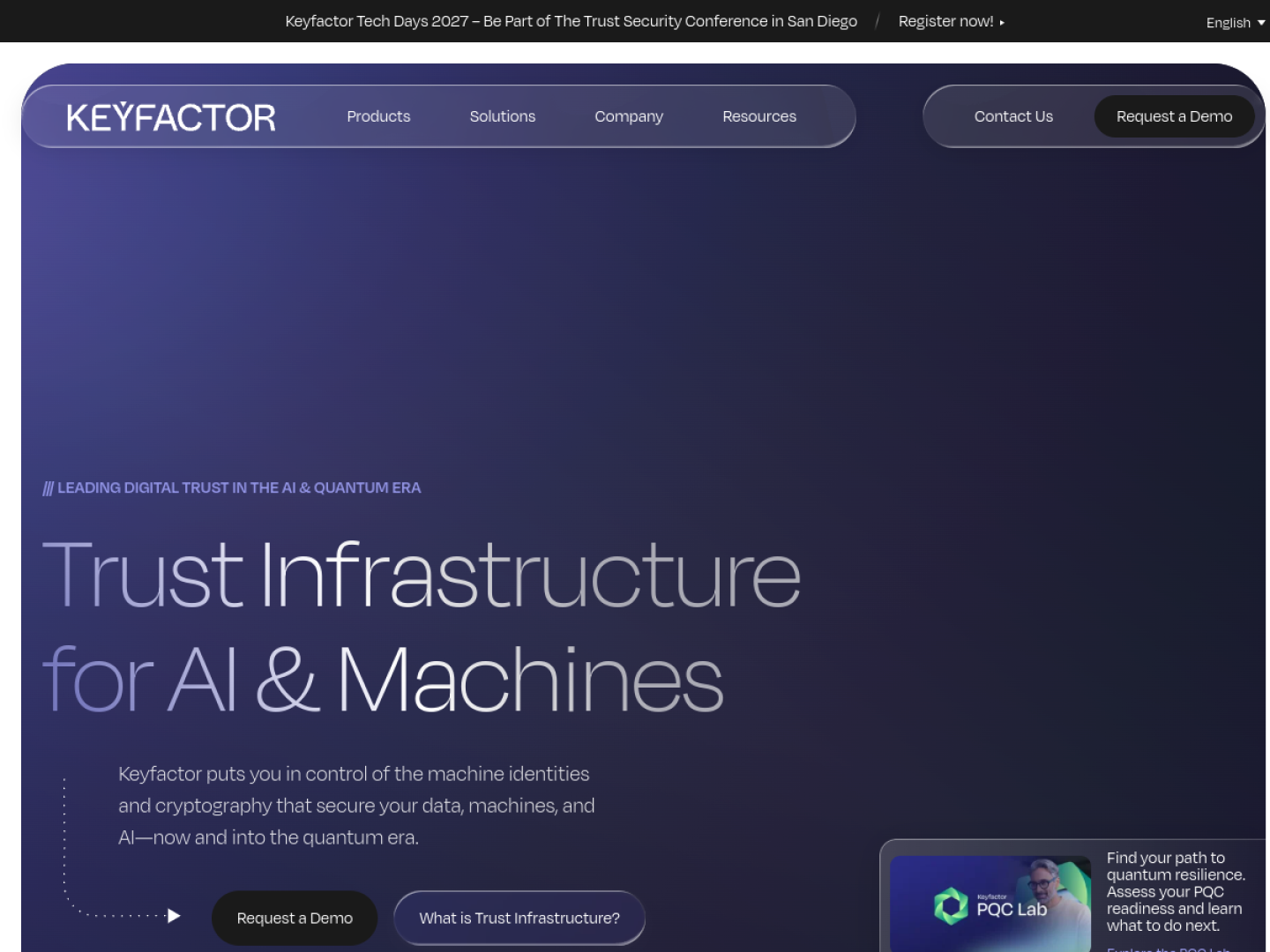
Keyfactor Command is a certificate lifecycle platform that discovers certificates through CA sync, network scans and key store discovery, then installs them through Keyfactor Orchestrators. It pairs with EJBCA, the CA software Keyfactor acquired with PrimeKey in 2021, and its government service received FedRAMP Moderate authorization in May 2026.
The trade off is setup effort. Pricing is quote only, reviewers say the interface takes time to learn, and G2 users report a six-month average implementation. It suits teams that already run EJBCA, or public-sector buyers who need a FedRAMP-authorized service.
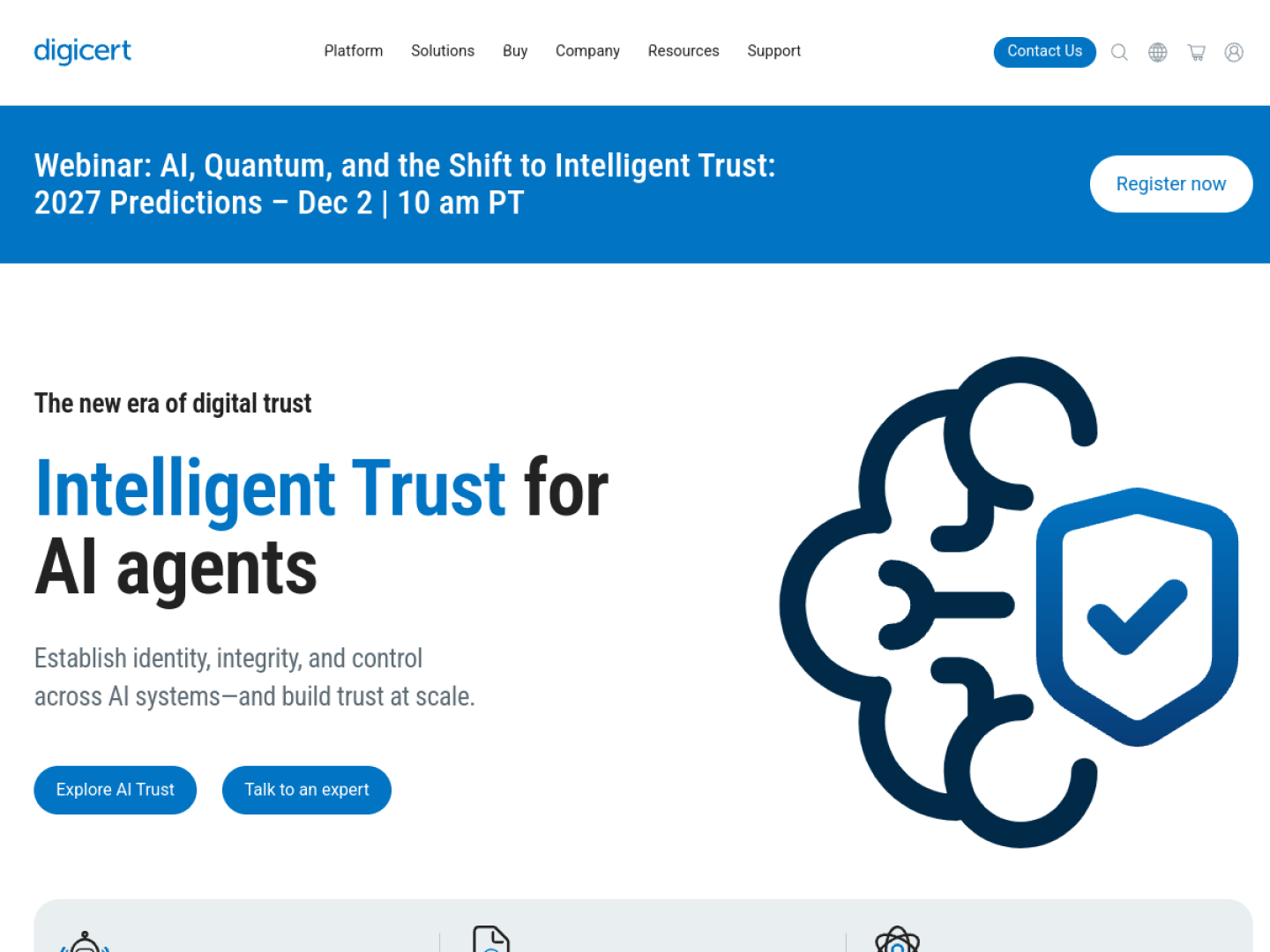
DigiCert Trust Lifecycle Manager homepage, captured Nov 2026.
DigiCert Trust Lifecycle Manager is the CLM product inside DigiCert ONE, and the most direct option when DigiCert already issues most of your certificates. It discovers through cloud scans, CT logs and imports, adds network scanning on the Advanced plan, and automates through ACME, SCEP and EST.
The trade off is that managing more than one CA needs the Advanced plan or above, and code signing and IoT are sold separately. Essentials lists at $40 per seat with a 25-seat minimum, so the entry cost is $1,000 a year. It suits DigiCert-standard estates that want one vendor for the CA and the lifecycle platform.
What we like
Published entry price, rare in this market
CA and CLM from one vendor
Automated domain validation through Continuous Validation
Quantum Central with CBOM export on Premium
Watch out for
Multi-CA management only on Advanced and above
Code signing and IoT sold separately
G2 rating of 4.3 is for DigiCert ONE, not TLM alone
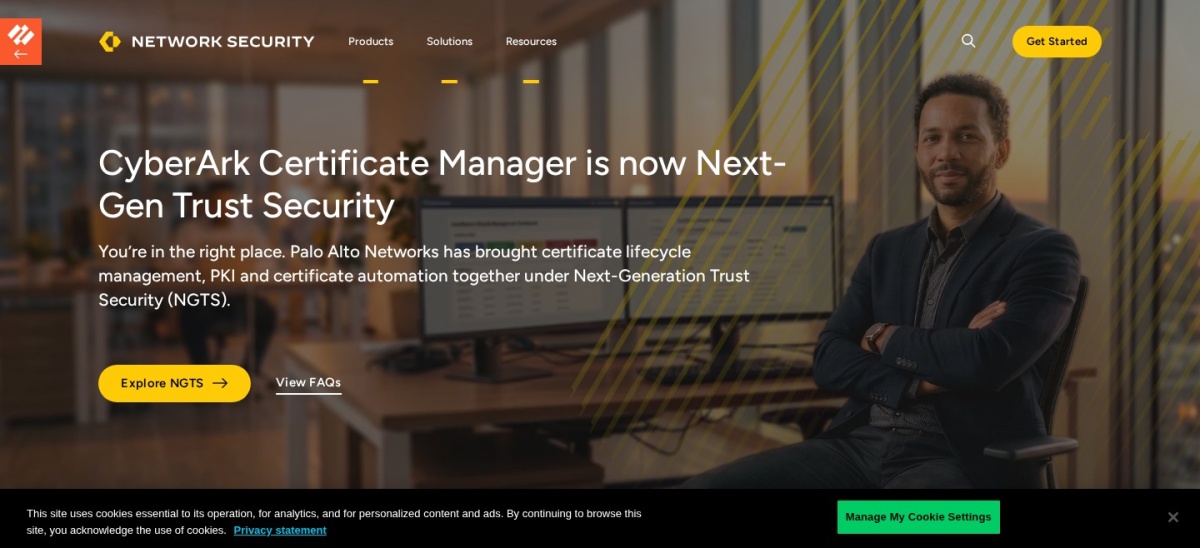
Venafi (Palo Alto NGTS) homepage, captured Nov 2026.
Venafi is the platform that defined this category, now sold by Palo Alto Networks as Next-Generation Trust Security. CyberArk bought Venafi in 2024, Palo Alto Networks completed its CyberArk acquisition in February 2026, and the SaaS product is now Next-Gen Trust Security inside Strata Cloud Manager.
The trade off is cost and scale. Pricing is quote only, the SaaS product has a documented minimum of 2,000 Secure Certificate Instances, and the G2 review base for the Venafi listing is only 4 reviews. It suits the largest regulated estates, especially Palo Alto firewall and SASE customers.
What we like
Longest track record at very large scale
Broadest integration ecosystem in this market
Rated 4.6 on Gartner Peer Insights from 223 ratings
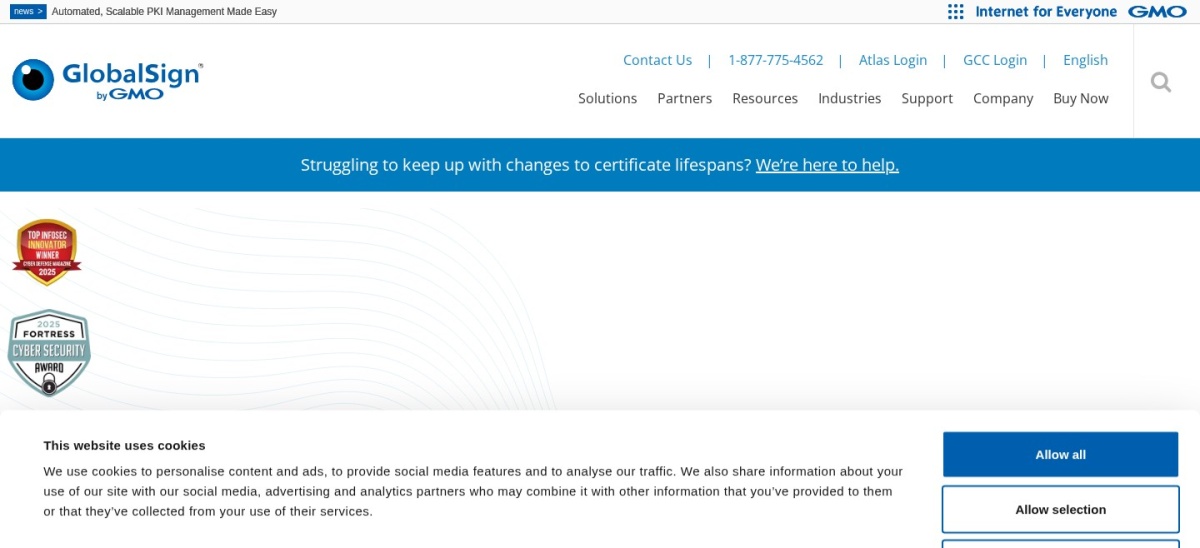
GlobalSign Atlas is a certificate management platform for issuing, inventorying, renewing, revoking and automating TLS certificates from one service. It is the natural fit when GlobalSign already issues your certificates, with discovery, APIs and automation built around the GlobalSign CA.
The trade off is transparency and review depth. Atlas is sold by quote on SAN-based licensing, and its G2 rating of 3.6 comes from only 12 reviews, the lowest in this list. It suits GlobalSign customers who want lifecycle controls beside the CA they already use.
What we like
CA and CLM from one long-standing vendor
SAN-based licensing reuses quota as certificates expire
TLS Connect covers small teams up to 100 certificates
LifeCycleX covers on-premises estates
Watch out for
Quote-only pricing with no public list price
Lowest G2 rating in this list at 3.6 from 12 reviews
Some automation needs the Premium TLS Connect add-on
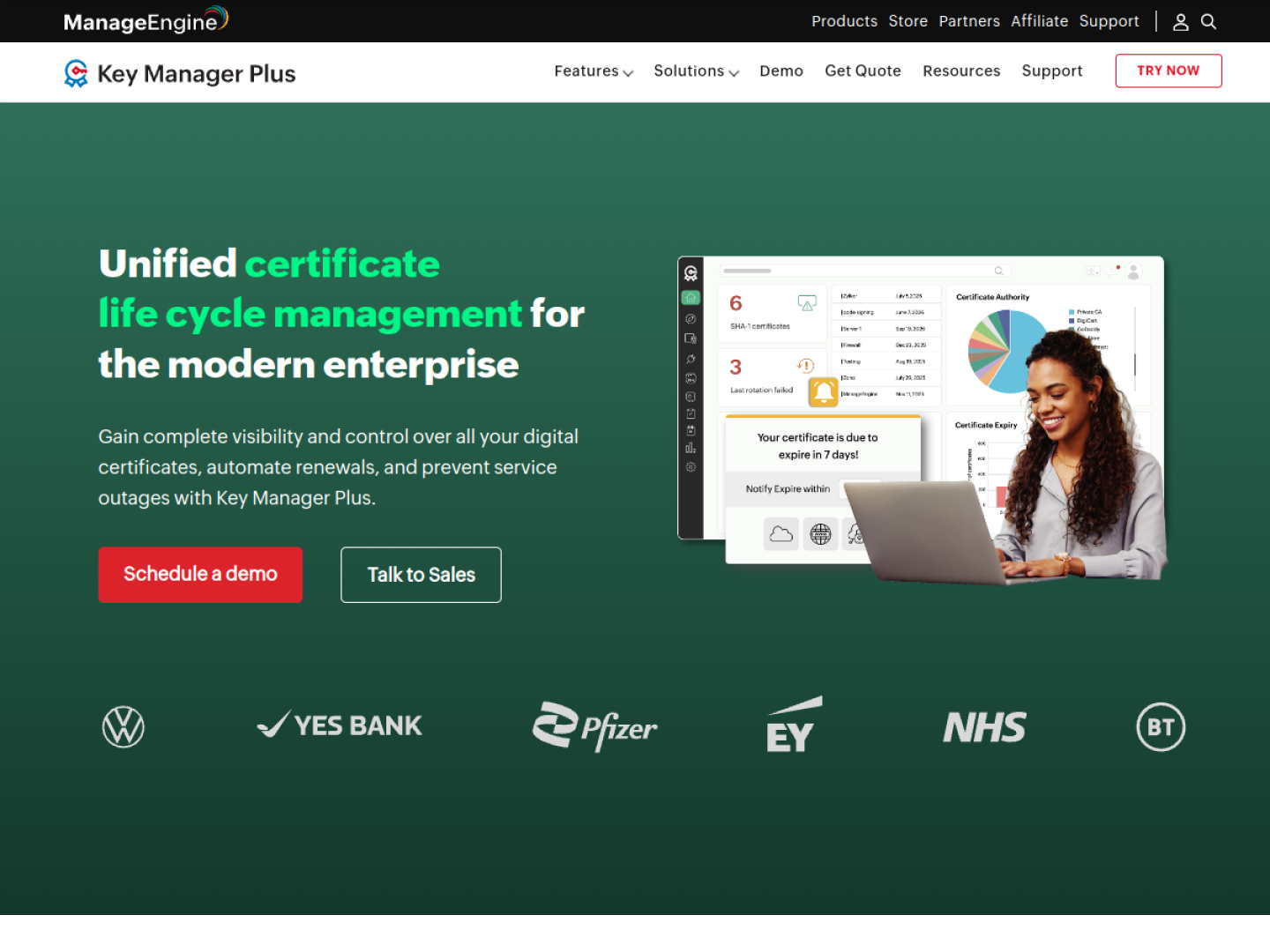
ManageEngine Key Manager Plus homepage, captured Nov 2026.
ManageEngine Key Manager Plus is a web-based platform that manages the full life cycle of SSL certificates and SSH keys from one console. It discovers certificates across the network, consolidates them in a central repository, automates renewal and deployment, and covers PGP keys and Azure secrets as well.
The trade off is review depth and polish. Its G2 rating of 4.5 comes from only 3 reviews, and it is a broader machine-identity tool rather than a dedicated CLM platform. It suits mid-sized IT teams that want on-premises control, SSH key management and a published price in one buy.
AWS Certificate Manager homepage, captured Nov 2026.
AWS Certificate Manager is a managed service that provisions, deploys and renews TLS certificates for AWS-integrated services. Public certificates from Amazon are free for use with Elastic Load Balancing, CloudFront and API Gateway, and renewal is automatic.
The trade off is the AWS boundary. Certificates cannot be exported for use outside integrated services, and private certificates need AWS Private CA at $400 a month per CA plus per-certificate fees. It suits teams whose workloads already run on AWS and need no certificates elsewhere.
What we like
Free public certificates for integrated services
Automatic renewal with no agent to run
Rated 4.5 out of 5 on G2 from 55 reviews
Private CA available in the same console
Watch out for
No certificates outside AWS-integrated services
Private CA costs $400 a month per CA before any certificates
Best cheap way to manage a few public certificates
Cheapest paid planBasic, $9.99/mo
Free plan3 free 90-day certificates
Basic includesUnlimited 90-day certificates
AutomationACME client and REST API
zerossl.com
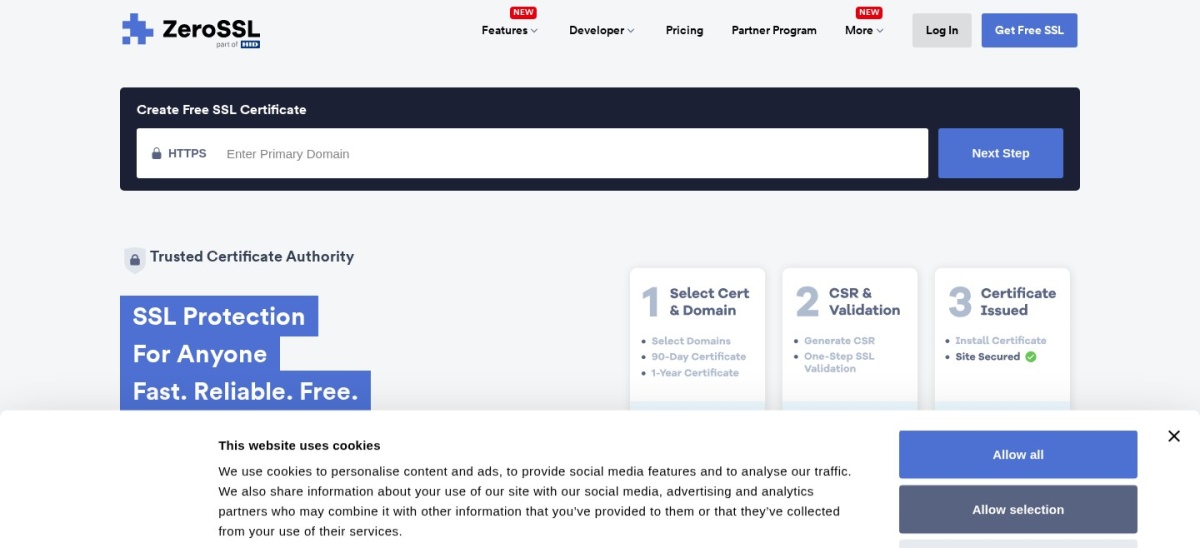
ZeroSSL homepage, captured Nov 2026.
ZeroSSL is a certificate authority with a web dashboard for issuing and managing SSL certificates. The free plan covers three 90-day certificates, and Basic at $9.99 a month adds unlimited 90-day certificates, with ACME and a REST API for automation.
The trade off is scope. ZeroSSL manages the certificates it issues rather than discovering certificates across every CA and endpoint, so it is not a full enterprise CLM platform. It suits small teams and single sites that want cheap, simple certificate management without a sales process.
Public TLS certificates are capped at 200 days today. Under CA/Browser Forum Ballot SC-081v3, the cap falls to 100 days on 15 March 2027 and to 47 days on 15 March 2029.
At 47 days, each certificate needs about 8 renewals a year instead of 1. A team managing 1,000 public certificates goes from roughly 900 renewals a year to about 7,800.
Domain validation reuse shrinks on the same dates, reaching 10 days in 2029, so nearly every renewal needs a fresh check. DNS-based validation is the method that scales.
Manual renewal does not survive that schedule. Any tool on this list should be judged on whether it renews, installs and confirms the new certificate without a ticket queue.
How we chose
We started from the G2 certificate lifecycle management category and Gartner Peer Insights, then kept the established platforms that manage certificates across more than one CA or environment, plus the free and low-cost options teams actually use beside them.
Prices come from each vendor's pricing page or published marketplace listing, checked on 24 November 2026. Ratings and review counts come from G2 on the same day. Where a vendor shows no list price, the list shows quote only and says so.
We left out narrow single-CA utilities and tools with no public review base. No vendor paid for a place, and we do not claim hands-on testing for this list.
How to choose certificate lifecycle management software
Start with where your certificates live, then match the tool to that estate.
Count your certificates and where they live. List every CA, load balancer, firewall, cloud account and Kubernetes cluster. A single-CA shop can use a CA-owned tool, while a mixed estate needs a CA-neutral platform.
Run discovery on a real network segment. Compare what the tool finds with your inventory. If it misses certificates on appliances or in keystores, it will miss the ones that cause outages.
Check the renewal path end to end. Confirm the tool renews, installs and verifies the certificate on your three most common endpoint types, not just on servers that run an ACME client.
Price it at 2029 volumes. Public certificates fall to 47 days in March 2029, so model the cost at about 8 renewals per certificate a year before signing a per-certificate deal.
FAQ
What is the best certificate lifecycle management software?
Sectigo Certificate Manager is the best pick for most teams. Its SCM Pro plan starts at $25 a month for up to three domains, it is rated 4.5 out of 5 on G2 from 199 reviews, and the enterprise platform covers discovery, automation and 50+ integrations.
What is certificate lifecycle management software?
It finds every digital certificate an organization uses, tracks owners and expiry dates, and automates requesting, renewing, installing and revoking certificates. Enterprise platforms also enforce policy, integrate with ITSM and DevOps tools, and inventory cryptographic algorithms for post-quantum planning.
How much does certificate lifecycle management software cost?
Most enterprise platforms are sold by quote, scaled to certificate volume and modules. Published examples in this list include Sectigo SCM Pro from $25 a month, DigiCert Essentials at $40 per seat, and ManageEngine Key Manager Plus from $475 a year.
Do I still need CLM software if I use ACME or Let's Encrypt?
Usually, yes. ACME automates issuance and renewal for servers that run an ACME client, but it does not discover certificates issued elsewhere, enforce policy, track ownership, or install certificates on appliances without ACME support, such as many load balancers and firewalls.
When do TLS certificates change to 47 days?
Under CA/Browser Forum Ballot SC-081v3, the maximum validity of public TLS certificates fell to 200 days in March 2026. It drops to 100 days on 15 March 2027 and to 47 days on 15 March 2029, with domain validation reuse shrinking to 10 days in 2029.
Is there a free certificate lifecycle management tool?
Yes, for small estates. AWS Certificate Manager issues free public certificates for AWS-integrated services, ZeroSSL offers three free 90-day certificates, and ManageEngine Key Manager Plus has a free edition for up to 5 keys. Larger or multi-cloud estates need a paid platform.
SaaS SEO and WordPress specialist with about 8 years of experience. Rakib compares WordPress plugins, themes, hosting and software using public pricing, documentation and user reviews. See how we rank.