Best Catalog Management Software in 2026: 9 Tools Compared
WLWPLegible EditorsLast verified 24 Nov 2026How we rank14 min read
★ Short answer
Plytix is the best catalog management software for most teams, with a free Standard plan for catalogs up to 100 SKUs and a G2 rating of 4.7 out of 5 from 452 reviews. Pick Catsy for print catalogs and Salsify for large retailer syndication.
How we make this list: we compare pricing pages, product documentation and public user reviews, then re-check every price before each update. No product paid for a place. Disclosure.
Plytix is the only tool here with a usable free plan and published prices, starting at $0 and Pro from $149 a month.
Catsy is the strongest choice for print catalogs, with live InDesign publishing and a G2 rating of 4.8 out of 5.
Salsify reaches more than 950 retail destinations, but G2 lists its Basic plan at $1,500 a month.
Akeneo starts at $45,000 a year and Pimberly at $30,000 a year, so both are enterprise buys, not small-team tools.
Five of the nine tools publish no prices at all, so expect a sales call and a custom quote for Catsy, Salsify, Sales Layer, Syndigo and Inriver.
What catalog management software should do
Catalog management software keeps every product name, price, image and specification in one place, then sends that data to a store, a marketplace or a printed catalog.
The core test is simple: can you change a price or a description once and see it update everywhere it appears, without retyping it in five systems?
Look for bulk editing, completeness checks that flag missing images or specs, and feeds for the channels you actually sell on. Our guide on how many products WooCommerce can handle shows why catalog size shapes the choice.
Print still matters for many sellers. If you need PDF or InDesign catalogs for distributors, that feature alone can decide the shortlist.
Prices in this list are the regular prices shown on vendor pricing pages or reported on G2 on 24 November 2026. Where a vendor publishes no price, the list says so instead of guessing.
Plytix is a cloud PIM and DAM for small and mid-sized teams, and it is the most open about price in this list. The free Standard plan covers catalogs up to 100 SKUs with unlimited seats and unlimited file storage, and every plan includes 500 AI credits a month for product text and images.
The trade off is that the price rises with catalog size. Pro starts at $149 a month for 100 SKUs, and larger catalogs cost more, so a 50,000-SKU catalog is a different price. It suits growing ecommerce teams that want a free start and a price they can read before talking to sales.
What we like
Only free plan in this list that covers a real catalog
Published prices, with no sales call needed to start
Highest G2 rating here alongside Catsy at 4.7 out of 5
Unlimited seats on every plan
Watch out for
Price climbs as SKU count grows
Advanced team controls need the Pro plan
Feed and brand portal features are paid add-ons
Pro adds more SKUs, more API calls and advanced team controlsVisit plytix.com
02
Catsy
4.8/5on G2 (136 reviews, checked Nov 2026)
PricingCustom/yr
Best for print and InDesign catalogs
Free planNo, free trial
PlansEssential, Multi-Store, Enterprise
Print catalogsLive InDesign publishing
ChannelsShopify, Amazon, Salesforce
catsy.com
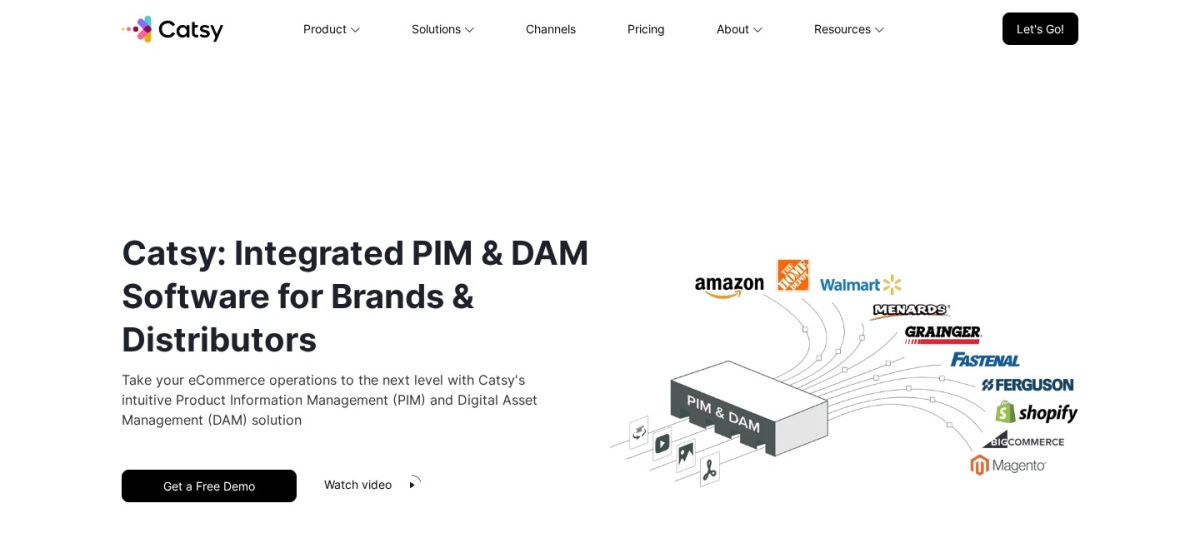
Catsy homepage, captured Nov 2026.
Catsy is a combined PIM and DAM built for brands, manufacturers and distributors, and it leads this list on print. Its live InDesign publishing turns catalog data into print-ready pages, and it also handles CAD and BOM files, which few rivals cover. It holds the highest G2 rating here at 4.8 out of 5 from 136 reviews.
The trade off is price. Catsy publishes no prices, so every plan is a custom quote, and its packages are built around Shopify stores. It suits B2B teams that still print catalogs for distributors and want one system for print and online product data.
What we like
Highest G2 rating in this list at 4.8 out of 5
Strongest print catalog output, with live InDesign
Handles CAD and BOM files for industrial catalogs
Reviewers praise its support highly
Watch out for
No published prices, quotes only
Packages are built around Shopify
Setup takes more effort than simpler PIM tools
Multi-Store and Enterprise add more stores, channels and onboardingVisit catsy.com
03
Salsify
4.4/5on G2 (129 reviews, checked Nov 2026)
Starts at$1,500/mo
Best for retailer syndication at scale
Free planNo
Basic plan$1,500/mo, per G2
Retail destinations950+
AI assistantAngie, built in
salsify.com
Salsify homepage, captured Nov 2026.
Salsify is an enterprise product experience platform that combines PIM, DAM and syndication. Its network connects brands to more than 950 retail destinations, and its GDSN data pool keeps product data in line with retailer standards. Its AI assistant, Angie, writes formulas and product content in plain language.
The trade off is cost and scale. Salsify publishes no prices on its own site, and G2 lists its Basic plan at $1,500 a month, or $18,000 a year. It suits large consumer brands that sell through many retailers and need one source of truth for every channel.
What we like
Largest retailer syndication network in this list
GDSN data pool for retailer compliance
Built-in AI assistant for formulas and content
Strong analytics on catalog performance
Watch out for
No prices on the vendor site, quotes only
Basic plan alone costs $18,000 a year
Reviewers note extra costs for small changes
Higher plans add more destinations, analytics and AI featuresVisit salsify.com
04
Akeneo
4.4/5on G2 (249 reviews, checked Nov 2026)
Starts at$45,000/yr
Best for large multichannel catalogs
Free planNo, free trial
Growth plan$45,000/yr
Higher plansAdvanced, Premium, quote only
AI featuresIncluded in paid plans
akeneo.com
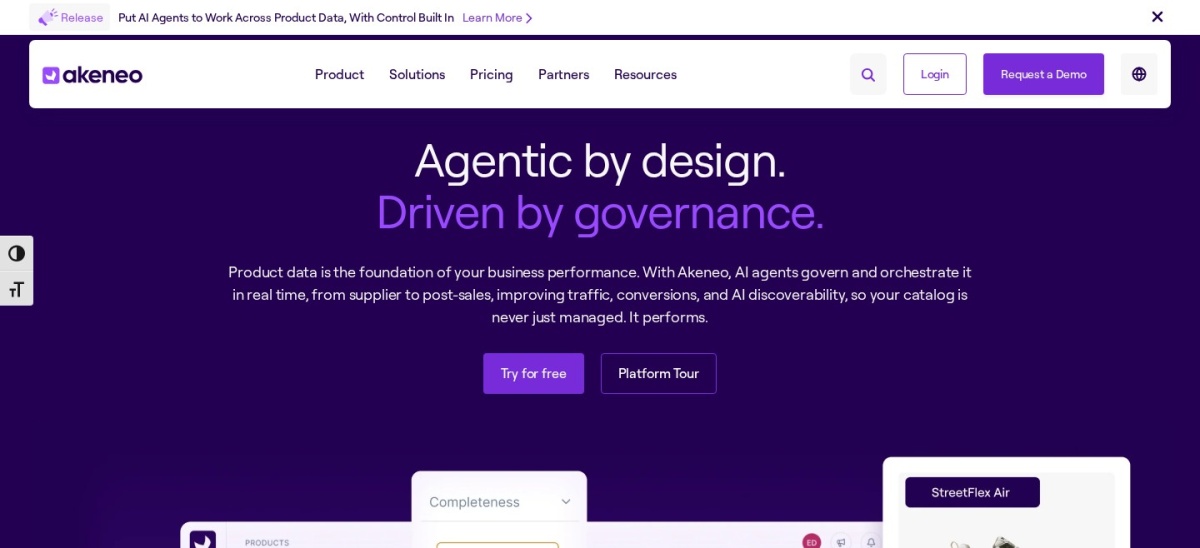
Akeneo homepage, captured Nov 2026.
Akeneo is a long-running enterprise PIM for brands with large, complex catalogs across many channels. The Growth package at $45,000 a year covers core enrichment, a rules engine and catalog management, with connectors for major ecommerce platforms. It is rated 4.4 out of 5 on G2 from 249 reviews.
The trade off is the jump in cost. A limited community edition sits below the paid plans, and the features most teams want, such as enrichment workflows and activation modules, sit in higher tiers. It suits mid-market and enterprise teams with thousands of SKUs and several sales channels.
What we like
Deepest enrichment and rules engine in this list
Wide range of ecommerce connectors
Strong G2 review volume at 249 reviews
Free trial before committing
Watch out for
Growth starts at $45,000 a year
Key workflows need higher, quote-only tiers
Add-ons push the total cost higher
Advanced and Premium add workflows, governance and analyticsVisit akeneo.com
05
Sales Layer
4.6/5on G2 (333 reviews, checked Nov 2026)
PricingCustom/yr
Best for fast marketplace syndication
Free planNo, 30-day trial
PlansPremium, Enterprise, Enterprise Plus
Enterprise usersUp to 35
PricingCustom quote
saleslayer.com
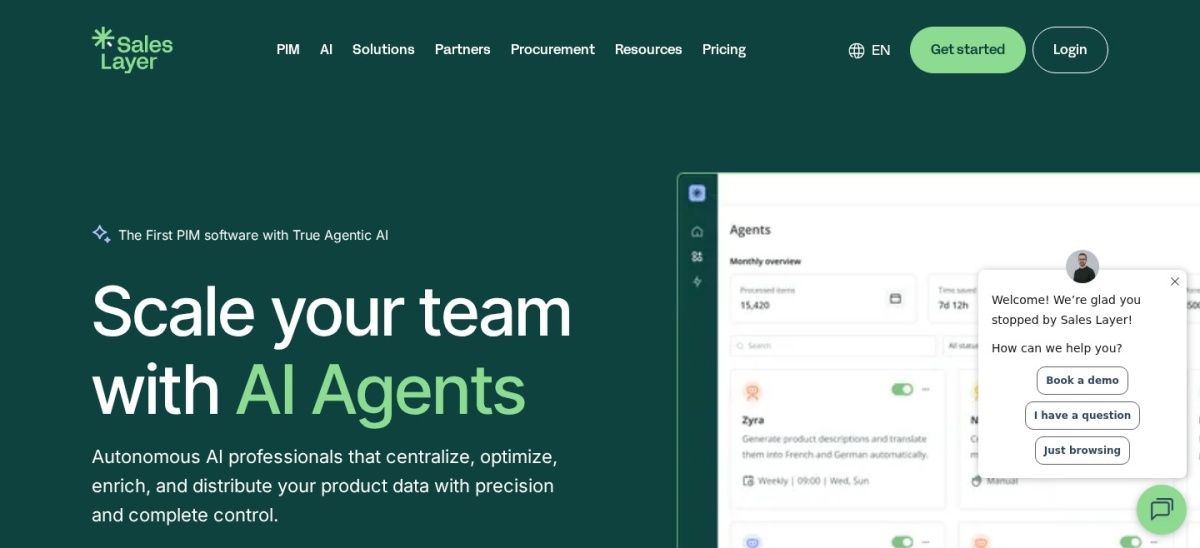
Sales Layer homepage, captured Nov 2026.
Sales Layer is a SaaS PIM aimed at manufacturers, retailers and distributors that need product data live on marketplaces fast. Its API-first design and guided onboarding get teams running in weeks rather than months, and its marketplace syndication is a particular strength. It is rated 4.6 out of 5 on G2 from 333 reviews.
The trade off is pricing. Sales Layer publishes no prices, and its price scales with product volume, so the cost is hard to predict as a catalog grows. It suits mid-market teams replacing spreadsheets who want quick marketplace feeds without a long implementation.
Syndigo combines PIM, DAM and content syndication for brands and retailers, with a large content network behind it. Reviewers praise its support more than any other strength, with 28 mentions on G2, and its portal is easy to browse for product data and assets. It is rated 4.4 out of 5 on G2 from 198 reviews.
The trade off is time and price. G2 puts average implementation at 4 months, and Syndigo publishes no prices, so buyers go through sales for a quote. It suits brands that want syndication plus a support team that reviewers consistently praise.
What we like
Support is the most praised feature on G2
Large syndication network for retail content
Easy portal for browsing product data
198 G2 reviews, a solid sample
Watch out for
No published prices, quotes only
Average implementation takes 4 months
Some reviewers call the cost high for suppliers
Paid plans add more syndication, analytics and content toolsVisit syndigo.com
07
Pimcore
4.5/5on G2 (50 reviews, checked Nov 2026)
Paid from$9,900/yr
Best open-core platform for technical teams
Free planCommunity, non-production use
Professional$9,900/yr
Enterprise$29,900/yr
PlatformPIM, DAM, CMS, MDM
pimcore.com
Pimcore homepage, captured Nov 2026.
Pimcore is an open-core platform that combines PIM, DAM, CMS and MDM in one system, so one data model can feed a store, a website and a catalog. The free Community edition is for non-production use, while Professional at $9,900 a year unlocks commercial use. It is rated 4.5 out of 5 on G2 from 50 reviews.
The trade off is technical effort. Pimcore is highly flexible, but it needs developers or an implementation partner to set up and run well. It suits technical teams that want one open platform instead of several separate tools.
What we like
Four systems in one: PIM, DAM, CMS and MDM
Free Community edition for evaluation
Very flexible data modeling
Rated 4.5 out of 5 on G2
Watch out for
Needs developers or a partner to implement
Only 50 G2 reviews, a small sample
Some features moved from free to paid tiers
Enterprise adds more features and platform-as-a-service hostingVisit pimcore.com
08
Pimberly
4.4/5on G2 (242 reviews, checked Nov 2026)
Starts at$30,000/yr
Best for enterprise PIM with built-in DAM
Free planNo
Regular plan$30,000/yr
Regular SKUs50,000
Regular users20
pimberly.com
Pimberly homepage, captured Nov 2026.
Pimberly is an enterprise SaaS PIM and DAM for brands, manufacturers, distributors and retailers. The Regular plan at $30,000 a year covers 50,000 SKUs and 20 users, with integrated DAM, unlimited channels, locales, workflows and variants. It is rated 4.4 out of 5 on G2 from 242 reviews.
The trade off is the entry price and the SKU ceiling. The next tier, Pro at $60,000 a year, covers 100,000 SKUs, so growing past 50,000 SKUs doubles the bill. It suits enterprise teams that want PIM and DAM together with strong workflow automation.
Inriver is an enterprise PIM for retail, consumer goods and manufacturing teams with complex product data. Its relation-based data model handles products with many linked parts and variants, and its Inspire tool generates product text with AI. It is rated 4.1 out of 5 on G2 from 161 reviews.
The trade off is cost and setup. Inriver publishes no prices, reviewers call it costly, and extra features add extra charges. It suits enterprise brands with tangled product relationships that simpler PIM tools cannot model well.
What we like
Flexible relation-based data model
AI text generation built in
Strong workflow efficiency, per reviewers
Named a Leader in the 2026 Gartner Magic Quadrant for PIM
Watch out for
No published prices, quotes only
Lowest G2 rating in this list at 4.1 out of 5
Reviewers cite high cost and extra charges
Paid tiers add more channels, AI and analytics featuresVisit inriver.com
Print vs digital catalogs: pick for the channel that sells
Digital catalogs update fast. Change a price in the PIM and the store, the marketplace feed and the brand portal all show the new price.
Print catalogs are slower but still close sales for distributors and trade buyers. Catsy and Plytix both generate product sheets from live data, so the printed page matches the online data.
If print is a side job, any tool with PDF export will do. If print is a core channel, put Catsy at the top of the shortlist and ask for a print demo before you buy.
How we chose
We started from the PIM and catalog tools with the most G2 reviews and the clearest catalog features, then kept nine that cover free, mid-market and enterprise buyers.
Prices come from each vendor's pricing page or from G2 pricing data, checked on 24 November 2026. Ratings and review counts come from G2 on the same day. Where a vendor shows no price, the list says the price is a custom quote.
We left out tools with very few reviews or no clear catalog features. No vendor paid for a place, and we do not claim to have used these tools ourselves.
How to choose catalog management software
Count your SKUs and list your channels first, then match the tool to that list.
Count your SKUs and your channels. A 500-SKU catalog on one store needs a different tool than a 50,000-SKU catalog on ten marketplaces.
Decide whether print matters. If distributors need printed catalogs, shortlist tools with InDesign or product-sheet output, such as Catsy.
Check the price at your SKU count. Plytix prices by SKU count, and Pimberly jumps a tier at 50,000 SKUs, so ask for a quote at your real volume.
Run a trial with your own data. Import a real sample of products, images and specs, then check completeness scores and channel feeds before you sign.
FAQ
What is the best catalog management software?
Plytix is the best pick for most teams. Its free Standard plan covers catalogs up to 100 SKUs, Pro starts at $149 a month, and it is rated 4.7 out of 5 on G2 from 452 reviews.
What is catalog management software?
It is software that stores product names, prices, images and specifications in one place, then sends that data to stores, marketplaces and printed catalogs. It replaces spreadsheets as the single source of truth for product data.
How much does catalog management software cost?
It ranges from free to $45,000 a year or more. Plytix starts at $0 with Pro from $149 a month, Pimberly starts at $30,000 a year, and Akeneo starts at $45,000 a year. Five tools here publish no prices.
Which catalog tool is best for print catalogs?
Catsy is the best choice for print. Its live InDesign publishing turns catalog data into print-ready pages, and it also handles CAD and BOM files for industrial catalogs.
Is there free catalog management software?
Yes, with limits. Plytix has a free Standard plan for catalogs up to 100 SKUs, and Pimcore has a free Community edition for non-production use. Most enterprise tools have no free plan.
What is the difference between a PIM and catalog management software?
A PIM is the system that stores and enriches product data, while catalog management is the job of turning that data into catalogs for each channel. Most tools in this list are PIMs that also handle catalog output.