Best Capacity Planning Software in 2026: 9 Tools Compared
WLWPLegible EditorsLast verified 24 Nov 2026How we rank13 min read
★ Short answer
Float is the best capacity planning software for most teams. Its Starter plan costs $7 per scheduled person a month and shows live capacity, time off and project margins in one schedule, while Resource Guru is the simplest visual scheduler at $5 a month and Runn suits teams planning months ahead with tentative projects.
How we make this list: we compare pricing pages, product documentation and public user reviews, then re-check every price before each update. No product paid for a place. Disclosure.
Float leads with live capacity views, time off and margin tracking from $7 per scheduled person a month.
Resource Guru is the cheapest full planner here at $5 a month, with clash alerts that stop double-bookings.
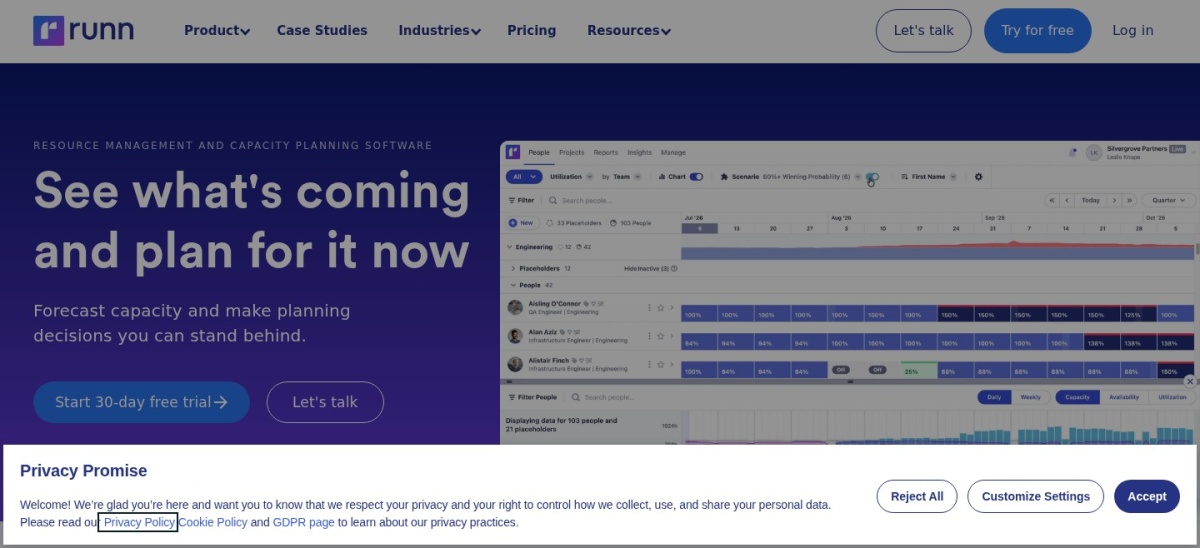
Runn plans months ahead with tentative projects and saved scenarios, but paid plans start at 20 seats.
Toggl Plan, ClickUp and Runn have free tiers; the other six tools offer free trials instead.
Smartsheet needs its Resource Management add-on for full capacity planning, on top of $19 a month.
What capacity planning software should do
Capacity planning software shows how much work your team can take on before you promise a date. It compares the hours your people have with the hours your projects need, week by week.
The core view is a schedule with a capacity line for each person. When bookings pass that line, the tool flags the overload so you can move work, add a contractor or push a deadline.
Good tools also track time off, public holidays and part-time hours, because those cut real capacity. They should also handle tentative work, so pipeline projects do not get planned as if they were already won.
Teams that run many projects at once feel the difference first. Keeping that work in one shared schedule matters as much as keeping client sites in one place, as our guide on managing many WordPress sites from one dashboard shows from the site side.
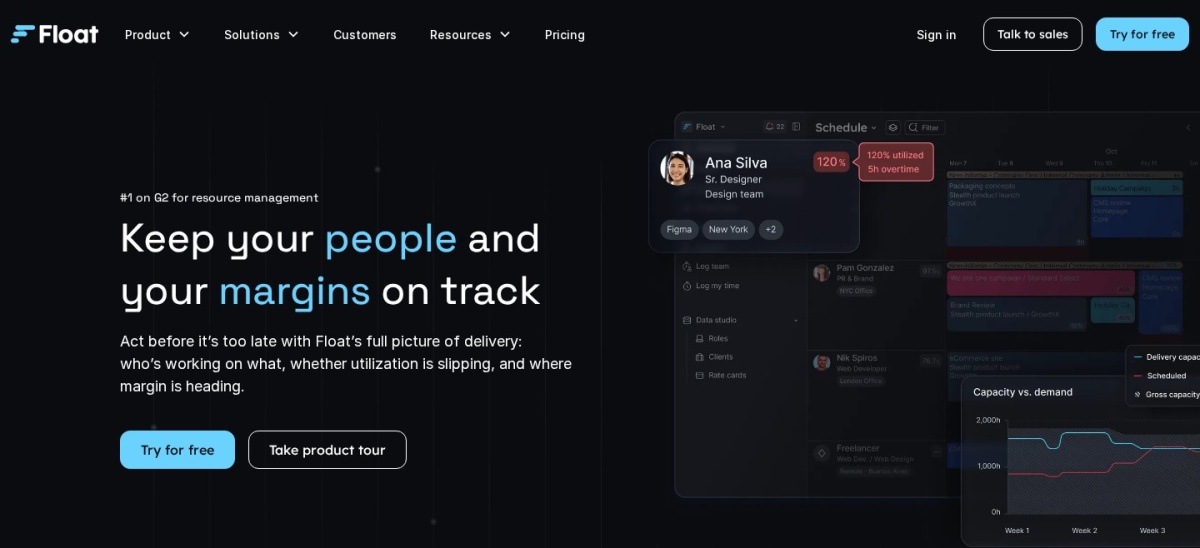
Float is a purpose-built resource and capacity planning tool for agencies and delivery teams. The Starter plan at $7 per scheduled person a month includes visual scheduling, capacity and time-off management, unlimited projects and project margin tracking, and only scheduled people are billed.
The trade off is that time tracking, single sign-on and advanced reporting need the Pro plan at $12 a month. It suits teams of about 30 to 1,000 people who want one live view of who is free and what work will cost.
What we like
Only scheduled people are billed
Live capacity and margin views on every plan
Time off and holidays built into the schedule
Rated 4.3 out of 5 on G2 from 1,995 reviews
Watch out for
No free plan, only a 30-day trial
Time tracking needs the $12 Pro plan
Not built for solo freelancers
Pro adds time tracking, single sign-on and advanced reportingVisit float.com
02
Resource Guru
4.6/5on G2 (506 reviews, checked Nov 2026)
Starts at$5/mo
Best for simple visual scheduling
Clash managementYes, with waiting list
Leave managementYes
Free trial30 days
Paid planGrasshopper, $5/mo
resourceguruapp.com
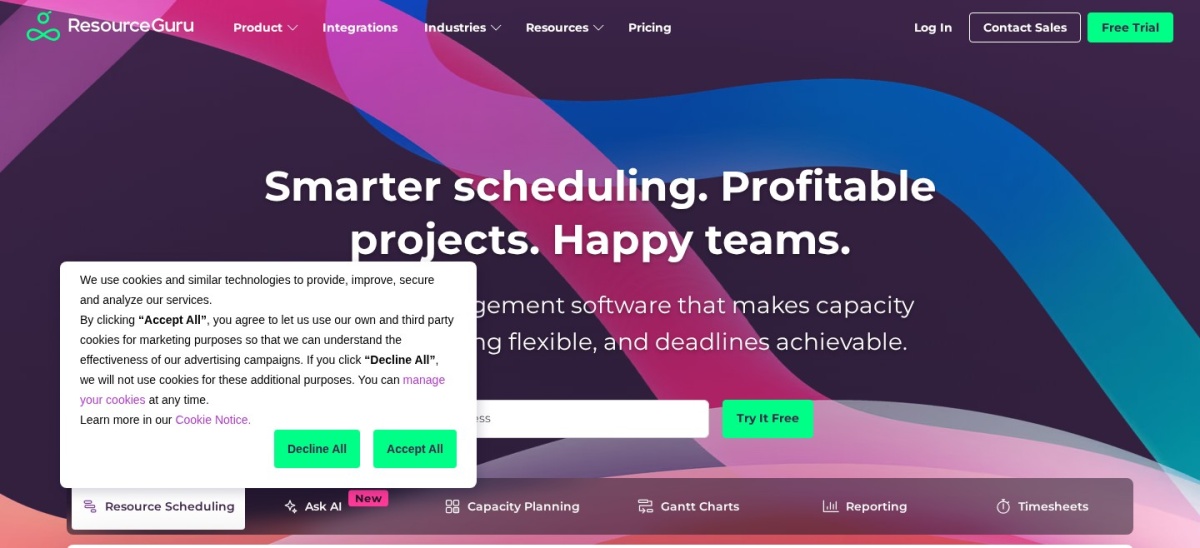
Resource Guru homepage, captured Nov 2026.
Resource Guru is a simple visual scheduler built around one job: stopping double-bookings. The Grasshopper plan at $5 per person a month covers drag-and-drop scheduling, clash management, leave management and unlimited projects and clients.
The trade off is reporting. Downloadable reports start on the Blackbelt plan at $8 a month, and in-app reporting insights need the Master plan at $12. It suits small teams that want a clear schedule without a full project suite.
Runn is a resource planning and forecasting platform for professional teams. The Lite plan at $7 per resource seat a month includes capacity and utilization charts, tentative projects, placeholders for roles you have not hired yet, and project financials.
The trade off is the 20-seat minimum on paid plans, which sets the lowest bill at $140 a month. It suits firms of 20 or more that plan capacity months ahead and want forecasts tied to project margins.
What we like
Strong forecasting with tentative projects
Placeholders plan roles before hiring
Rated 4.5 out of 5 on G2
Watch out for
20-seat minimum on paid plans
Saved scenarios need Standard at $11 a seat
Harvest sync needs the quote-only Advanced plan
Standard at $11 adds saved scenarios; Advanced is quotedVisit runn.io
04
Toggl Plan
4.2/5on G2 (44 reviews, checked Nov 2026)
Paid from$9/mo
Best simple planner for small teams
Free planSolo, 1 user
Timeline viewYes
Time-off trackingTeam plan
Paid planTeam, $9/mo
toggl.com
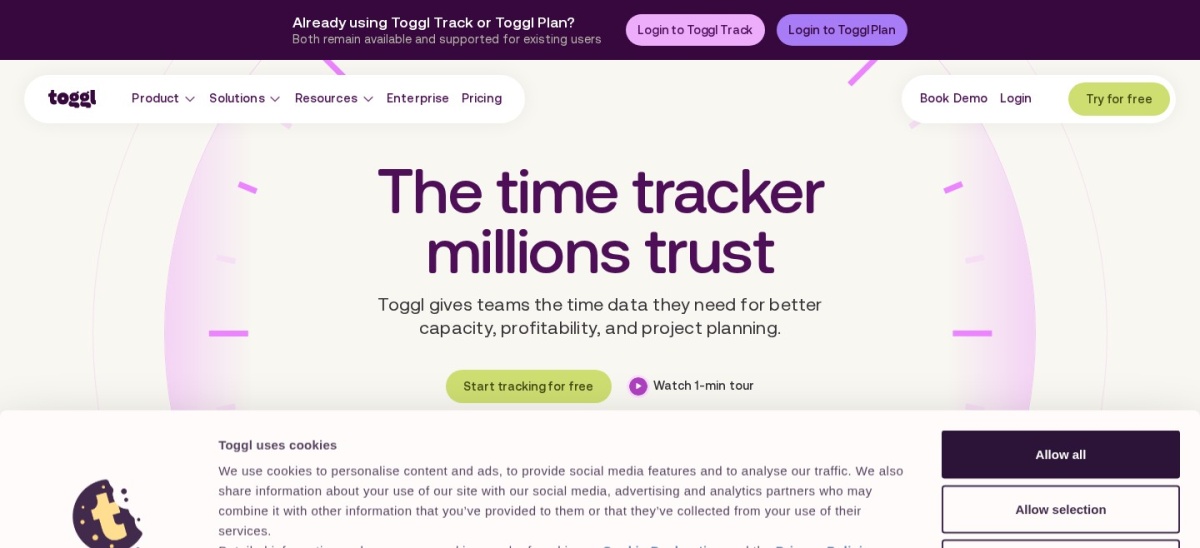
Toggl Plan homepage, captured Nov 2026.
Toggl Plan is a simple timeline planner for small teams that schedule people across projects. The free Solo plan covers one user, and the Team plan at $9 per user a month adds shared timelines, time-off tracking and team reports.
The trade off is depth. It has no forecasting, scenario planning or margin reports, so larger teams outgrow it fast. It suits small creative and consulting teams that want a clear timeline without a heavy setup.
What we like
Free Solo plan for one user
Easy to learn and quick to set up
Time-off tracking on the Team plan
Watch out for
No forecasting or scenario planning
Small G2 review base of 44 reviews
No margin or profitability reports
Team adds shared timelines; Business is $15 a monthVisit toggl.com
05
Teamdeck
4.6/5on G2 (15 reviews, checked Nov 2026)
Starts at$6/mo
Best low-cost planner with leave tracking
Time trackingYes, Full Member
Leave managementYes
Free trial14 days
Paid planFull Member, $6/mo
teamdeck.io
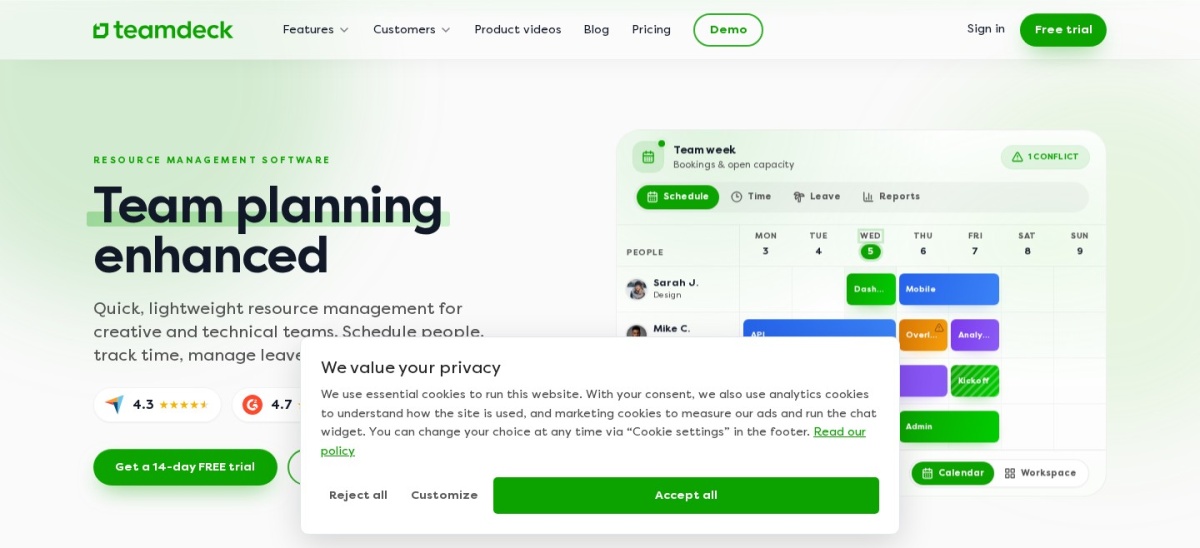
Teamdeck homepage, captured Nov 2026.
Teamdeck is a lightweight resource manager for creative and technical teams. The Full Member plan at $6 per user a month covers scheduling, time tracking, leave management and reports, while Light Member seats at $2 are view-only.
The trade off is scale and proof. It has only 15 G2 reviews, and it lacks the forecasting depth of Float or Runn. It suits small teams that want scheduling, time and leave in one low-cost tool.
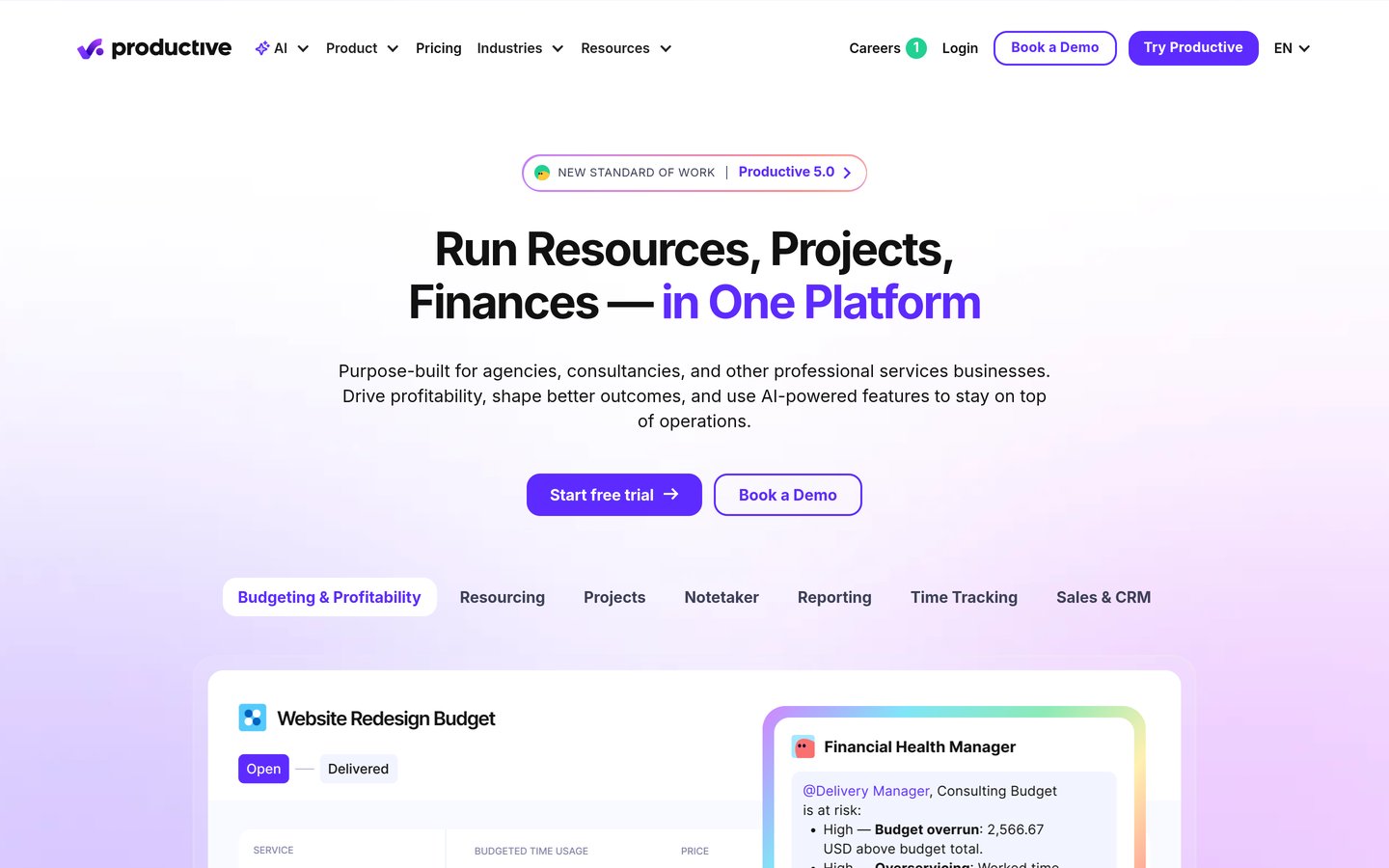
Productive is an all-in-one operations platform for agencies and consultancies. The Essential plan from $10 per user a month combines resource planning, placeholders, budgets, time tracking and profitability reports in one place.
The trade off is that it is a broad platform, so teams that only need scheduling pay for features they will not use. It suits agencies that want planning, budgets and invoicing in one system instead of three tools.
ClickUp is an all-in-one workspace for tasks, docs and dashboards with workload views for capacity. The free plan covers unlimited members and tasks, and the Business plan at $12 per user a month adds more automation, dashboards and admin controls.
The trade off is depth. Its workload views are lighter than a purpose-built planner, with no margin forecasting or scenario planning. It suits teams that already run their work in ClickUp and want basic capacity views without a second tool.
What we like
Free plan with unlimited members and tasks
Rated 4.7 out of 5 on G2 from 9,000+ reviews
Tasks, docs and chat in one workspace
Watch out for
Capacity views are lighter than dedicated planners
Harvest Forecast is a visual scheduler that sits beside Harvest time tracking. The Forecast plan costs $5 per person a month and covers project scheduling, capacity views and task-level planning, with free placeholders for roles you have not filled yet.
The trade off is that it is billed separately from Harvest, so the real cost is $5 plus $9 for Harvest Teams per seat a month. It suits teams that already track time in Harvest and want a simple scheduler on top.
Smartsheet is a spreadsheet-style work platform with workload tracking and dashboards. The Business plan at $19 per member a month covers sheets, reports and dashboards, and Resource Management is sold as a separate premium add-on for capacity planning.
The trade off is price and packaging. The add-on has no public price, so the true cost of capacity planning is higher than $19 a month. It suits large teams that already run their work in Smartsheet and need portfolio-level views.
What we like
Rated 4.4 out of 5 on G2 from 23,028 reviews
Familiar spreadsheet-style interface
Strong dashboards and portfolio views
Watch out for
Capacity planning needs a separately priced add-on
Free plans cover basic scheduling well. Toggl Plan gives one user a timeline, ClickUp gives unlimited members and tasks, and Runn is free for up to five users.
Paid plans mostly add forecasting, reports and controls. Scenario planning, margin reports and single sign-on usually sit on the second or third tier, not the cheapest plan.
Check the seat rules before you compare prices. Runn bills a 20-seat minimum, Float bills only scheduled people, and Harvest Forecast bills everyone who is scheduled, even if they never log in.
How we chose
We started from the capacity planning tools that appear most often in agency and consultancy shortlists, then kept nine with public pricing and a G2 rating.
Prices come from G2 pricing pages and vendor comparison guides that quote the vendors' own pricing, checked on 24 November 2026. Ratings and review counts come from G2 on the same day. Where a vendor shows a sale, the list shows the regular price.
We left out tools with no public price, such as Kantata and Forecast.app, and tools without a usable G2 rating. No vendor paid for a place, and we do not claim hands-on testing for this list.
How to choose capacity planning software
Start with your planning horizon, then check the seat rules before you compare prices.
Work out how far ahead you plan. Four weeks of staffing is a scheduling job. Two quarters of demand against supply needs forecasting and tentative projects.
Count who gets billed. Float bills only scheduled people and Runn has a 20-seat minimum, so the same per-seat price can mean very different monthly bills.
Check what the entry plan leaves out. Reports, scenarios and single sign-on often sit on higher tiers, so read the plan comparison before you buy.
Run a trial on one live project. Plan one real project for a month and compare planned hours with actual hours. The tool with the smallest gap is the right one.
FAQ
What is the best capacity planning software?
Float is the best pick for most teams. Its Starter plan costs $7 per scheduled person a month and shows live capacity, time off and project margins in one schedule, and it is rated 4.3 out of 5 on G2 from 1,995 reviews.
How much does capacity planning software cost?
Entry prices in this list run from $5 to $19 per person a month. Resource Guru and Harvest Forecast start at $5, Float and Runn at $7, and Smartsheet at $19, with its Resource Management add-on priced separately.
Is there free capacity planning software?
Yes, with limits. ClickUp has a free plan with unlimited members and tasks, Toggl Plan is free for one user, and Runn is free for up to five users. The other tools in this list offer free trials instead of free plans.
What is the difference between capacity planning and resource scheduling?
Scheduling assigns named people to dated work, while capacity planning compares total demand with total availability over weeks or months. Scheduling answers who does what this week; capacity planning answers whether the team can take on the next project at all.
Do I need a separate tool, or will ClickUp or Smartsheet do?
A separate planner fits teams that live in capacity data every day, with forecasting, scenarios and margin views. ClickUp or Smartsheet fit teams that already run their work there and only need basic workload views beside their projects.
What should I check before I buy?
Check the seat rules, the plan that carries forecasting and reports, and whether capacity features need an add-on. Then run a trial on one live project and compare planned hours with actual hours before you commit.