Carta is the best cap table software for most venture-backed startups, because it is the platform investors, lawyers and auditors already know how to read. Pick Eqvista for a free cap table with the cheapest 409A valuations, or Cake Equity for a flat $1,000 a year with published prices.
How we make this list: we compare pricing pages, product documentation and public user reviews, then re-check every price before each update. No product paid for a place. Disclosure.
Carta is the industry-standard cap table platform, free on Launch up to 25 stakeholders and $1M raised, and rated 4.3 out of 5 on G2 from 232 reviews.
Eqvista is free up to 20 shareholders and charges $2 per shareholder a month after that, with 409A valuations bundled from $990 a year, the cheapest in this list.
Cake Equity is the clearest flat price here: free up to 5 stakeholders, Build at $1,000 a year for 25 stakeholders, and Team at $2,750 a year with two 409As.
Astrella starts at $1,200 a year with simple stakeholder-band pricing, and Qapita's Surge plan costs $1,600 a year for 40 stakeholders with published per-stakeholder overages.
Pulley shuts down on 8 December 2026 and is left out of this list, so do not start a new cap table there and migrate existing data before that date.
What cap table software should cover
Cap table software tracks who owns what in a private company: shares, options, SAFEs, convertible notes and vesting. The best tools also handle 409A valuations, board consents and scenario modelling for the next funding round.
If you have 20 or fewer shareholders, you should not be paying for cap table software. Eqvista is free up to 20 shareholders, Gust's core cap table tools are free, Cake Equity is free up to 5 stakeholders, and Carta Launch is free up to 25 stakeholders for companies that raised under $1M.
Published pricing is rare past the free tier. Eqvista charges $2 per shareholder per month and Cake Equity's Build plan starts at $1,000 per year, both public, while Carta, Ledgy, Shareworks and Fidelity quote custom prices.
The 409A valuation is the hidden second purchase. Eqvista bundles unlimited 409As from $990 per year, while everywhere else it is a separate line item, typically $1,000 to $5,000 per valuation.
Carta is the default answer in US startup equity, and defaults matter. When your law firm, your investors and your acquirer's counsel all already work in Carta, diligence moves faster and nobody questions your records. The platform covers electronic cap tables, securities issuance, 409A valuations, ASC 718 reporting, scenario modelling, fund administration and secondary liquidity.
The trade off is price transparency. Carta publishes no prices for paid plans, saying only that pricing depends on the needs and size of your team, and add-ons such as Total Compensation and Liquidity are sold separately. It suits VC-backed US startups from seed to pre-IPO that want the industry-standard platform.
What we like
Industry-standard platform investors expect
Free Launch plan up to 25 stakeholders
409A valuations, fund admin and liquidity in one place
Eqvista is the cheapest serious cap table here. It is completely free for companies with fewer than 20 shareholders, and Premium Cap Table costs $2 per shareholder a month, so a 30-person cap table costs about $60 a month, with custom pricing above 50 stakeholders.
The trade off is review depth. Eqvista's own pages claim 4.9 out of 5 on G2, but the G2 figure found in independent roundups is 4.2 from only 10 reviews, so treat the rating with care. It suits startups that want a free cap table bundled with the cheapest credible 409A valuations.
What we like
Free cap table up to 20 shareholders
409A bundles from $990 a year
$2 per shareholder a month after free
SEC-registered transfer agent
Watch out for
G2 rating is disputed: 4.2 from 10 reviews, vendor claims 4.9
409A price varies with revenue and capital structure
Cake Equity is a cap table tool for founders who want a clear flat price. The free plan covers up to 5 stakeholders with no card, which is enough for co-founders and a first advisor. Build costs $1,000 a year for 25 stakeholders, and Team costs $2,750 a year for 40 stakeholders and includes two 409A valuations a year.
The trade off is scale. Cake Equity focuses on the employee experience of equity, and larger or pre-IPO companies will outgrow it. It suits growing startups that want published prices and a founder-friendly Carta alternative, especially in APAC and Australia.
Ledgy is the strongest choice for European and international startups. It handles multi-jurisdiction share classes, local compliance conventions and multi-currency equity, with round modelling and stakeholder management across several countries in one platform.
The trade off is price. Ledgy publishes no dollar price, paid plans are quote-based, and earlier published figures were in euros, at 900 euros a year for Build and 3,000 euros a year for Team. It suits European and international startups that need equity management across multiple jurisdictions.
Shareworks is a share plan platform from Morgan Stanley, designed for late-stage and public companies. It manages employee share plans at scale, with participant dashboards, real-time valuations and reporting for companies whose equity programmes have outgrown startup tools.
The trade off is fit and rating. Shareworks is custom-quoted, has no free tier, and holds the lowest G2 rating here at 3.8 out of 5 from 32 reviews. It suits late-stage and pre-IPO companies that need a bank-backed platform for large employee share plans.
Gust is the free front door for pre-seed founders. Its core cap table management tools are free, with incorporation, stock issuance and a referral network in the same platform, so a founder can set up a real cap table with no budget at all.
The trade off is depth and proof. Gust's paid tiers are quoted rather than published, and its G2 rating of 4.5 comes from only 3 reviews, so treat it as thin evidence. It suits pre-seed founders who need a real cap table and have no budget for one.
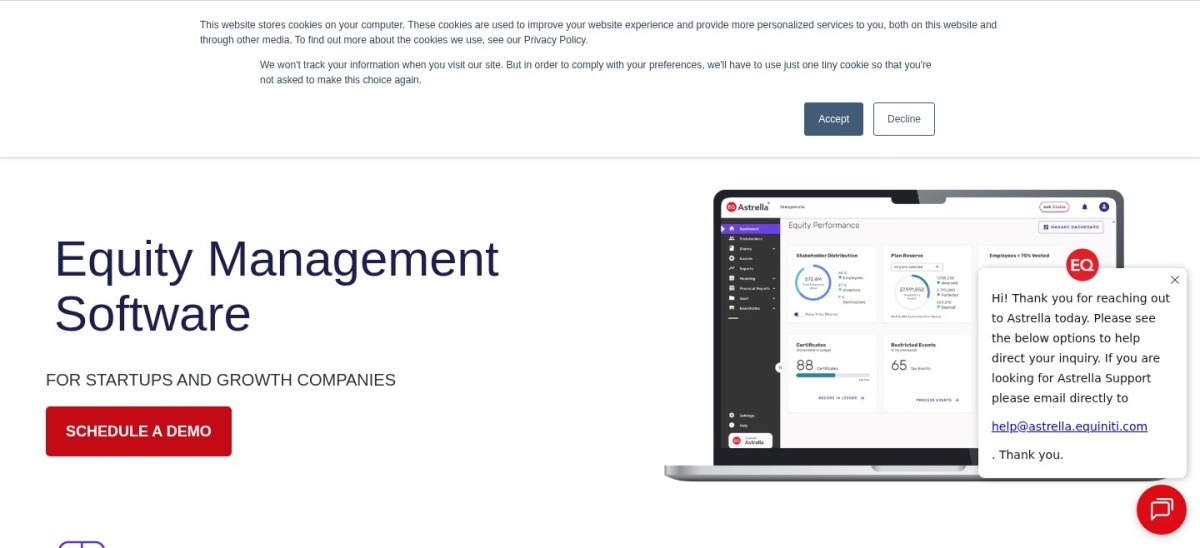
Astrella is a cap table platform for startups that want simple stakeholder-band pricing as they grow past 25 holders. It covers cap table management, option grants and 409A valuations in a clean platform, with a published starting price of $1,200 a year instead of a custom quote.
The trade off is review depth. Astrella holds a 4.5 out of 5 G2 rating from 51 reviews, a smaller base than Carta or Cake Equity, and it has no free tier. It suits startups that want a capable alternative with a clear price and no negotiation.
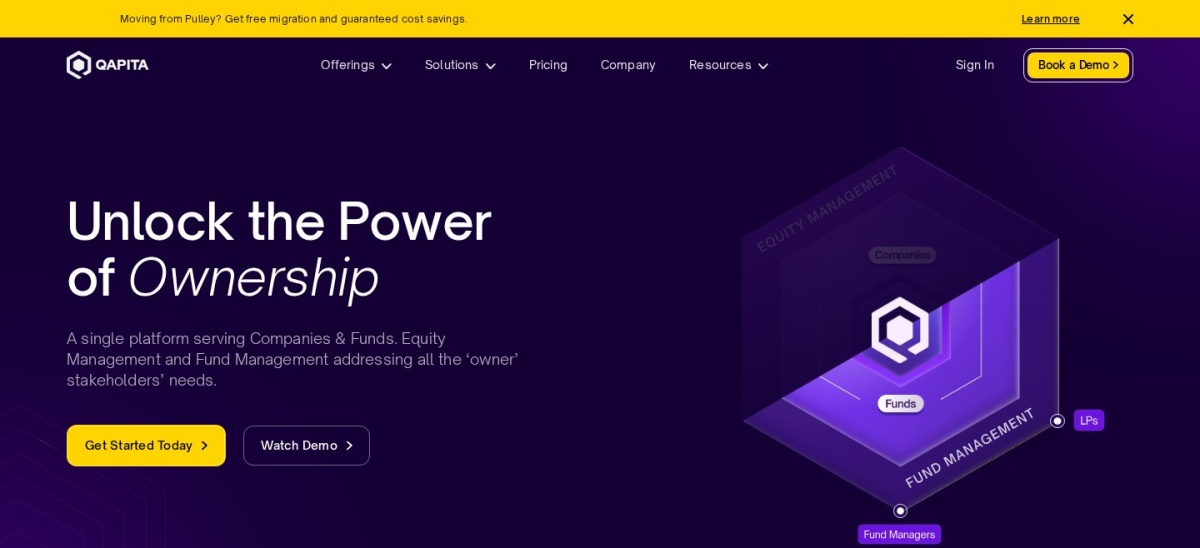
Qapita is a Singapore-headquartered equity management platform for seed-to-IPO companies with global structures. It covers cap table management, stock plan administration, 409A valuations, ASC 718 reporting and tender offers, with multi-entity and multi-jurisdiction support across the US, India and Southeast Asia.
The trade off is the free tier's ceiling. Spark is free for up to 25 stakeholders and $1M raised, but Surge costs $1,600 a year for 40 stakeholders, and the 409A add-on is priced two ways on the vendor's own page, at $1,500 and as custom pricing. It suits global startups that want published prices instead of a quote.
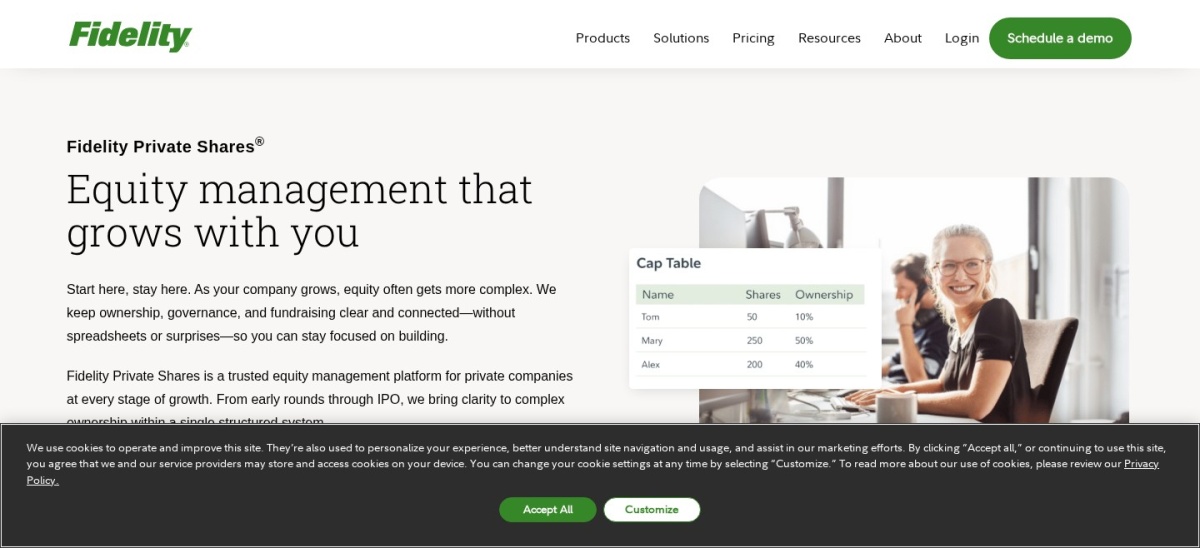
Fidelity Private Shares homepage, captured Nov 2026.
Fidelity Private Shares is the bank-backed alternative for startups, formerly Shoobx. Its Launch plan is free for up to 25 stakeholders per year, with incorporation, stock issuance, board consents and e-signatures in one platform, and it is rated 4.8 out of 5 on G2 from 34 reviews.
The trade off is scale. Paid plans are custom-quoted, and Fidelity suits earlier-stage companies better than pre-IPO programmes, where Shareworks or Carta fit better. It suits first-time founders who want a free, bank-backed cap table with strong support.
Free tiers cover the basics well. Carta Launch, Eqvista, Cake Equity, Ledgy, Gust and Fidelity Private Shares all offer a free start, and for a pre-seed company with a handful of shareholders that is usually enough.
Paid plans mostly add scale and valuations. More stakeholders, priced round modelling, 409A valuations and ASC 718 reporting are what push a team from free to paid.
Pulley, once a popular early-stage pick, announced it will cease operations on 8 December 2026, so do not start a new cap table there. Existing Pulley customers should migrate before that date.
How we chose
We started from the cap table tools that appear most often in current founder roundups, then kept the nine with the strongest review record and a live product in 2026. Pulley was left out because it shuts down on 8 December 2026.
Prices come from each vendor's pricing page, checked on 23 November 2026. Ratings come from G2 on the same day. Where a vendor publishes no price, the list says so, and where a rating is disputed between sources the lower figure is used.
We left out tools that only do valuations with no cap table, and tools that stopped accepting new customers. No vendor paid for a place, and we do not claim hands-on testing for this list.
How to choose cap table software
Start with your shareholder count, since that decides whether you should pay at all.
Count your shareholders first. With 20 or fewer, Eqvista is free and Carta Launch is free, so do not pay for a cap table until the shareholder count or the funding stage forces it.
Check the 409A price, not just the cap table price. A 409A valuation typically costs $1,000 to $5,000 as a separate purchase, so a bundle such as Eqvista's $990 a year can be worth more than the cap table itself.
Ask who already reads the platform. If your law firm, investors and acquirer's counsel all work in Carta, diligence moves faster and nobody questions your records, which is worth a custom quote.
Confirm the migration path. Cap table data is hard to move, so check export formats and whether the vendor is still accepting new customers before you commit to a year.
FAQ
What is the best cap table software?
Carta is the best pick for most venture-backed startups. It is the platform investors, lawyers and auditors already know, with a free Launch plan up to 25 stakeholders, and it is rated 4.3 out of 5 on G2 from 232 reviews.
Is there free cap table software?
Yes. Eqvista is free up to 20 shareholders, Carta Launch is free up to 25 stakeholders for companies that raised under $1M, Cake Equity is free up to 5 stakeholders, and Gust's core cap table tools are free.
How much does cap table software cost?
Eqvista charges $2 per shareholder a month, Cake Equity's Build plan starts at $1,000 a year, Astrella starts at $1,200 a year, and Qapita's Surge plan costs $1,600 a year. Carta, Ledgy, Shareworks and Fidelity quote custom prices.
What is a 409A valuation?
A 409A valuation sets the fair market value of a private company's shares, which decides the strike price of stock options. Most startups need one every year or after a major funding round.
Which cap table software includes 409A valuations?
Eqvista bundles unlimited 409A valuations from $990 a year, Cake Equity includes two a year on its $2,750 Team plan, and Carta adds 409A valuations on its Grow tier and above.
Should I use Carta or Eqvista?
Pick Carta if you are venture-backed and want the platform your investors and lawyers already use. Pick Eqvista if you are cost-conscious and want a free cap table with the cheapest bundled 409A valuations.
SaaS SEO and WordPress specialist with about 8 years of experience. Rakib compares WordPress plugins, themes, hosting and software using public pricing, documentation and user reviews. See how we rank.