Best Brand Reputation Management Tools in 2026: 9 Tools Compared
WLWPLegible EditorsLast verified 23 Nov 2026How we rank13 min read
★ Short answer
Birdeye is the best brand reputation management tool for most businesses, with review requests, responses, listings and surveys in one platform. Pick Podium for text-first review requests, or BrightLocal for the cheapest paid plan at $39 a month.
How we make this list: we compare pricing pages, product documentation and public user reviews, then re-check every price before each update. No product paid for a place. Disclosure.
Birdeye leads on breadth, with review requests, responses, listings and surveys, and a 4.7 rating on G2 from 4,205 reviews.
Podium is the strongest text-first pick, with review invites by text and payments built in, though its $399 monthly price is third-party reported.
Trustpilot is the only free plan in this list, with 50 review invites a month, but its 3.4 G2 rating is the lowest here.
NiceJob holds a 4.8 rating on G2 from 437 reviews, the highest score in this list, at $95 a month.
BrightLocal is the cheapest paid plan at $39 a month, though review features need the $59 Grow plan.
What reputation management tools should do
Reputation tools do three jobs: ask happy customers for reviews, answer every review fast, and keep business listings correct across the web. The best ones automate the ask by text or email after each sale or visit.
Pricing is the hard part here. Birdeye, Podium and ReviewTrackers publish no prices on their own sites, so the figures in this list come from third-party pricing reads and should be confirmed with the vendor.
Per-location pricing changes the math. A $299 plan is cheap for one shop and steep for twenty, so work out the total across every location before you compare.
A free plan can carry a small business. Trustpilot's free plan covers 50 review invites a month, and Yext's Reviews add-on costs $199 a year per location on top of listings. Our guide on adding product reviews in WooCommerce covers the store side of review collection.
Birdeye is an all-in-one reputation platform with review requests by text and email, AI responses, listings, surveys and social posting. It serves more than 150,000 businesses and holds a 4.7 rating on G2 from 4,205 reviews, the largest review count in this list. It fits multi-location brands that want every reputation job in one dashboard.
The trade off is the price. Birdeye publishes no prices: its pricing page is a lead form, and third-party reads list Starter at $299 a location a month on annual contracts. It suits businesses that can afford a full platform and want it managed in one place.
Podium is a messaging-first reputation platform with review invites by text, webchat, payments and AI responses. Core costs $399 a month and Pro costs $599, both reported by third parties after Podium pulled public prices in late 2025. It holds a 4.5 rating on G2 from 2,109 reviews.
The trade off is the price and the proof. Neither price appears on Podium's own site, so confirm the quote before you sign, and the platform is built for US text-first businesses. It suits service businesses that already text customers and want reviews from the same thread.
Trustpilot is the best-known review platform, with review invites, profile pages, review widgets and a free plan covering 50 invites a month. Plus costs $319 a month per domain billed annually, or $3,828 prepaid, and includes unlimited invites and AI responses. It fits businesses that want reviews on a brand buyers already trust.
The trade off is the rating. Trustpilot holds 3.4 out of 5 on G2 from 263 reviews, the lowest in this list, and the Plus price is high for a small shop. It suits brands that sell online and want the Trustpilot badge on their site.
Reputation.com is an enterprise reputation platform for multi-location brands, with review monitoring, responses, listings, surveys and social management. Rep Core costs $80 a location a month, and the platform holds a 4.5 rating on G2 from 2,469 reviews. It fits chains and franchises that need one view across hundreds of locations.
The trade off is the audience. Reputation.com is built for mid-market and enterprise teams, so a single-location business will find it heavy and the sales process slow. It suits brands with a reputation team and a real location count.
NiceJob is a reputation tool for home services, trades and local businesses, with automated review requests by text and email, follow-ups, review widgets and referral requests. Starter costs $95 a month, after a price rise on 4 November 2026 from $75, and it holds a 4.8 rating on G2 from 437 reviews, the highest score in this list.
The trade off is the recent price rise. Older guides still list $75 a month, so check the pricing page before you buy, and the tool is built for service businesses rather than retail. It suits contractors and trades that want review requests to run themselves after every job.
ReviewTrackers is a review management platform that pulls reviews from Google, Facebook, Yelp and more than 100 sites into one inbox, with AI responses, reporting and competitive intelligence. Pricing is officially quote-only, and third-party reads list $89 a location a month. It holds a 4.6 rating on G2 from 161 reviews.
The trade off is the quote-only model. The $89 figure is third-party reported, so confirm it with the vendor, and the platform is built for multi-location teams rather than single shops. It suits businesses that track reviews across many sites and locations.
BrightLocal is a local SEO platform with review management, rank tracking, citation building and listing management. Track costs $39 a month, and review features need Grow at $59 a month. It holds a 4.6 rating on G2 from 229 reviews. It fits small businesses that want reviews plus local search visibility in one tool.
The trade off is the plan split. The $39 Track plan covers rank tracking and citations, so review requests and responses wait for Grow at $59. It suits local businesses that already care about Google Maps rankings and want reviews on the same bill.
Yext is a listings and local search platform with review monitoring and responses as an add-on. The Reviews add-on costs $199 a year per location on top of a listings plan, and Yext holds a 4.4 rating on G2 from 1,135 reviews. It fits brands with many locations that need hours, addresses and services correct everywhere.
The trade off is that reviews are an add-on, not the core. You pay for listings first, then $199 a year per location for review tools, and the platform is built for larger teams. It suits chains that already use Yext for listings and want reviews on the same dashboard.
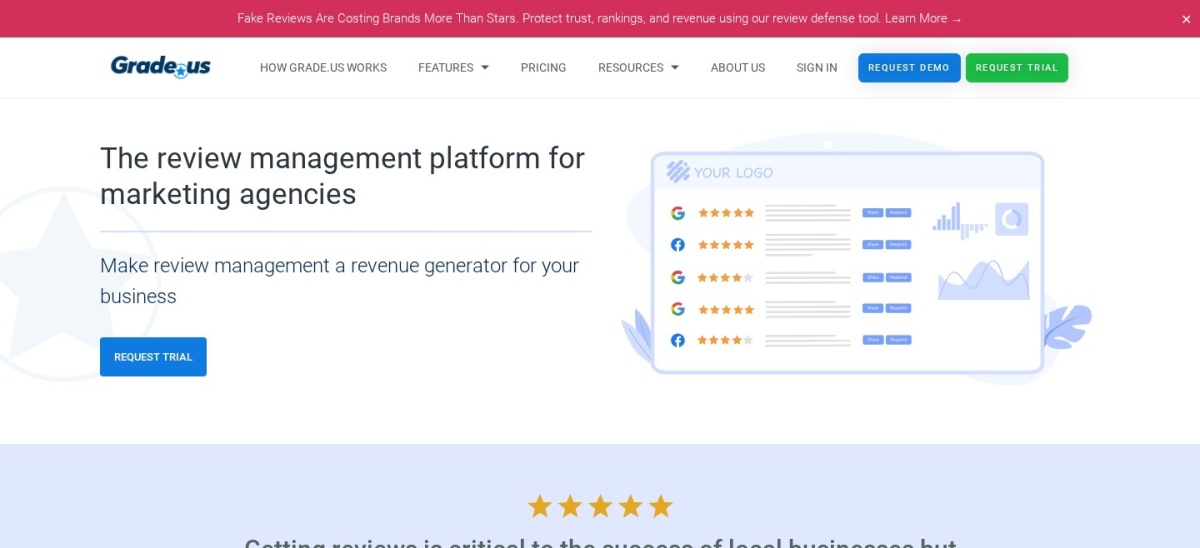
Grade.us is a simple reputation tool for small businesses, with automated review requests, review widgets and a white-label option for agencies. It costs $180 a month, and it holds a 4.6 rating on G2 from 143 reviews. It fits small businesses and agencies that want review requests running with no learning curve.
The trade off is the price figure. The $180 monthly price comes from a third-party pricing read, and directory listings show $99 and $110 plans that the official page does not show, so confirm the price before you buy. It suits owners who want a simple tool that just sends review requests.
What we like
Simplest review tool in this list
White-label option for agencies
Rated 4.6 out of 5 on G2
Watch out for
Price is third-party reported, not vendor-published
Review requests drive new reviews. Birdeye, Podium and NiceJob send text or email asks after each job, and the best ones time the ask to the moment the customer is happiest.
Listing management keeps facts correct. Yext and BrightLocal sync hours, addresses and services across Google, Apple Maps and dozens of directories.
Most businesses need both, but small ones should start with requests. A steady flow of new reviews lifts rankings faster than perfect listings, and it costs less.
How we chose
We started from the reputation tools most often recommended for local and multi-location businesses, then kept the nine with published or widely reported pricing.
Prices come from each vendor's pricing page where published, or from third-party pricing reads where the vendor shows no price, checked on 23 November 2026. Ratings come from G2 on the same day.
We left out invite-only enterprise suites and tools with no public pricing page. No vendor paid for a place, and we do not claim hands-on testing for this list.
How to choose a reputation management tool
Start with your location count, then check how reviews get asked for.
Count your locations first. Per-location prices multiply fast. A $299 plan costs $3,588 a year for one shop and $71,760 for twenty.
Check how review requests go out. Text and email asks after each job drive the most reviews. Ask whether invites, follow-ups and review widgets are included or cost extra.
Ask for the real price in writing. Birdeye, Podium and ReviewTrackers publish no prices. Get a quote that lists every location, add-on and contract term before you sign.
Run a trial on one location. Send requests for two weeks, measure the new review count and response time. See our guide on writing product reviews that rank for what good review copy looks like.
FAQ
What is the best brand reputation management tool?
Birdeye is the best pick for most businesses, with review requests, responses, listings and surveys in one platform. Podium suits text-first teams, and BrightLocal is the cheapest paid plan at $39 a month.
How much does reputation management software cost?
Expect $39 to $399 a month for small businesses, with multi-location platforms charging $80 to $299 per location. Yext's Reviews add-on is the cheapest at $199 a year per location, on top of listings.
Is there free reputation management software?
Trustpilot offers a free plan with 50 review invites a month, and Google Business Profile is free for listings and review replies. Most full platforms have no free plan, only a trial or demo.
Does Birdeye publish its pricing?
No. Birdeye's pricing page is a lead form with no plan prices. Third-party pricing reads list Starter at $299 a location a month, with Growth at $349 and Dominate at $449 on annual contracts.
Which tool is best for multi-location businesses?
Birdeye and Reputation.com lead for chains, with per-location pricing, centralized responses, listing sync and review monitoring across every site. ReviewTrackers also suits chains, with competitive intelligence and reporting across locations.
Can I manage Google reviews from these tools?
Yes. All nine tools in this list collect and respond to Google reviews, and most add Facebook, Yelp and industry sites. Yext and BrightLocal also manage the business listings those reviews sit on.