Fivetran is the best big data integration platform for most teams, with 700+ managed connectors, a free plan to 500,000 monthly active rows and a 4.3/5 G2 rating. Pick Airbyte for the cheapest managed start and free self-hosting, and Informatica for enterprise governance.
How we make this list: we compare pricing pages, product documentation and public user reviews, then re-check every price before each update. No product paid for a place. Disclosure.
Fivetran leads with 700+ fully managed connectors, a free plan to 500,000 monthly active rows and a 4.3/5 G2 rating.
Airbyte is the cheapest managed start at $20 a month, and its Core edition is free to self-host.
Hevo Data is the clearest on price: Starter starts at $265 a month for 1-hour syncs.
Informatica, Talend and Matillion publish no prices, so budget them by quote only.
Stitch is the simplest ELT option at $100 a month, but Advanced jumps to $1,500 a month.
Integrate.io charges one flat $1,999 a month for unlimited data, which suits heavy steady volume.
What to look for in a big data integration platform
Big data integration platforms move data from databases, SaaS apps and files into a warehouse or lake, then keep it in sync. The best ones handle schema changes and retries without hand-written code.
Connector count matters most. Fivetran and Airbyte each list 700+ connectors, while Hevo lists 210+ sources and Stitch about 130, so check your exact sources before shortlisting.
Pricing is hard to compare because every vendor meters something different: Fivetran bills monthly active rows, Airbyte bills credits, Hevo bills events and Matillion bills credits. Model the cost at your real volume.
Data quality and governance separate the enterprise tools from the loaders. Informatica and Talend build quality checks and stewardship into the platform, while simpler tools move data and leave quality to the warehouse.
Fivetran is a fully managed data integration platform that moves data from 700+ sources into a warehouse or lake. The free plan covers 500,000 monthly active rows and 5,000 model runs a month, and Standard adds unlimited users, 15-minute syncs and access to the REST API.
The trade off is usage-based billing. Fivetran charges by monthly active rows, with a $5 base charge per connection, so wide tables that update often raise the bill. It suits teams that want managed reliability for business-critical pipelines and can budget by row volume.
Airbyte is an open-source data integration platform with 700+ connectors for moving data into warehouses and lakes. Airbyte Core is free to self-host, and Airbyte Cloud starts at $20 a month for Standard, with credit-based billing by rows or gigabytes synced.
The trade off is metering. Standard syncs at most hourly, and API sources burn 6 credits per million rows, so SaaS-heavy stacks scale fast. It suits teams that want the cheapest managed start and a free self-hosted fallback.
Informatica is an enterprise data platform, the Intelligent Data Management Cloud, that covers data integration, quality, cataloging, governance and master data management in one place. Its CLAIRE AI engine helps profile and clean data, and the platform claims connections to more than 50,000 sources.
The trade off is price and weight. Informatica publishes no price list and bills by Informatica Processing Units, so you need a sales quote, and rollouts take time. It suits large enterprises that need governance and data quality beside integration.
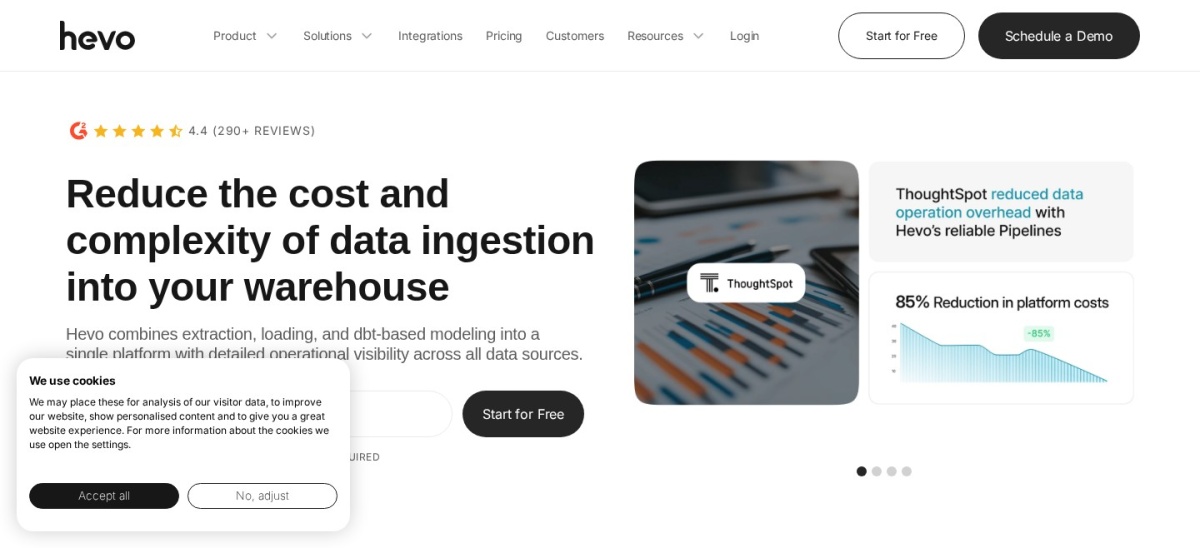
Hevo Data is a fully managed, no-code data pipeline platform that loads data from 210+ sources into a warehouse. The free plan covers 1 million events a month, and Starter starts at $265 a month with 1-hour scheduling, up to 10 users and dbt integration.
The trade off is event metering. Costs rise with event volume, and the fixed-price unlimited plan is quote-only. It suits growing teams that want predictable pipeline pricing without writing code.
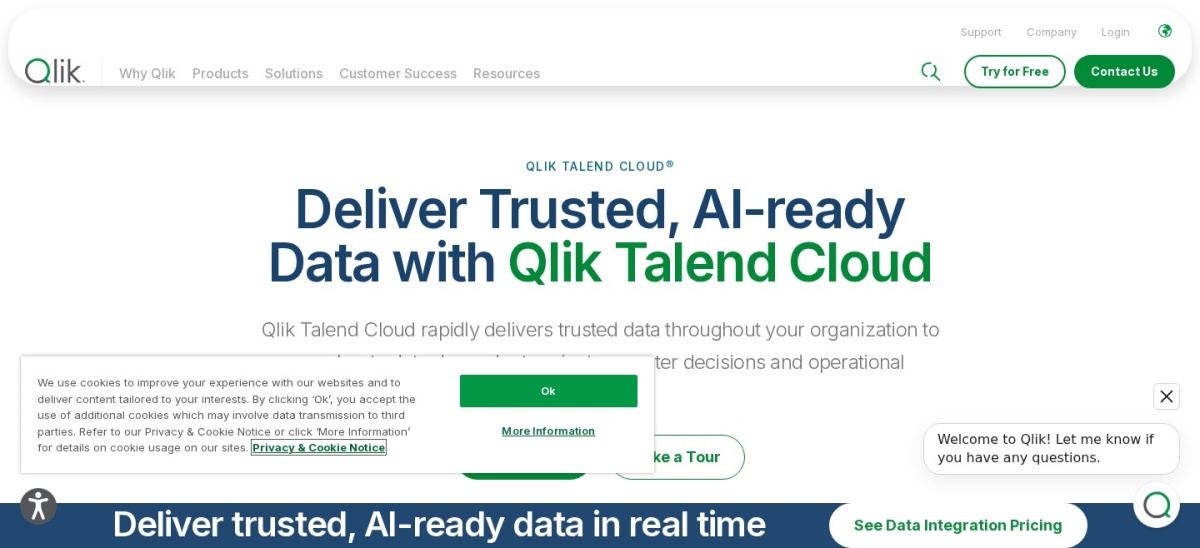
Talend is a data integration platform, now Qlik Talend Cloud, with 900+ connectors and data quality built into the pipeline. It covers ETL and ELT patterns across cloud and self-hosted estates, with governance and stewardship beside connectivity.
The trade off is price. Talend publishes no price list, and enterprise costs run high once training and extra modules add up. It suits hybrid estates that need data quality inside the integration tool itself.
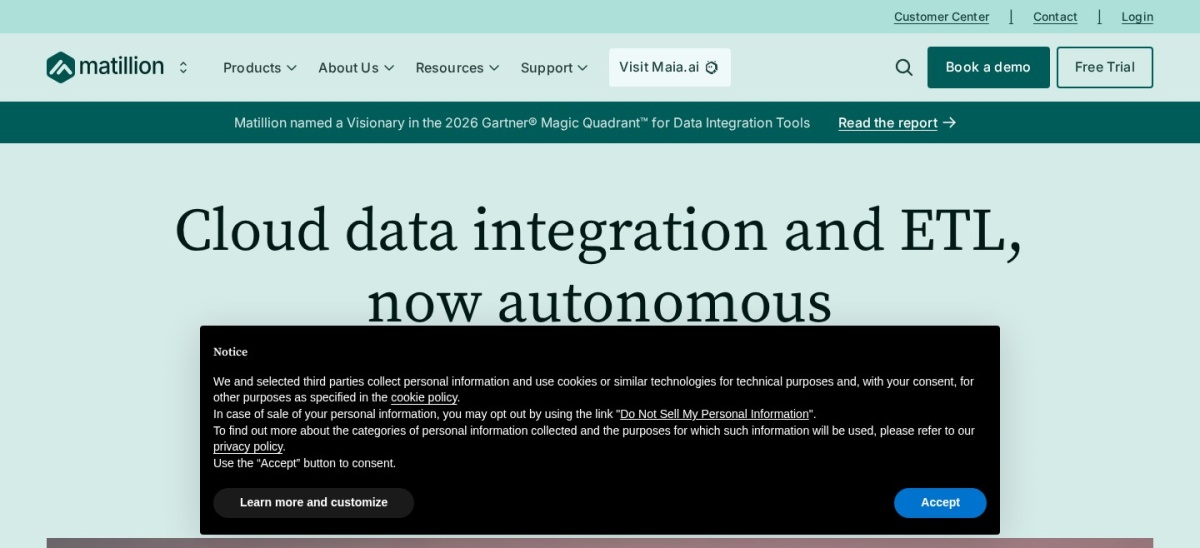
Matillion is a cloud data integration platform built around visual, in-warehouse transformation on Snowflake, Databricks, Redshift and BigQuery. Its Maia agents help build and fix pipelines, and a 14-day trial includes 500 credits.
The trade off is pricing clarity. Matillion publishes credit consumption rates but no dollar price, and all three editions are quote-only annual packages. It suits warehouse-first teams that want ingestion and heavy transformation in one platform.
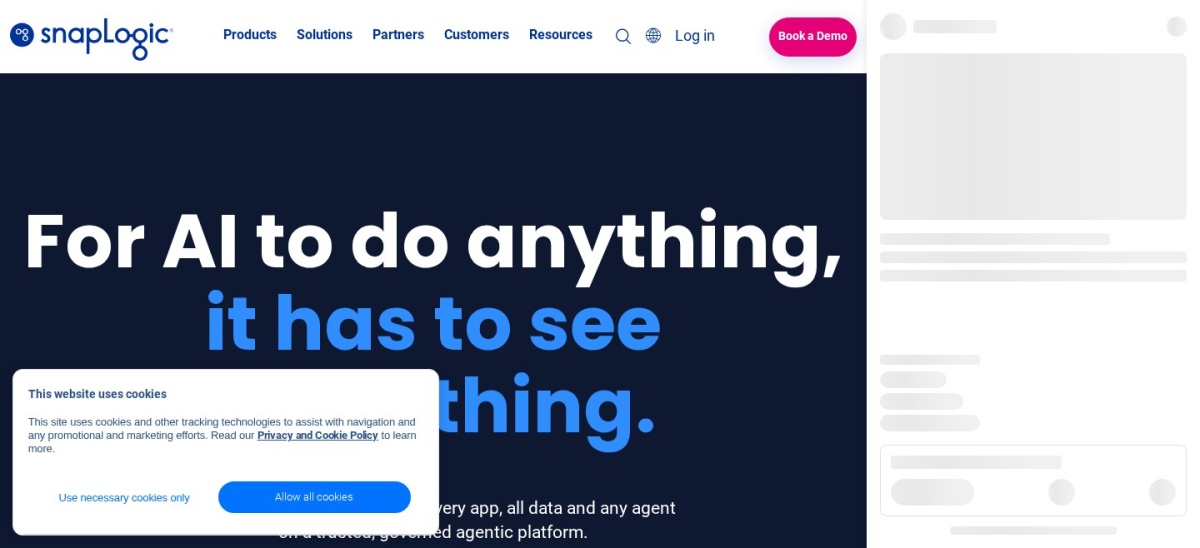
SnapLogic is a low-code integration platform that builds pipelines from prebuilt connectors called Snaps, with AI help for design and mapping. It covers data, application and API integration, and G2 lists its Basic plan at $9,995 a year.
The trade off is the entry price. At nearly $10,000 a year for Basic, it is priced for enterprises, and the vendor site itself gives no price list. It suits large teams that want business users building integrations without code.
Stitch is a simple ELT service from Qlik that replicates data from 130+ sources into a warehouse. Standard starts at $100 a month for 5 million rows, with 10 standard sources, one destination and five users, and every plan includes a 14-day trial.
The trade off is the jump to Advanced. The next tier is $1,500 a month billed annually, a steep rise from Standard, and Stitch has no free plan. It suits small teams with a handful of sources that want predictable row-based pricing.
Integrate.io is a low-code data pipeline platform with one flat fee: Core costs $1,999 a month billed annually for unlimited data volumes, pipelines, connectors and users. Pipelines can run every 60 seconds, and the platform covers ETL, ELT, CDC and reverse ETL.
The trade off is the single price. There is no cheaper tier for light use, and security extras such as role-based access and HIPAA readiness are quoted add-ons. It suits teams with heavy, steady volume that want a bill that never moves with usage.
Most tools in this list bill by usage. Fivetran counts monthly active rows, Airbyte counts credits, Hevo counts events and Matillion counts credits, so the same workload can cost very different amounts on each.
Flat-fee tools remove the surprise. Integrate.io charges $1,999 a month whatever the volume, and Stitch charges by row tiers from $100 a month.
Quote-only tools need a sales call. Informatica, Talend and Matillion publish no dollar prices, so ask for a written quote at your expected volume before you compare them with the priced tools.
How we chose
We started from the best-known data integration platforms on G2, then kept nine that cover managed ELT, open-source ELT and enterprise integration.
Prices come from each vendor's pricing page, checked on 24 November 2026. Ratings and review counts come from G2 on the same day. Where a vendor shows a sale, the list shows the regular price.
We left out tools that only do transformation or only move data between SaaS apps. No vendor paid for a place, and we do not claim hands-on testing for this list.
How to choose a big data integration platform
Start with your sources and your volume, then match the pricing model to both.
List every source you must connect. Check the connector list for each one. A tool with 700 connectors still fails if your legacy database is missing.
Estimate your monthly volume. Count rows, events or gigabytes for a typical month, then price that volume on each tool. Usage-based bills move with volume.
Decide who builds the pipelines. No-code tools suit analysts, while open-source and warehouse-first tools need data engineers to run them.
Check governance needs early. If you need data quality checks, lineage or role-based access, shortlist the enterprise tools first, since loaders add those late or not at all.
FAQ
What is the best big data integration platform?
Fivetran is the best pick for most teams. It has 700+ managed connectors, a free plan to 500,000 monthly active rows, 15-minute syncs on Standard and a 4.3 out of 5 G2 rating from 841 reviews.
What is the cheapest big data integration platform?
Airbyte is the cheapest way in. Its Core edition is free to self-host, and Airbyte Cloud starts at $20 a month. Fivetran also has a free plan to 500,000 monthly active rows, and Stitch starts at $100 a month.
What is the difference between ETL and ELT?
ETL transforms data before loading it into the warehouse, while ELT loads raw data first and transforms it inside the warehouse. Most tools in this list do ELT, which suits cloud warehouses, while Talend and Matillion cover both patterns.
Do I need an enterprise platform like Informatica?
Only if you need governance, data quality and master data management beside integration. Smaller teams get by with Fivetran, Airbyte or Hevo. Pick Informatica or Talend when compliance, stewardship and lineage are requirements, not nice extras.
How much does Fivetran cost?
Fivetran bills by monthly active rows, with a $5 base charge per connection, so there is no single monthly price. The free plan covers 500,000 monthly active rows, and annual contracts save up to 22% on the standard rates.
Can I self-host a data integration platform?
Yes, with Airbyte Core, which is free to self-host under the Elastic License 2.0. Talend and Matillion also support hybrid deployment, with part of the platform running in your own environment. The other tools in this list are cloud-only.
Which platform is best for small teams?
Stitch and Airbyte suit small teams best. Stitch starts at $100 a month for 5 million rows with a simple setup, while Airbyte Cloud starts at $20 a month and Core is free to self-host. Both keep the bill low at small volumes.
SaaS SEO and WordPress specialist with about 8 years of experience. Rakib compares WordPress plugins, themes, hosting and software using public pricing, documentation and user reviews. See how we rank.