Best B2B Ecommerce Platforms in 2026: 7 Tools Compared
WLWPLegible EditorsLast verified 22 Nov 2026How we rank9 min read
★ Short answer
Shopify is the best B2B ecommerce platform for most businesses, offering up to 3 B2B catalogs on its $29-per-month Basic plan with annual billing. BigCommerce suits businesses requiring more advanced commerce infrastructure, while Zoey is designed specifically for wholesale distributors and manufacturers.
How we make this list: we compare pricing pages, product documentation and public user reviews, then re-check every price before each update. No product paid for a place. Disclosure.
Shopify Basic costs $348 per year and includes up to 3 B2B catalogs without requiring Shopify Plus.
BigCommerce Core starts at $348 per year, but native customer-specific price lists require Performance, starting at $1,499 per month.
Zoey Starter starts at $600 per month and includes 50 customer accounts and unlimited sales orders.
OroCommerce earns 4.3/5 from 37 G2 reviews and includes 25 administrative users with its enterprise license.
Sana Commerce earns 4.4/5 from 126 G2 reviews and focuses on ERP-connected manufacturing and distribution.
Adobe Commerce, OroCommerce, Sana Commerce and VTEX use custom pricing, so their subscription costs require individual quotations.
What to look for in a B2B ecommerce platform
B2B ecommerce platforms help manufacturers, distributors and wholesalers sell directly to business customers online. Unlike standard retail stores, they must accommodate negotiated prices, business accounts, purchase orders and more complicated ordering requirements.
Look for customer-specific pricing and catalog management. These features allow different buyers to see the products, discounts and payment terms associated with their commercial agreements.
Business buyers often purchase products in bulk or reorder previously purchased items. Quick order forms, saved shopping lists and repeat ordering can reduce the administrative work involved in processing wholesale transactions.
Integration with enterprise resource planning software is particularly important for distributors and manufacturers. Connected systems help maintain consistent inventory availability, customer records, negotiated prices and financial information.
Compare the cost of the subscription that actually includes your required wholesale features. Some platforms advertise inexpensive retail subscriptions but reserve advanced B2B functionality for enterprise plans.
For enterprise commerce and marketplace operations
Custom pricing
No free plan
4.5/5
Price ladder: cheapest paid plan per year
List prices, USD, checked Nov 2026
OroCommerceFREECustom
AdobeCustom
SanaCustom
VTEXCustom
Shopify$348
BigCommerce$348
Zoey$7,200
The 7 best B2B ecommerce platforms
01
Shopify
4.5/5on Capterra (6,764 reviews, checked Nov 2026)
Starts at$29/mo
Best for combined retail and wholesale ecommerce
Basic B2B catalogsUp to 3
Plus B2B catalogsUnlimited
HostingIncluded
Paid planBasic, annual billing
shopify.com
Shopify homepage, captured Nov 2026.
Shopify is a hosted ecommerce platform that supports retail and wholesale sales through a shared commerce system. Its Basic subscription now includes up to 3 B2B catalogs, unlimited products and support for 10 inventory locations, making basic wholesale functionality accessible without an enterprise subscription.
The trade off is that Basic costs $29 per month with annual billing, while unlimited B2B catalogs require Plus, starting at $2,300 per month. Shopify also advertises temporary introductory discounts. It suits businesses that want to operate retail and wholesale sales through the same platform without managing hosting independently.
What we like
B2B catalogs included on standard subscriptions
Affordable entry subscription for smaller businesses
Shared retail and wholesale commerce infrastructure
Large application and integration marketplace
Managed hosting and checkout
Watch out for
Standard plans limit B2B catalogs
Substantial price increase for Shopify Plus
Additional applications can increase operating costs
Plus adds unlimited B2B catalogs, advanced checkout customization and unlimited staff accounts.Visit shopify.com
02
BigCommerce
4.4/5on Capterra (341 reviews, checked Nov 2026)
Starts at$29/mo
Best for scalable wholesale commerce infrastructure
Entry annual sales allowance$30,000
Entry inventory locationsUp to 4
Native price listsPerformance
Paid planCore, annual billing
bigcommerce.com
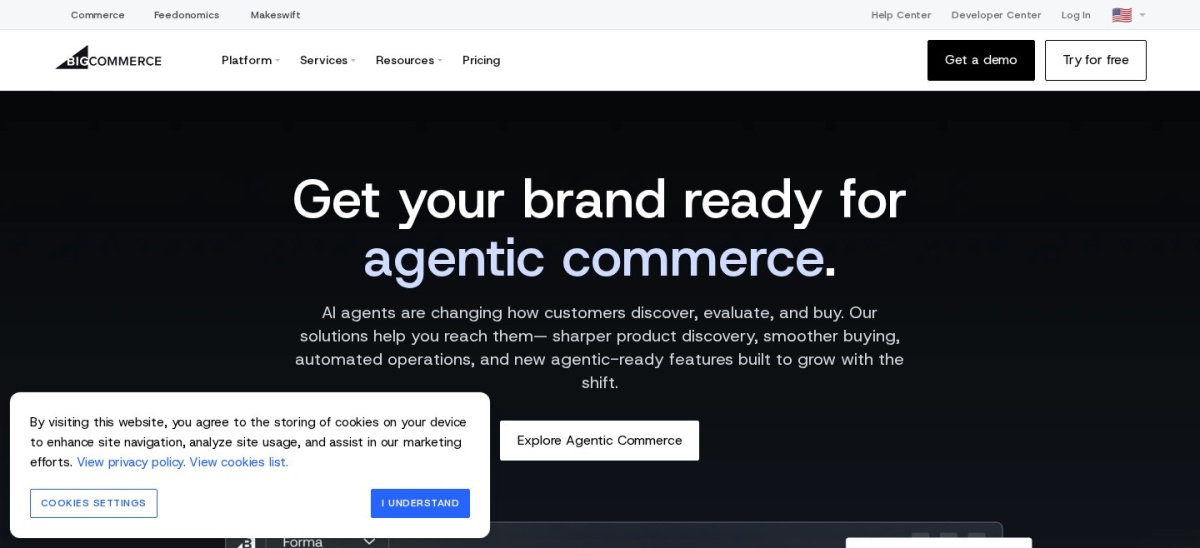
BigCommerce homepage, captured Nov 2026.
BigCommerce is a hosted ecommerce platform for retailers, manufacturers and wholesale distributors that need flexible storefronts and commerce integrations. Its Core subscription starts at $29 per month with annual billing, supporting up to 4 inventory locations and $30,000 in trailing annual sales.
The trade off is that advanced customer-specific price lists require Performance, starting at $1,499 per month with annual billing, rather than the $29 Core subscription. Temporary first-year promotions do not represent renewal pricing. It suits growing businesses that need flexible commerce infrastructure and can budget for advanced B2B functionality.
What we like
Supports retail and wholesale business models
Flexible storefront architecture
Product-level pricing for customer groups on Performance
Integration options for business management systems
Sales thresholds can trigger subscription upgrades
Certain payment providers incur additional platform fees
Performance introduces native price lists and advanced promotional management.Visit bigcommerce.com
03
Zoey
4.5/5on G2 (47 reviews, checked Nov 2026)
Starts at$600/mo
Best for wholesale distributors and sales representatives
Starter customer accounts50
Starter administrative licenses1
Sales ordersUnlimited
Paid planStarter
zoey.com
Zoey homepage, captured Nov 2026.
Zoey is a B2B commerce and order management platform built for manufacturers, wholesale distributors and sales representatives. Its Starter subscription includes 50 customer accounts, 1 administrative license, unlimited sales orders, CRM functionality and payment terms, with a choice between a storefront and mobile application.
The trade off is that Starter begins at $600 per month, and additional customer accounts and administrative licenses increase the cost. Annual contract prepayment can reduce the subscription by 6%. It suits wholesale businesses that want dedicated ordering and customer management functionality rather than adapting a general retail platform.
What we like
Designed specifically for wholesale operations
Unlimited sales orders
Built-in customer and order management
Supports payment terms
Accounting and shipping integrations
Watch out for
High starting price for small wholesalers
Entry subscription limits customer accounts
Starter requires choosing between storefront and mobile application
Higher subscriptions expand account capacity, automation and operational flexibility.Visit zoey.com
04
OroCommerce
4.3/5on G2 (37 reviews, checked Nov 2026)
PricingCustom pricing
Best for complex manufacturing and distribution workflows
Enterprise administrative users25
Customer account limitsUnlimited
Integrated CRMIncluded
Paid planEnterprise
oroinc.com
OroCommerce homepage, captured Nov 2026.
OroCommerce is a B2B ecommerce platform designed around complex catalogs, negotiated pricing, sales quotations and corporate account structures. Its enterprise license includes 25 administrative users, integrated CRM capabilities and support for multiple storefronts without additional per-storefront licensing charges.
The trade off is that Enterprise uses custom pricing based on merchandise volume, internal users and deployment requirements, while the open-source Community edition requires independent implementation. It suits manufacturers and distributors whose purchasing workflows, account structures and contractual pricing exceed the capabilities of ordinary retail platforms.
What we like
Native corporate account hierarchies
Configurable B2B pricing rules
Integrated quotation and CRM functionality
Flexible hosting and deployment options
No additional license charges for customer accounts
Enterprise adds commercial support and licensing for advanced B2B operations.Visit oroinc.com
05
Adobe Commerce
4.3/5on Capterra (662 reviews, checked Nov 2026)
PricingCustom pricing
Best for customized enterprise ecommerce
B2B company accountsSupported
DeploymentCloud service or managed infrastructure
Commerce modelsB2B and B2C
Paid planCustomized commercial package
business.adobe.com
Adobe Commerce homepage, captured Nov 2026.
Adobe Commerce is an enterprise ecommerce platform for organizations that need customized digital storefronts, complex product catalogs and business purchasing workflows. Its commercial offerings support retail and wholesale commerce, API-based extensions, third-party integrations and technical support available 24 hours a day.
The trade off is that Adobe Commerce uses custom pricing, and development, implementation and ongoing maintenance can add substantial costs beyond the commercial license. It suits established businesses with technical resources that need greater control over commerce architecture, customer experiences and business integrations.
More complex administration than simpler hosted platforms
Commercial packages provide enterprise commerce infrastructure, integrations and support.Visit business.adobe.com
06
Sana Commerce
4.4/5on G2 (126 reviews, checked Nov 2026)
PricingCustom pricing
Best for ERP-connected manufacturers and distributors
Native ERP integrationIncluded
Stock informationReal-time
Quote-to-order conversionPro
Paid planEssential
sana-commerce.com
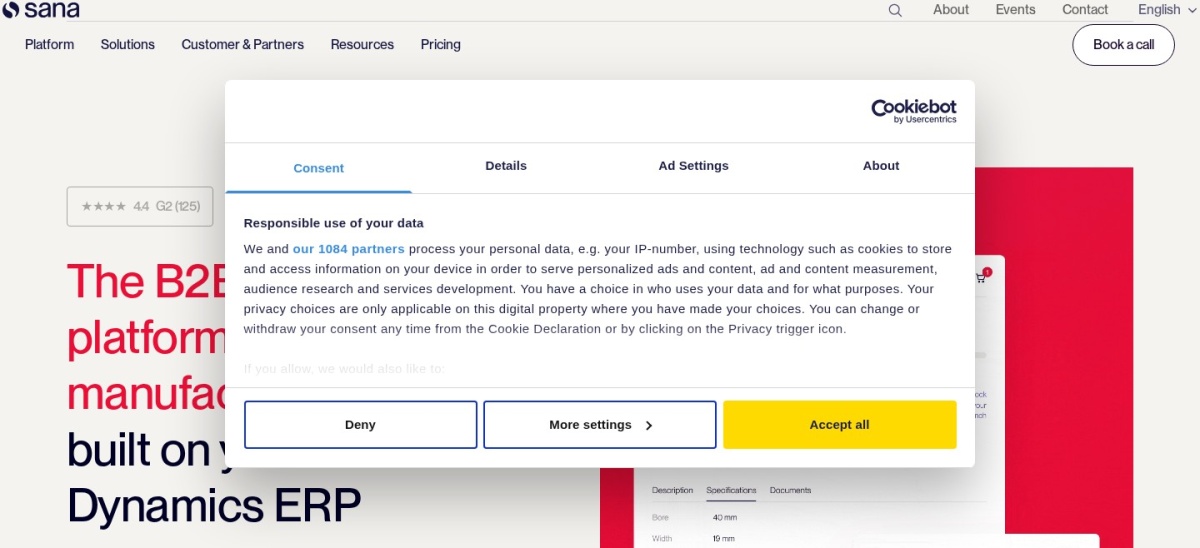
Sana Commerce homepage, captured Nov 2026.
Sana Commerce is an ERP-connected B2B ecommerce platform for manufacturers and wholesale distributors. Its Essential subscription includes native ERP connectivity, historical business documents, storefront design tools and real-time stock information, while its 3 subscription tiers accommodate increasingly complex business requirements.
The trade off is that Essential, Pro and Advanced use custom pricing, and supported ERP systems and purchasing functionality vary by subscription. Quote-to-order conversion requires Pro, while multi-account hierarchies require Advanced. It suits businesses that want their ecommerce storefront to reflect existing ERP data and commercial processes.
Pro adds quote conversion and customer segmentation, while Advanced expands enterprise controls.Visit sana-commerce.com
07
VTEX
4.5/5on G2 (37 reviews, checked Nov 2026)
PricingCustom pricing
Best for enterprise commerce and marketplace operations
B2B commerceSupported
Order managementIntegrated
Marketplace functionalityAvailable
Paid planEnterprise quotation
vtex.com
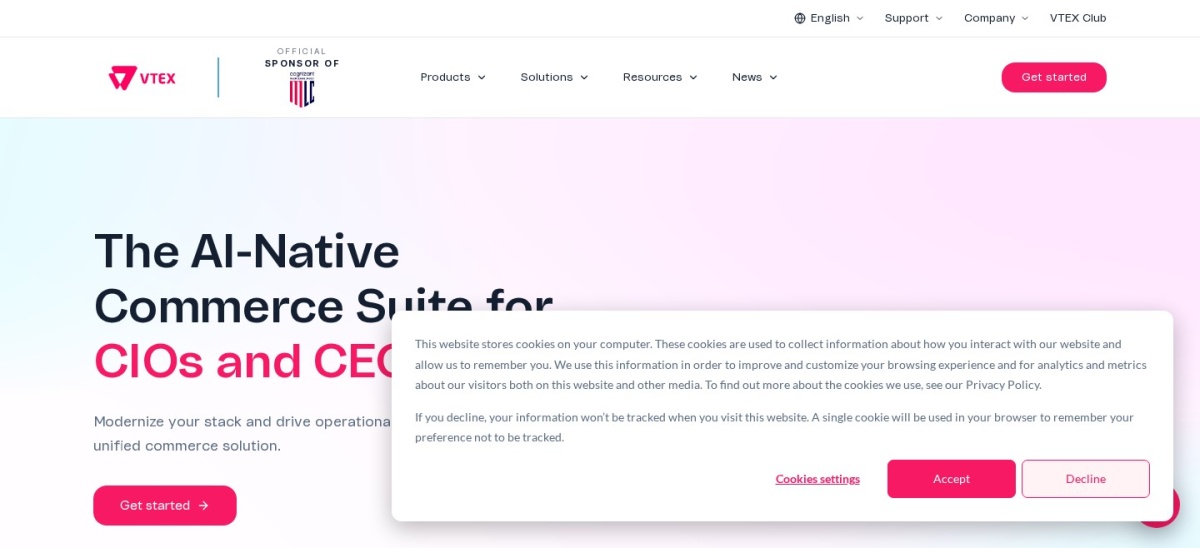
VTEX homepage, captured Nov 2026.
VTEX is a cloud commerce platform that combines storefronts, order management and marketplace functionality for enterprise businesses. Rated 4.5/5 across 37 G2 reviews, it supports wholesale commerce alongside direct-to-consumer sales, retail operations and marketplace business models.
The trade off is that VTEX uses custom pricing and requires businesses to discuss commercial requirements before obtaining a subscription estimate, with implementation costs depending on operational complexity. It suits enterprises that want to coordinate wholesale orders, multiple sales channels and marketplace operations through shared commerce infrastructure.
What we like
Combines B2B and retail commerce
Integrated order management functionality
Supports marketplace business models
Flexible storefront and integration architecture
Designed for complex enterprise operations
Watch out for
Public subscription pricing is unavailable
Implementation can require specialist assistance
May be excessive for smaller wholesale businesses
Commercial licensing provides integrated commerce, order management and marketplace capabilities.Visit vtex.com
How much does a B2B ecommerce platform cost?
Shopify and BigCommerce have published regular entry prices of $348 per year with annual billing. However, these subscriptions provide different levels of wholesale functionality and should not be treated as equivalent B2B packages.
Shopify includes up to 3 B2B catalogs on Basic, while BigCommerce reserves native customer-specific price lists for Performance, starting at $17,988 per year. Shopify Plus starts at $27,600 per year and removes the standard B2B catalog restriction.
Zoey Starter starts at $7,200 per year before its available annual prepayment discount. Its subscription includes dedicated wholesale ordering and customer management features that general ecommerce platforms may reserve for higher tiers.
OroCommerce, Adobe Commerce, Sana Commerce and VTEX require custom quotations. Their annualized pricing fields use zero as a technical placeholder for unpublished prices, not as an indication that their commercial subscriptions are free.
Budget separately for implementation, ERP integration, product migration, additional applications and ongoing maintenance. These expenses can significantly affect the overall cost of an enterprise B2B storefront.
What is the difference between B2B and B2C ecommerce platforms?
B2C ecommerce platforms primarily serve individual shoppers purchasing products for personal use. Their storefronts generally emphasize product discovery, straightforward checkout, promotions and immediate payment.
B2B ecommerce platforms accommodate commercial purchasing relationships. Customers may have negotiated prices, restricted product catalogs, purchasing approval requirements, credit arrangements and payment deadlines established through contracts.
Business customers also need efficient ordering tools for large or repeat purchases. Features such as bulk order forms, saved purchase histories, quotations and purchase order processing are therefore more important than they are in typical retail stores.
Businesses selling to both customer types should consider platforms that share inventory and product information while maintaining separate pricing, catalog visibility and purchasing rules. Shopify, BigCommerce, Adobe Commerce and VTEX support combined commerce models.
How we chose
We selected established B2B ecommerce platforms from Capterra and G2, then compared official vendor pricing, subscription details and product documentation. Selection focused on wholesale ordering, customer catalogs, commercial pricing, account management and integration capabilities.
The editorial verification date is 22 Nov 2026. Vendor pricing pages, public ratings and review counts were accessed on 24 Nov 2026. We used regular published entry prices rather than introductory promotions and identified features that require higher subscriptions. Custom prices are explicitly distinguished from free plans.
We excluded standalone payment processors, shipping applications and products without sufficient evidence of B2B commerce functionality or established public reviews. Rankings prioritize practical purchasing requirements, pricing transparency and business suitability rather than review scores alone. No vendor paid for a place, and we do not claim testing for this list.
How to choose the best B2B ecommerce platform
Evaluate your wholesale purchasing requirements before comparing platform subscriptions, integrations and implementation costs.
Define your customer pricing and ordering requirements. Identify whether customers need individual price lists, volume discounts, restricted catalogs, purchase orders or negotiated payment terms. Confirm that your intended subscription supports these requirements without relying on extensive additional development.
Review your existing business software. Document your ERP, accounting, inventory and customer management systems. Check available integrations and establish how product data, inventory levels, customer prices and sales orders will move between applications.
Calculate the complete cost of ownership. Compare regular subscription prices, implementation estimates, integration charges and potential transaction fees. Request detailed quotations from enterprise vendors and clarify how costs change as revenue, customer accounts or administrative users increase.
Evaluate the business purchasing experience. Review how buyers create accounts, access negotiated catalogs, submit orders, request quotations and reorder products. Ask potential vendors to demonstrate these workflows using examples that reflect your actual business requirements.
FAQ
What is the best B2B ecommerce platform?
Shopify is our top pick for businesses combining retail and wholesale sales because its Basic plan includes B2B catalogs at an accessible price. BigCommerce offers flexible commerce infrastructure, while Zoey provides dedicated ordering and account management for wholesale distributors.
What is a B2B ecommerce platform?
A B2B ecommerce platform is software that enables businesses to sell products or services online to other businesses. It typically supports commercial customer accounts, negotiated pricing, wholesale catalogs, bulk ordering, quotations and integrations with existing business management systems.
What is the cheapest B2B ecommerce platform?
Shopify Basic and BigCommerce Core have the lowest published paid entry prices in this comparison, both starting at $348 per year with annual billing. However, Shopify includes limited B2B catalogs, while advanced BigCommerce price lists require Performance.
Is Shopify suitable for B2B ecommerce?
Yes. Shopify now includes up to 3 B2B catalogs on Basic, Grow and Advanced subscriptions. Businesses requiring unlimited catalogs and more advanced enterprise commerce functionality can upgrade to Shopify Plus, which starts at $2,300 per month.
Which B2B ecommerce platform is best for manufacturers?
OroCommerce and Sana Commerce are particularly suitable for manufacturers with complicated ordering requirements. OroCommerce emphasizes configurable pricing and corporate account structures, while Sana Commerce focuses on connecting customer-facing storefronts with existing ERP systems and real-time business information.
Can a B2B ecommerce platform integrate with ERP software?
Yes. Many B2B ecommerce platforms support ERP integration through native connectors, third-party applications or APIs. Sana Commerce focuses specifically on ERP-connected operations, while OroCommerce, Shopify, BigCommerce, Zoey, Adobe Commerce and VTEX offer different integration approaches.
Is there a free B2B ecommerce platform?
OroCommerce offers an open-source Community edition that can be deployed without purchasing its enterprise license. However, hosting, development, implementation and ongoing maintenance still create costs, and commercial support or advanced enterprise requirements may require a paid agreement.
Can businesses sell B2B and B2C products on the same platform?
Yes. Shopify, BigCommerce, Adobe Commerce and VTEX support both business and consumer commerce. Businesses should confirm that their selected subscription can maintain separate customer pricing, catalog visibility, payment rules and account permissions while sharing relevant product and inventory information.
What features are essential for wholesale ecommerce?
Essential features include business customer accounts, customer-specific prices, bulk ordering, repeat purchases, inventory visibility and commercial payment terms. Manufacturers and distributors may also require quotation management, purchasing approvals, purchase order processing and integration with existing ERP systems.