Intruder is the best automated penetration testing tool for most teams, rated 4.8 out of 5 on G2 from 209 reviews, with continuous scanning and a free plan. Pick Burp Suite Professional for manual web app work at $449 a year, and Astra when you want automated scans plus a human pentest.
How we make this list: we compare pricing pages, product documentation and public user reviews, then re-check every price before each update. No product paid for a place. Disclosure.
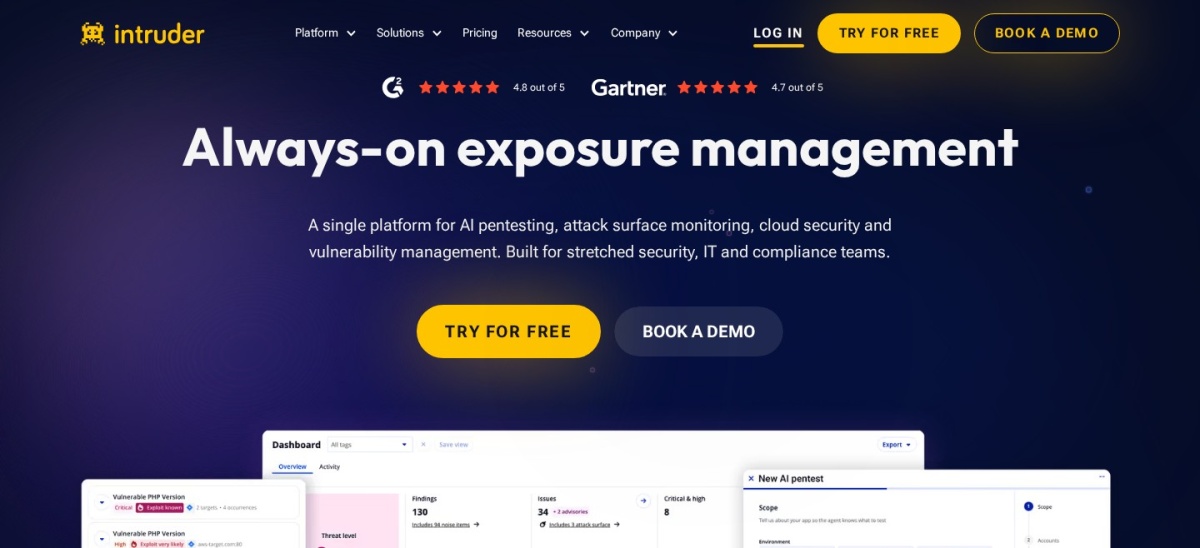
Intruder leads at 4.8/5 on G2, with continuous scanning, cloud integrations and a free plan.
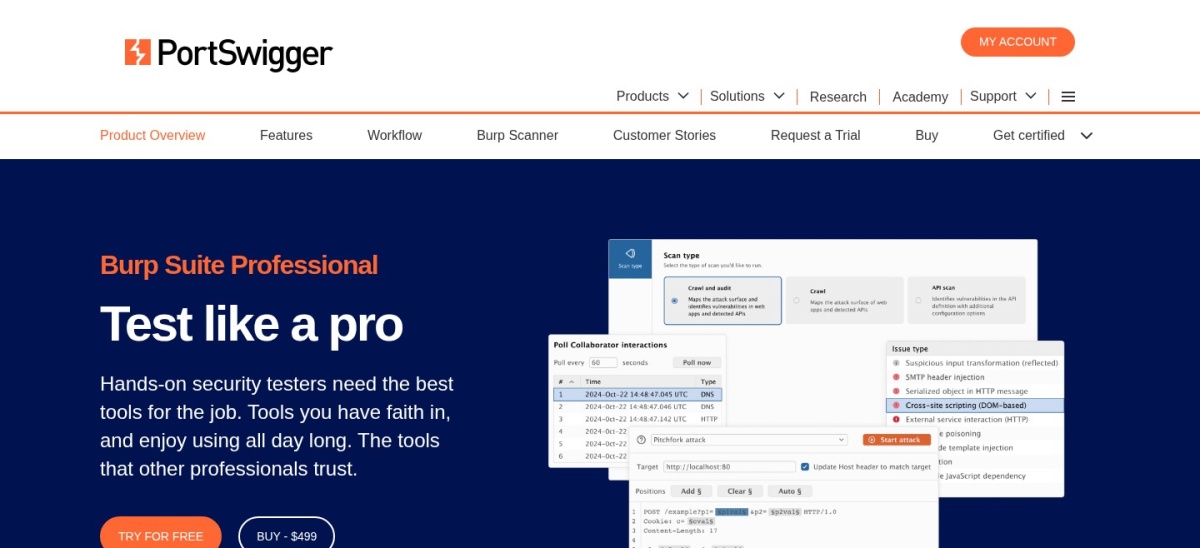
Burp Suite Professional costs $449 a year per user and is the standard toolkit for web app pentesters.
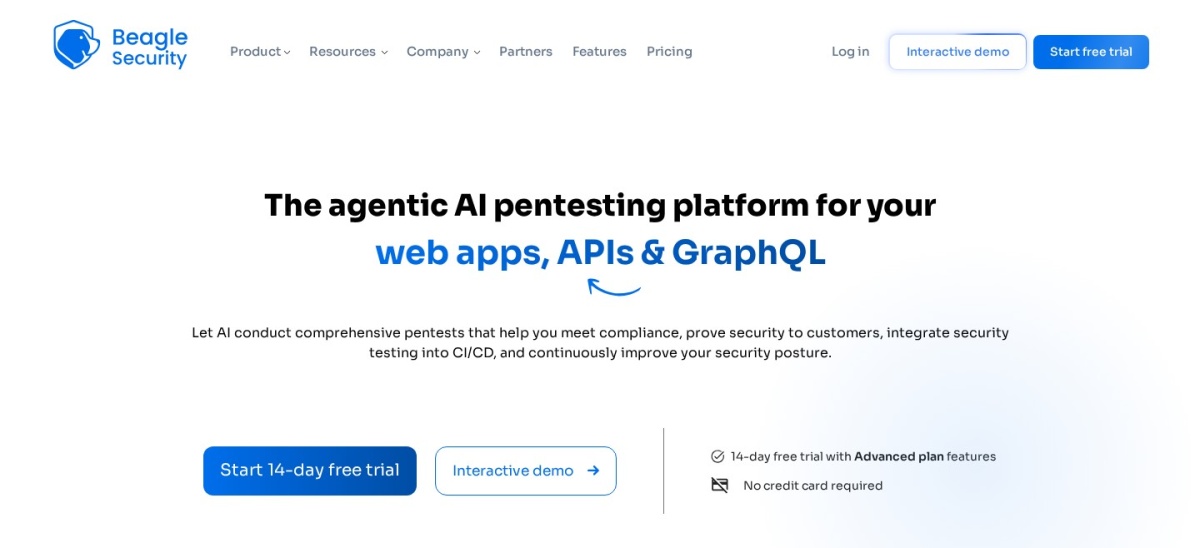
Beagle Security starts at $99 a month and runs AI-led pentests for web apps, APIs and GraphQL.
Astra pairs automated scans from $699 a year with human pentests from $2,999 per pentest.
Cobalt and Acunetix price per test, at $3,500 and up to $500 respectively, so costs rise with each engagement.
What automated penetration testing should cover
Automated penetration testing scans your systems the way an attacker would, then shows which flaws are actually exploitable. It runs far more often than a yearly manual pentest, so new flaws surface soon after they appear.
A good tool should cover web apps, APIs and infrastructure, rank findings by real risk, and give clear fix steps. Our guide on checking a plugin for vulnerabilities shows how the same ranking idea applies on a smaller scale.
Some tools in this list are scanners with pentest-style reporting, while others add human testers or autonomous agents that chain flaws into attack paths. Match the depth to your risk: a small web app needs different coverage from a large internal network.
Prices vary widely because vendors charge per target, per asset, per user or per test. Read the pricing basis before you compare headline figures.
Intruder is a cloud platform for continuous vulnerability scanning across infrastructure, web apps, APIs and cloud accounts. The free plan covers basic scanning, while paid plans add scheduled scans, compliance reporting, integrations with Jira and GitHub, and an AI pentest for web apps.
The trade off is pricing. Cloud and Pro use a base fee plus a small fee per target, so the bill grows as you add targets, and internal scanning needs the Pro plan at $499 a month. It suits lean teams that want set-and-forget scanning without a dedicated security hire.
What we like
Highest G2 rating in this list at 4.8 out of 5
Free plan and 14-day trial of the Cloud plan
Cloud integrations discover new services automatically
Compliance reports for SOC 2, ISO 27001 and Cyber Essentials
Burp Suite Professional homepage, captured Nov 2026.
Burp Suite Professional is the web application security testing platform from PortSwigger, built around its intercepting proxy. Professional adds the automated scanner, unrestricted Intruder, project saving and AI features to the free Community Edition, and the BApp store adds more than 300 extensions.
The trade off is that it is a toolkit, not a managed service. You run the tests yourself, schedule your own scans and write your own reports, and the $449 price is per user per year. It suits working pentesters and bug bounty hunters who want full control.
Beagle Security is an AI-led penetration testing platform for web applications, APIs and GraphQL. Its AI is trained on more than 350,000 penetration test workflows, and it runs scheduled tests, filters false positives, and pushes findings to Jira, Azure Boards and Slack with fix steps.
The trade off is scope. Essential at $99 a month billed yearly covers 2 tests a month, so teams that test often need Advanced at $299 a month. It suits development teams that want pentest-style reports inside their release cycle without hiring an agency.
Astra Security is a penetration testing platform that pairs an automated DAST scanner with human pentests by certified experts. Scanner Lite costs $69 a month or $699 a year for one target with 3 scans a month, and the scanner runs more than 10,000 tests with AI help for fixes.
The trade off is per-target pricing. Each web app, API or mobile app counts as a target, so the bill climbs with every extra app, and the human pentest starts at $2,999 per pentest. It suits small teams that want a published pentest certificate for compliance.
NodeZero by Horizon3 is an autonomous penetration testing platform that runs real attacks across internal networks, cloud, identity and web apps. It chains weaknesses into proven attack paths, ranks fixes by impact, and re-runs tests to confirm each fix, with no agents to install.
The trade off is the pricing basis. Core costs $50 per asset per year, so the total depends on how many servers, workstations and devices you count, and web app pentesting is priced separately. It suits larger teams that need proof of exploitability, not just a list of flaws.
What we like
Proves which flaws are actually exploitable
Runs safely in production with no agents
Rated 4.7 out of 5 on G2
Used by more than 7,000 customers
Watch out for
Per-asset pricing is hard to budget without a count
No free plan or self-serve trial
Web app testing costs extra
Pro and Elite add more coverage at $65 and $85 per asset per yearVisit horizon3ai.com
06
Cobalt
4.5/5on G2 (178 reviews, checked Nov 2026)
Starts at$3,500/test
Best for on-demand human pentests
Human pentesters500+ vetted experts
Autonomous pentest$3,500 per test
FindingsWithin 24 hours
Paid planCredit packages, quote
cobalt.io
Cobalt homepage, captured Nov 2026.
Cobalt is a penetration testing as a service platform that pairs a workflow dashboard with a network of more than 500 vetted human pentesters. Its Autonomous Pentest costs $3,500 per web application test, with findings in 24 hours and human oversight, while human-led tests run on annual credit packages.
The trade off is cost and complexity. The $3,500 autonomous price is a limited offer for tests finished before 31 December 2026, and credit pricing can be hard to estimate for a new scope. It suits teams that need auditor-ready human pentests on demand.
Tenable Nessus Professional homepage, captured Nov 2026.
Tenable Nessus Professional is a vulnerability scanner for computers, servers and network gear, with more than 336,000 CVE checks and real-time plugin updates. Nessus Essentials is free for up to 16 IPs, while Professional scans unlimited IPs with pre-built policies for configuration and compliance audits.
The trade off is that it is a scanner, not a pentest platform. It finds known flaws and ranks them, but it does not chain them into attack paths or provide human testers, and there is no central dashboard on Professional alone. It suits consultants and small teams that scan their own networks.
What we like
Deepest CVE coverage in this list
Free Essentials edition for 16 IPs
Rated 4.5 out of 5 on G2 from 304 reviews
Unlimited assessments on Professional
Watch out for
No central dashboard or multi-user roles
No human pentesting included
Highest yearly price in this list
Nessus Expert adds external attack surface scanning at $6,790 a yearVisit tenable.com
08
Probely
4.7/5on G2 (19 reviews, checked Nov 2026)
Paid from$49/mo
Best budget scanner for agile teams
Web and API scanningYes
OWASP Top 10Yes
Free planLite, free
Paid planStarter, $49/mo
probely.com
Probely homepage, captured Nov 2026.
Probely is a web vulnerability scanner built for agile teams, with continuous scanning of web applications and APIs. It covers the OWASP Top 10 and thousands of further checks, maps findings to PCI DSS, ISO 27001, HIPAA and GDPR, and offers a free Lite plan plus a 14-day trial on paid plans.
The trade off is depth. Probely is a scanner with a fix workflow, not a full pentest service, so it will not find business logic flaws the way a human tester would. It suits small development teams that want developers to handle most fixes without waiting on a security team.
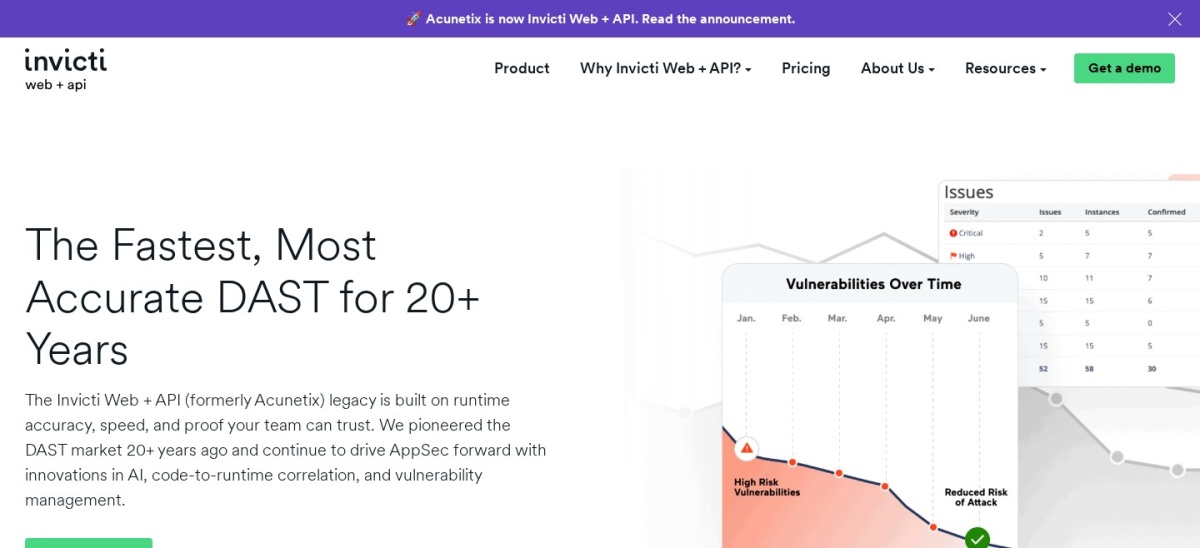
Acunetix, now sold as Invicti Web + API, is a dynamic application security testing scanner for web applications and APIs. Its proof-based scanning confirms which flaws are exploitable, and AcuSensor adds code-level detail for supported languages during authenticated scans of single-page apps and APIs.
The trade off is price transparency. The main subscription is quote-based with per-target licensing in bundles of 5, 10 or 20, and only the Agentic Pentest carries a published price of up to $500 per pentest. It suits mid-market teams that want proof-based findings at scale.
Automated tools are fast at finding known flaws, misconfigurations and common injection issues. They run on a schedule and catch regressions soon after a release.
They miss business logic flaws, such as a user seeing another account's data, because those need a human to understand how the app should work. Our guide on common WordPress vulnerabilities lists the flaw types scanners do catch well.
Use automation for continuous coverage and a human pentest once or twice a year for depth. That mix gives you both speed and judgement.
How we chose
We started from the best-known automated pentest and DAST tools, then kept those with published prices or a published per-test price, a public rating, and an active product page.
Prices come from each vendor's pricing page or provider-supplied G2 pricing, checked on 24 November 2026. Ratings come from G2 on the same day. Where a vendor shows a sale, the list shows the regular price.
We left out tools with no published price and no public rating. No vendor paid for a place, and we do not claim hands-on testing for this list.
How to choose an automated penetration testing tool
Start with what you need to test, then match the pricing basis to your estate.
List what you need to test. Web apps, APIs, internal networks and cloud accounts need different coverage, and not every tool covers all four.
Check how the vendor charges. Per-target, per-asset, per-user and per-test pricing look alike until you count your estate, so get a total before you buy.
Run a trial on a real app. A trial on a staging copy shows scan quality, false positives and report detail far better than a sales demo.
Plan the human pentest too. Automation covers known flaws, so book a human test once or twice a year for business logic and access control.
FAQ
What is the best automated penetration testing tool?
Intruder is the best pick for most teams, rated 4.8 out of 5 on G2 from 209 reviews, with continuous scanning and a free plan. Burp Suite Professional is better for manual web app work, and Astra adds a human pentest option.
What is the difference between automated and manual penetration testing?
Automated testing uses software to scan for known flaws on a schedule, so it is fast and repeatable. Manual testing uses a human expert who thinks like an attacker and finds business logic flaws that scanners miss.
How much does automated penetration testing cost?
Prices in this list run from $49 a month for Probely to $4,790 a year for Nessus Professional, with per-test options from $500 to $3,500. Per-target and per-asset pricing means the total depends on how much you scan.
Can automated penetration testing replace a human pentest?
No. Automation finds known flaws quickly and often, but it cannot judge business logic or access control the way a human can. Most teams use automation for continuous coverage and a human pentest once or twice a year.
Is there a free automated penetration testing tool?
Yes. Intruder, Nessus Essentials and Probely Lite all have free plans, and Burp Suite has a free Community Edition. Free plans cover basic scanning, while paid plans add scheduled scans, reporting and more targets.
Which tool is best for web applications and APIs?
Beagle Security and Astra are strong for web apps and APIs, with AI-led or hybrid testing and compliance reports. Burp Suite Professional is the best choice when a human tester runs the web app test by hand.
SaaS SEO and WordPress specialist with about 8 years of experience. Rakib compares WordPress plugins, themes, hosting and software using public pricing, documentation and user reviews. See how we rank.