Best Attack Surface Management Tools in 2026: 9 Tools Compared
WLWPLegible EditorsLast verified 22 Nov 2026How we rank12 min read
★ Short answer
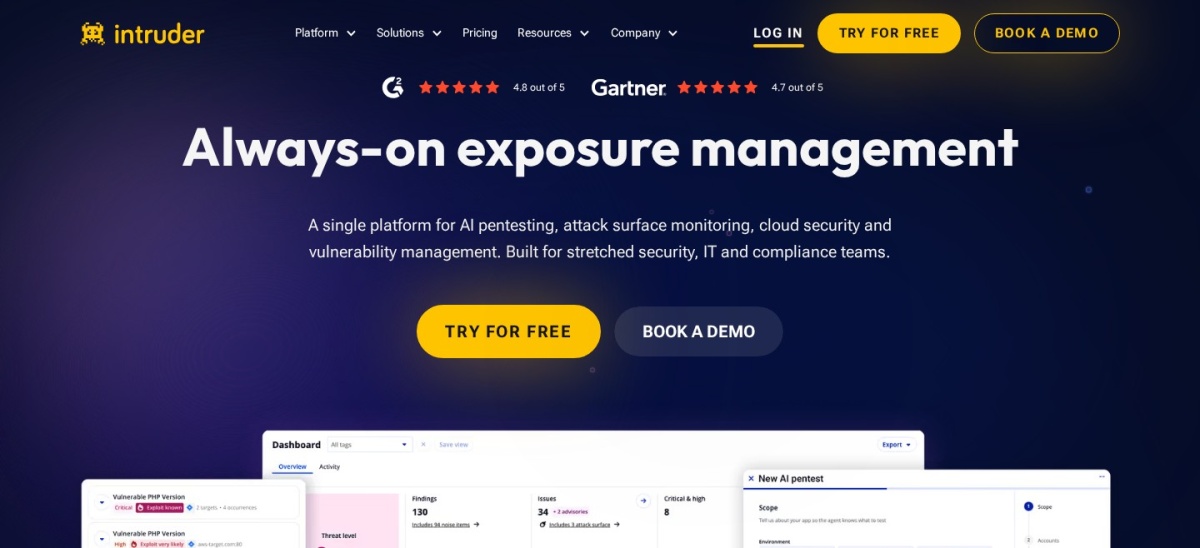
Intruder is the best attack surface management tool here, rated 4.8 out of 5 on G2 from 223 reviews, with a free plan and more than 11,000 vulnerability checks. Censys matches its score from only 3 reviews, and Halo Security is the best-priced option at $399 a month.
How we make this list: we compare pricing pages, product documentation and public user reviews, then re-check every price before each update. No product paid for a place. Disclosure.
Intruder leads at 4.8 out of 5 on G2 from 223 reviews, with a free plan and more than 11,000 vulnerability checks.
Censys matches that 4.8 score, but from only 3 G2 reviews, so treat its ranking with care.
Six of the nine tools publish no price and quote per company, including CyCognito, Bitsight and Mandiant.
Halo Security Platform publishes its price at $399 a month, covering 25 targets.
Microsoft Defender EASM is metered at $0.011 per billable asset per day, the cheapest route for a small estate.
What attack surface management covers
Attack surface management means finding everything connected to your company on the internet, then ranking what an attacker could actually use. That includes forgotten subdomains, exposed cloud storage, weak TLS and leaked credentials.
Most tools in this market are built for large security teams and priced by quote, not by a public price list. Only three of the nine below publish a usable price, and one of those is metered by asset.
Ratings here come from two different reviewer pools, G2 and Gartner Peer Insights, so do not compare them as if they were the same survey. A 4.8 from 3 reviews and a 4.8 from 223 reviews are very different claims.
Intruder is a vulnerability scanner and attack surface management tool for lean teams. Its free plan covers basic scanning, Cloud adds checks of connected cloud accounts every 2 hours for new hosts, and the platform runs more than 11,000 vulnerability checks.
The trade off is price transparency. Intruder's own pricing page quotes a base fee plus a per-target fee with no amounts shown, while G2 lists Cloud from $299 a month. It suits small security teams that want a clear scanner with a free plan.
Censys is an attack surface management tool built on its own internet scanning. It scans all 65,000 ports, starts discovery from seeds you supply, then expands to assets it finds itself, and scores risk with EPSS and CISA KEV data.
The trade off is the thin review base. Its 4.8 out of 5 on G2 rests on only 3 reviews, and the ASM product is quote-only, with no published price. It suits teams that want internet-wide discovery and already trust Censys data.
What we like
Scans all 65,000 ports from its own data
Risk scoring uses EPSS and CISA KEV
Integrates with Jira, ServiceNow and Sentinel
Watch out for
4.8 score rests on only 3 G2 reviews
ASM product is quote-only, no published price
Free tier covers the search platform, not ASM
ASM plans are quote-only; platform Starter is $79 a monthVisit censys.com
03
CrowdStrike Falcon Surface
4.6/5on Gartner Peer Insights (102 reviews, checked Nov 2026)
PricingCustom/yr
Best for CrowdStrike customers
Cheapest paid planQuote only
Rating sourceGartner, 102 reviews
CoverageInternal + external exposures
Free trial15 days
crowdstrike.com
CrowdStrike Falcon Surface homepage, captured Nov 2026.
CrowdStrike Falcon Surface is the exposure management module of the Falcon platform. It scans the internet continuously with an attacker-eye view, holds internal and external exposures in one dashboard, and prioritises them with adversary intelligence.
The trade off is that it is quote-only and tied to Falcon. Surface is priced on top of Falcon bundles, so a team without Falcon faces two buying decisions, not one. It suits teams already running CrowdStrike.
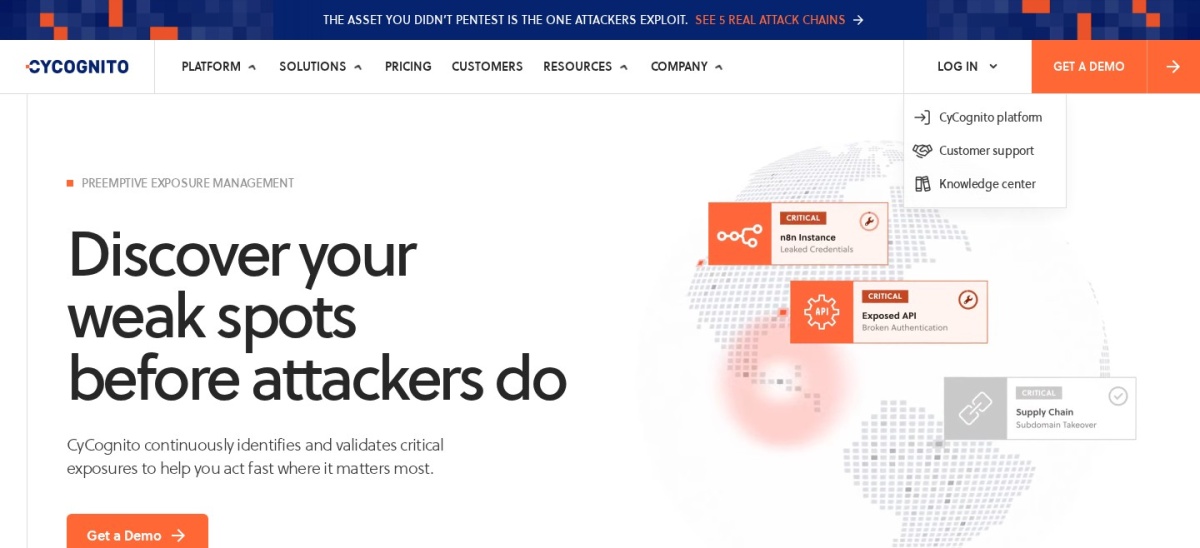
CyCognito is an attack surface management platform that maps a company's internet footprint from its name alone, with no IP ranges or asset lists needed. It finds forgotten subdomains, shadow cloud and subsidiary assets, then attributes each one to its owner for remediation.
The trade off is price and proof. Pricing is quoted by asset volume with no public numbers, and the G2 rating rests on only 5 reviews. It suits large firms with sprawling subsidiaries and acquired infrastructure.
What we like
Seedless discovery needs only the company name
Owner routing sends findings to the right team
Validates which exposures are actually exploitable
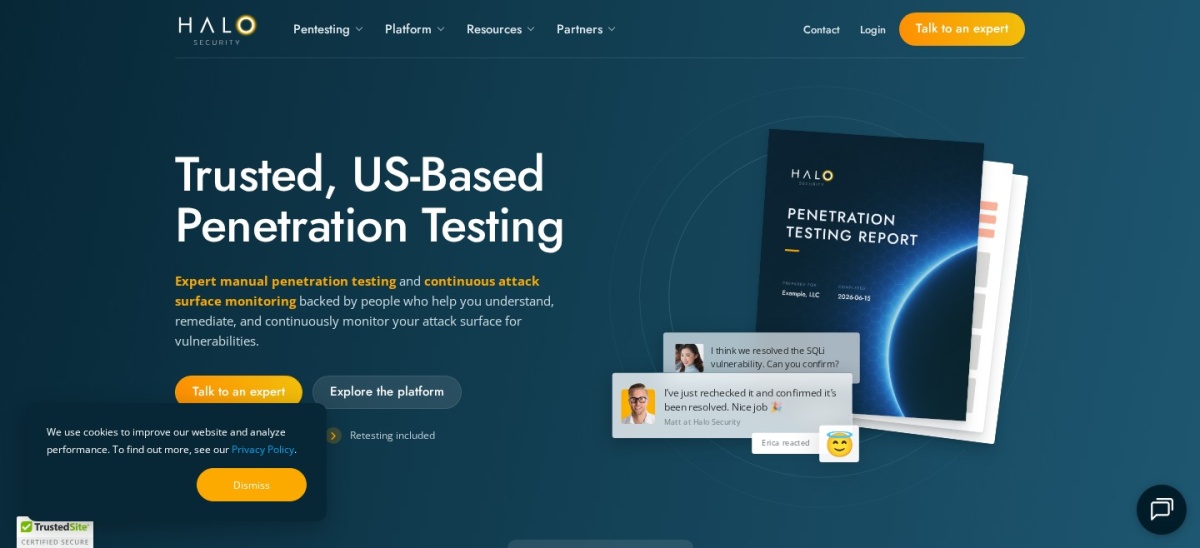
Halo Security is an external attack surface management platform for lean security teams, combining outside-in discovery, continuous monitoring and prioritised findings in one dashboard. The Platform plan starts at $399 a month for 25 targets, with PCI compliance reporting included.
The trade off is depth and metering. Application scanning costs extra per target, and reviewers note a learning curve and manual PCI report cycles. It suits mid-market teams that want priced EASM without an enterprise sales process.
What we like
Published $399 a month pricing for 25 targets
PCI compliance reporting included in the plan
Free trial covers 100 targets with no card
4.5 out of 5 on G2 from 56 reviews
Watch out for
Application scanning is $60 extra per target a month
Bitsight is a security ratings platform with an exposure management module. It scans from outside your network, rates companies on a 300 to 820 scale updated daily, and maps internet-facing assets and vulnerabilities.
The trade off is price transparency. Bitsight publishes no price list and sells packages on request, though it offers a free risk report for your own organisation. It suits teams that want a rated view of themselves and their vendors.
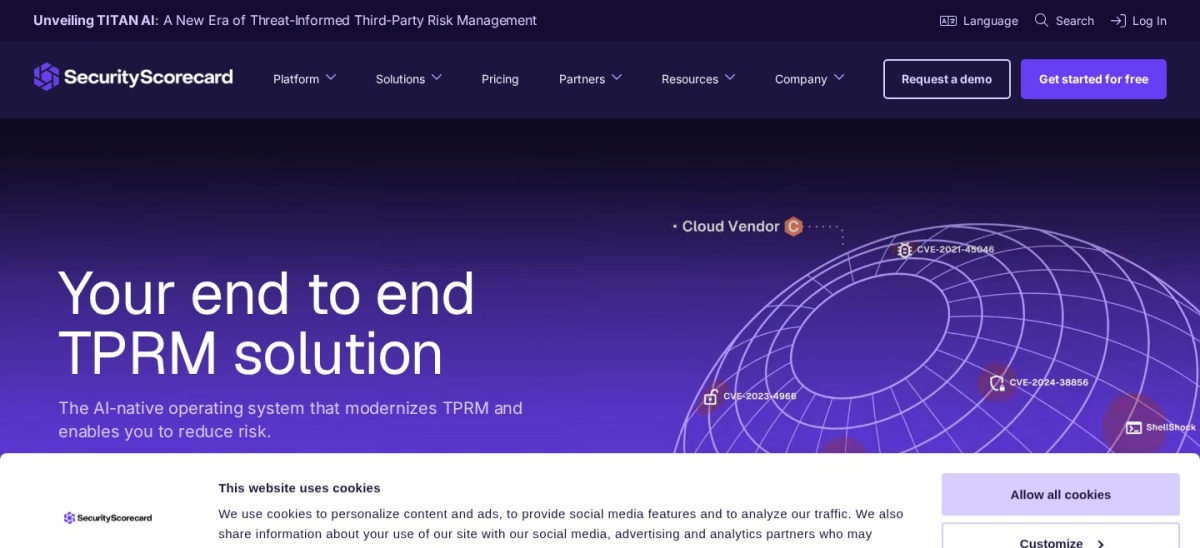
SecurityScorecard is a platform that rates companies from the outside in. It continuously rates 12M+ companies across 10 risk-factor categories, gives A to F letter grades, and adds an Attack Surface Intelligence module for software-specific vulnerabilities.
The trade off is price. Paid plans are priced by the number of organisations monitored and no dollar amounts appear on the vendor pricing page. It suits teams that want a simple grade to track and share.
What we like
Rates 12M+ companies across 10 factors
Simple A to F letter grades
Free Scorecard for your own domain
Watch out for
No dollar amounts on the vendor pricing page
Free Scorecard covers only your own domain
G2 lists a $20,000 figure the vendor does not publish
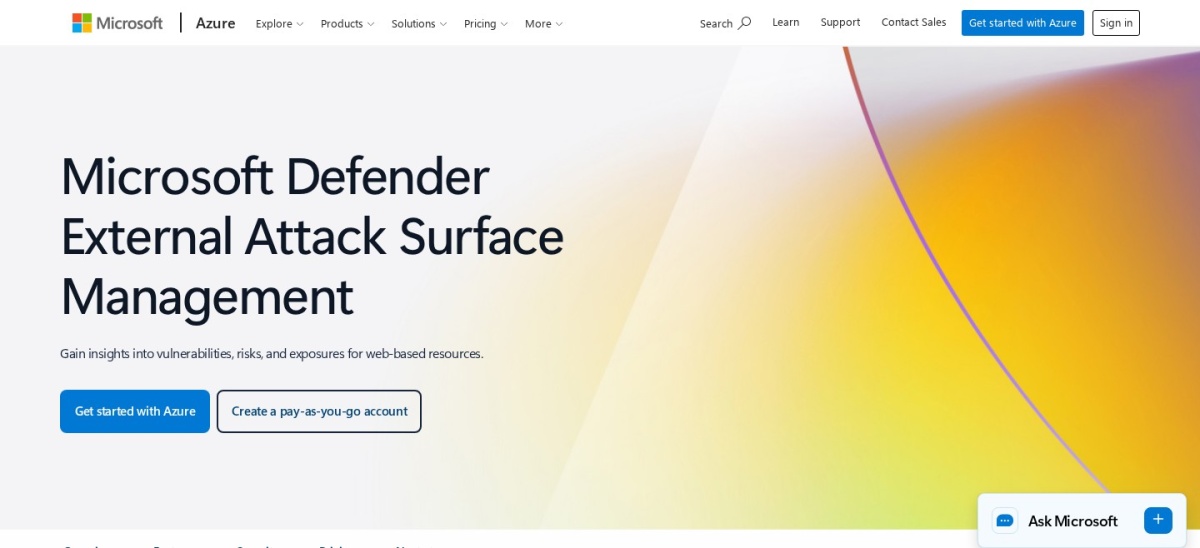
Microsoft Defender EASM homepage, captured Nov 2026.
Microsoft Defender EASM is the attack surface management service inside Azure. It discovers assets from seeds such as domains and IP blocks, plus Microsoft's prebuilt inventory, and feeds Security Exposure Management and Sentinel.
The trade off is metering. It charges $0.011 per billable asset per day, so the yearly total depends on your asset count, and only assets you approve into inventory are billed. It suits teams already running Microsoft security tools.
4.2/5on Gartner Peer Insights (32 reviews, checked Nov 2026)
PricingCustom/yr
Best for Mandiant threat intelligence
Cheapest paid planQuote only
DiscoveryDomains, networks, SaaS accounts
Active checksThreat-intel exploit tests
Free planNo
cloud.google.com
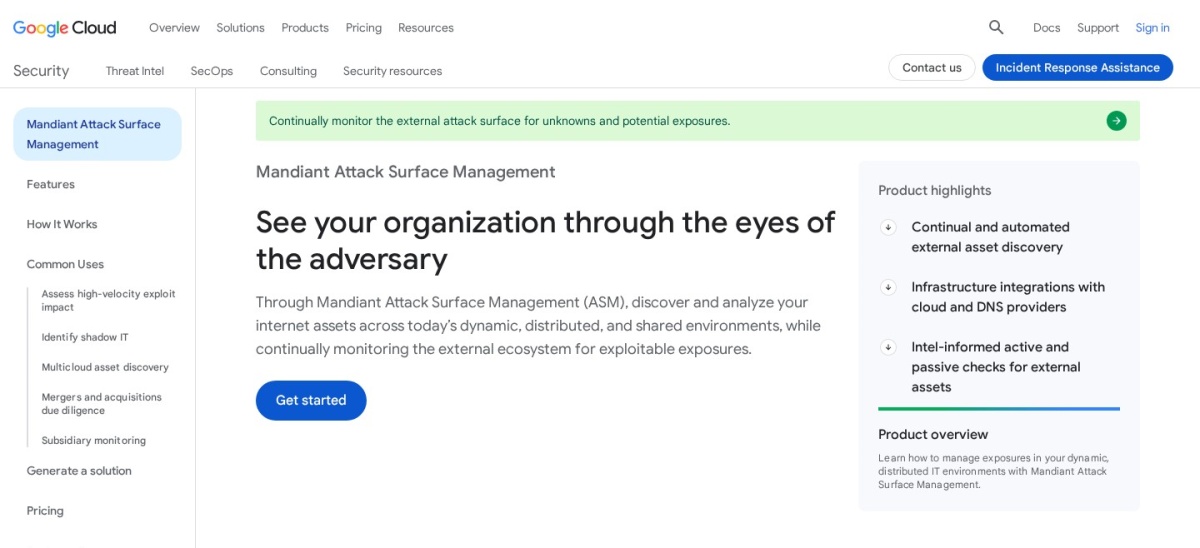
Mandiant Advantage ASM homepage, captured Nov 2026.
Mandiant Advantage ASM is Google Cloud's ASM product. It discovers assets from a domain, networks or SaaS accounts, and runs active asset checks that use Mandiant threat intelligence to test whether an exposure is exploitable.
The trade off is access and price. It is quote-only, priced by employee count with a base fee, and trials run through sales rather than self-service. It suits large teams that already buy Mandiant intelligence.
Six of the nine tools here publish no price at all. Enterprise ASM is priced by the size of your estate, the number of assets scanned and the modules you buy, so vendors quote per company.
That makes the three published prices more useful than they look. Intruder quotes a base fee plus a per-target fee, Halo Security lists its Platform plan at $399 a month, and Microsoft charges $0.011 per billable asset per day.
Before you ask for a quote, count your domains, IPs and cloud accounts. The quote will be based on that count, and a smaller estate is your best lever on price.
How we chose
We started from the established attack surface management tools with a public rating on G2 or Gartner Peer Insights, then kept the nine strongest by score and review count.
Prices come from each vendor's pricing or help page, checked on 22 November 2026. Ratings and review counts come from G2 or Gartner Peer Insights on the same day. Where a vendor shows a sale, the list shows the regular price.
We left out tools with no public rating for the ASM product itself. No vendor paid for a place. This list is based on pricing, docs and reviews, not on using the tools ourselves.
How to choose an attack surface management tool
Count your exposed assets first, then match the tool to the size of your estate.
List your domains, IPs and cloud accounts. The quote will be based on that count, and a smaller estate is your best lever on price.
Shortlist by rating and review count. Pick one high scorer, one broad-coverage tool like CyCognito, and one priced tool you can cost today.
Check what is actually priced. Six tools here publish no price, so ask for a quote and compare it against Intruder, Halo Security and Defender EASM.
Trial the priced tools on your own estate. Intruder has a free plan and Defender EASM has a 30-day trial, so check what they find before you buy.
FAQ
What is the best attack surface management tool?
Intruder is the best attack surface management tool here, rated 4.8 out of 5 on G2 from 223 reviews. It has a free plan and runs more than 11,000 vulnerability checks.
What is the cheapest attack surface management tool?
Intruder has a free plan, and Microsoft Defender EASM charges $0.011 per billable asset per day, so a small estate costs a few dollars a year. Halo Security Platform starts at $399 a month.
Why do most ASM tools not publish prices?
Enterprise ASM is priced by the size of your estate and the modules you buy, so vendors quote per company. Six of the nine tools here publish no price at all.
What is the difference between G2 and Gartner ratings?
G2 and Gartner Peer Insights use different reviewer pools, so their scores are not directly comparable. Censys scores 4.8 on G2 from 3 reviews, while Falcon Surface scores 4.6 on Gartner from 102.
Do ASM tools replace a vulnerability scanner?
No. ASM finds and ranks your exposed assets, while a scanner checks them in depth. Intruder covers both, which is one reason it leads this list.
Can a small business use an ASM tool?
Yes, if it picks a priced tool. Intruder and Microsoft Defender EASM both suit a small estate, while CyCognito and Mandiant are built and priced for large teams.