Best Asset Performance Management Software in 2026: 9 Tools Compared
WLWPLegible EditorsLast verified 24 Nov 2026How we rank13 min read
★ Short answer
IBM Maximo is the best asset performance management software for most asset-heavy organizations, rated 4.4 out of 5 on G2 from 632 reviews. Pick GE Vernova APM for power and energy assets, and MaintainX if your team needs a fast, mobile-first start at $20 per user a month.
How we make this list: we compare pricing pages, product documentation and public user reviews, then re-check every price before each update. No product paid for a place. Disclosure.
IBM Maximo is the deepest suite: EAM, asset health, IoT monitoring and AI failure prediction in one platform, rated 4.4/5 on G2.
GE Vernova APM is the strongest choice for power generation, with 1,000+ plants monitored through its remote monitoring center.
SAP APM only makes sense if you already run SAP EAM, where its closed-loop integration is the main selling point.
MaintainX and Limble are the highest rated tools here at 4.8/5 on G2, and both start under $30 per user a month.
Four of the nine tools publish no price at all. Expect a quoted, six-figure annual deal from the enterprise suites.
What asset performance management software should cover
Asset performance management, or APM, sits above day-to-day maintenance. It uses sensor data, failure history and analytics to predict which assets will fail, when, and what to do about it.
The core split is between predictive depth and execution speed. Enterprise suites model failure modes and remaining useful life; modern CMMS platforms get technicians logging work fast and add lighter reliability insights on top.
Look for condition monitoring, asset health scoring, risk-based maintenance planning and a clear path from an alert to a work order. If alerts never become scheduled work, the analytics are decoration.
A written maintenance plan helps before you buy anything. Our guide on writing a WordPress maintenance plan covers the same discipline of scheduled checks, ownership and review, applied to a smaller system.
The 9 best asset performance management software tools
01
IBM Maximo Application Suite
4.4/5on G2 (632 reviews, checked Nov 2026)
Starts at$3,150/mo
Best asset performance management software overall
Cheapest paid planEssentials, $3,150/mo
Predictive analyticsMaximo Predict, AI failure prediction
DeploymentSaaS or on-premises
LicensingAppPoints pool
ibm.com
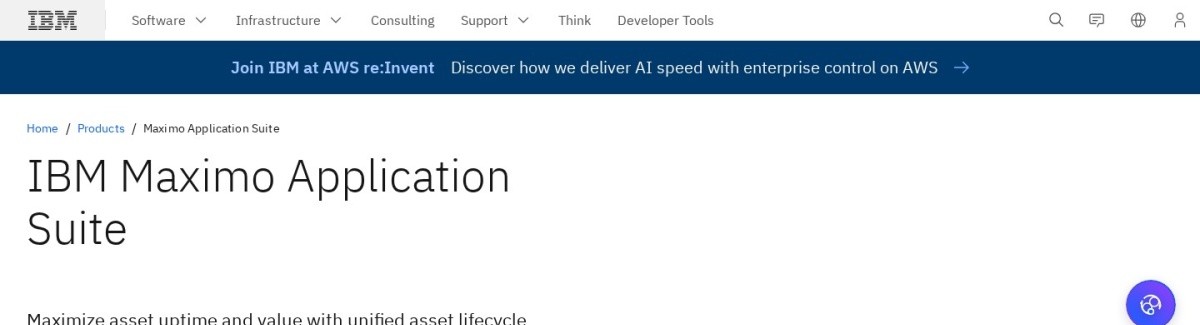
IBM Maximo Application Suite homepage, captured Nov 2026.
IBM Maximo Application Suite is the reference platform for enterprise asset management, combining asset and work registries with reliability-centered maintenance, condition-based maintenance from live sensor data, asset lifecycle planning and inventory control. The suite adds Maximo Health for condition scoring, Maximo Monitor for IoT data and Maximo Predict for AI-driven failure prediction.
The trade off is cost and effort. The entry Essentials tier starts at about $3,150 a month for 150 AppPoints, and rollout is a project that takes months, with licensing sized by a shared AppPoints pool rather than per user. It suits large, asset-intensive organizations where downtime costs real money.
What we like
Deepest asset registry and lifecycle coverage in this list
Predictive analytics, IoT monitoring and health scoring in one suite
Largest review base here, with 632 G2 reviews
Runs on AWS, Azure or IBM Cloud, or on-premises
Watch out for
Entry price is about $3,150 a month before implementation
AppPoints licensing is hard to size without help
Implementation takes months, not weeks
Standard and Premium tiers add more apps and environments, priced on applicationVisit ibm.com
02
GE Vernova APM
4.4/5on G2 (64 reviews, checked Nov 2026)
PricingCustom/yr
Best for power generation and heavy industry
Cheapest paid planQuote only
Predictive analyticsAPM SmartSignal
ModulesStrategy, Health, Reliability, Integrity
DeploymentCloud or on-premises
gevernova.com
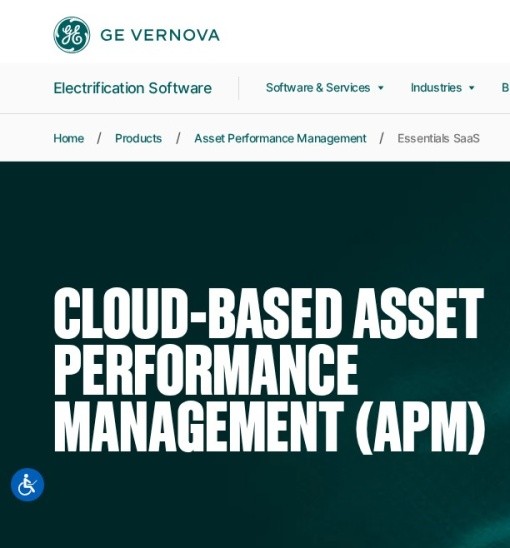
GE Vernova APM homepage, captured Nov 2026.
GE Vernova APM is a modular, cloud-ready platform built on GE Vernova's experience running power infrastructure. It covers asset strategy, health, reliability and integrity, with SmartSignal predictive analytics, digital twins and operator rounds, and its monitoring center watches more than 1,000 power generation plants.
The trade off is focus. Pricing is quoted per deal, implementation averages about 5 months on G2 data, and the deepest value sits with energy, utility and heavy industrial fleets. It suits power producers and grid operators more than general manufacturers.
What we like
Deep energy domain expertise from an equipment maker
Digital twins and SmartSignal predictive analytics included
Modular design, so teams can start with one application
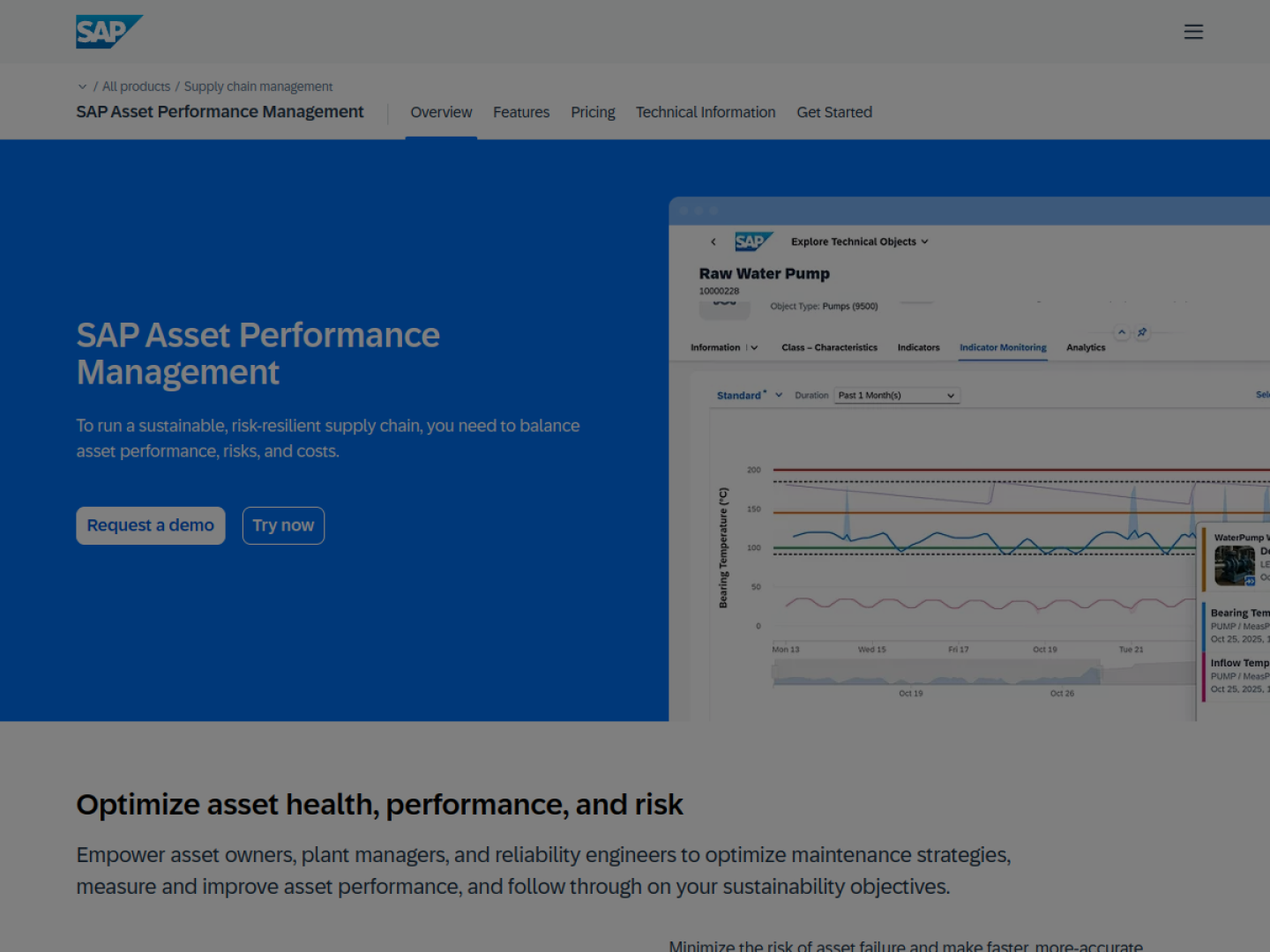
SAP Asset Performance Management homepage, captured Nov 2026.
SAP Asset Performance Management is a cloud-native application that monitors equipment health, predicts failures and builds maintenance strategies from IoT sensor data and maintenance records. It adds risk and criticality scoring, reliability-centered maintenance and failure modes analysis, plus AI-assisted visual inspection.
The trade off is dependence. It requires SAP Enterprise Asset Management, so it only fits organizations already running SAP, and setup is complex enough that reviewers flag configuration as the hardest part. It suits SAP shops that want reliability work feeding straight back into maintenance execution.
What we like
Closed-loop integration with SAP EAM and S/4HANA
RCM and FMEA built in, not bolted on
Real-time health alerts from IoT sensor data
Rated 4.4 out of 5 on G2 from 88 reviews
Watch out for
No published price; every deal is quoted
Requires SAP EAM, so it is not a standalone pick
Setup and configuration are complex
Paid plans are quoted; SAP EAM is a prerequisiteVisit sap.com
04
Octave Attune EAM
4.3/5on G2 (102 reviews, checked Nov 2026)
PricingCustom/yr
Best for full-lifecycle asset management
Cheapest paid planQuote only
FormerlyHxGN EAM
Digital twin2D CAD and 3D
DeploymentSaaS on AWS
octave.com
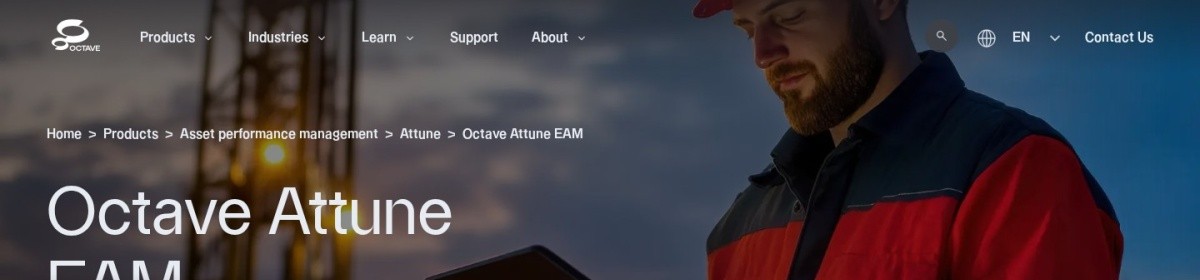
Octave Attune EAM homepage, captured Nov 2026.
Octave Attune EAM is the current name for HxGN EAM, a proven cloud enterprise asset management system covering the full asset lifecycle. It handles asset hierarchies, work orders, inventory, procurement, compliance and calibration, with built-in AI assistance, mobile access and 2D and 3D digital twin views.
The trade off is that it is a lifecycle manager first and a failure predictor second. Pricing is quoted, setup is complex for migrating teams, and the rebrand is recent, so older materials still carry the HxGN name. It suits organizations that need EAM depth alongside maintenance, not pure predictive analytics.
What we like
Complete asset lifecycle coverage in one system
Digital twins and AI assistance included
Strong mobile apps with offline access
Highly configurable for different industries
Watch out for
No published price; every deal is quoted
Setup can be complex, especially when migrating
Recent rebrand means mixed naming in older materials
Plus Edition bundles core and advanced modules in one licence, priced on applicationVisit octave.com
05
MaintainX
4.8/5on G2 (1,601 reviews, checked Nov 2026)
Paid from$20/mo
Best for fast frontline adoption
Cheapest paid planEssential, $20/user/mo annual
Free planBasic, free
Premium plan$65/user/mo annual
Mobile appiOS and Android
getmaintainx.com
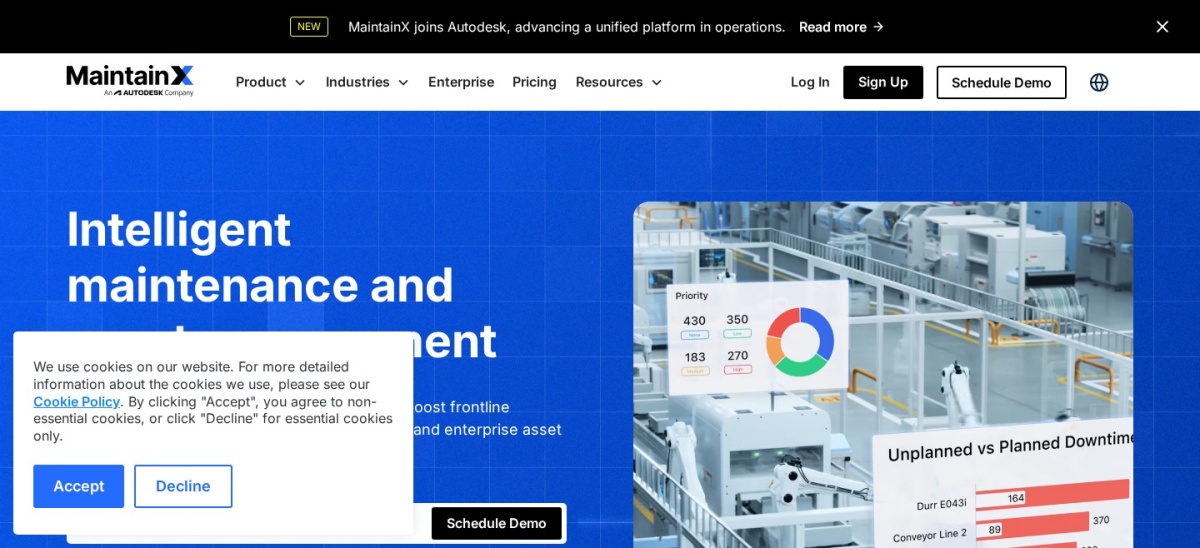
MaintainX homepage, captured Nov 2026.
MaintainX is a mobile-first maintenance platform built for technicians on the floor, with work orders, preventive maintenance scheduling, asset tracking and real-time messaging, plus AI help for work orders, anomaly detection and reporting. The free Basic plan covers unlimited work orders, and Essential costs $20 per user a month billed annually, or $25 month to month.
The trade off is predictive depth. Condition-based triggers and reliability insights exist, but this is not the failure-mode modeling of the enterprise suites, and parts inventory needs the $65 Premium plan. It suits small and mid-size teams whose main problem is getting technicians to use the system every shift.
What we like
Highest rating in this list at 4.8/5 on G2 from 1,601 reviews
Free Basic plan for small teams
Fast setup with a strong mobile experience
AI-assisted work orders and reporting
Watch out for
Less predictive depth than the enterprise suites
Parts inventory and purchasing need Premium
Per-seat pricing adds up with many occasional users
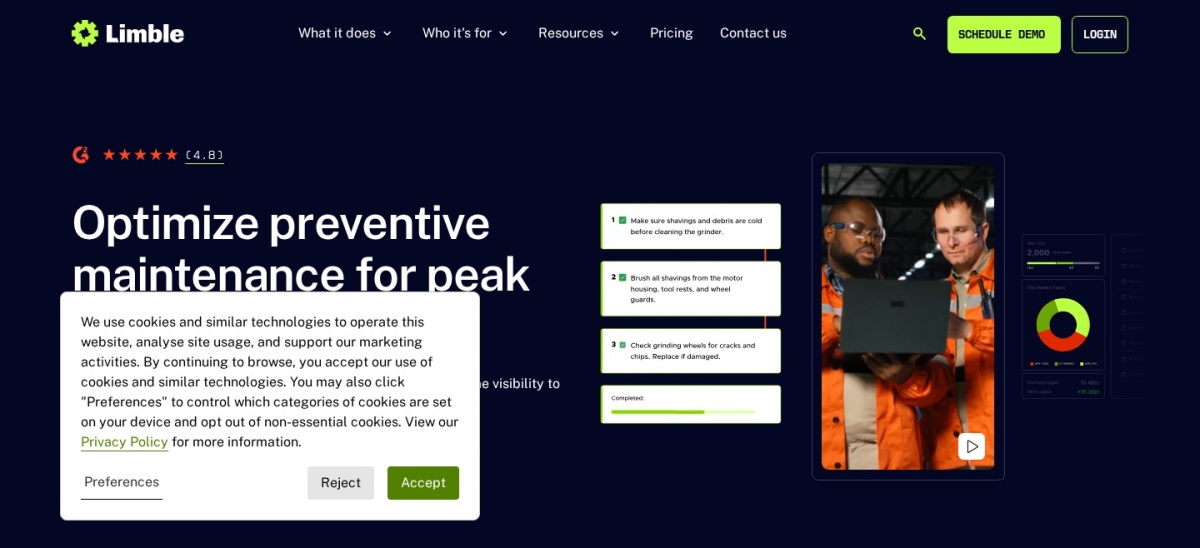
Limble is a modern CMMS that mid-market maintenance teams adopt quickly, with work orders, preventive maintenance scheduling, QR-code work requests, asset performance dashboards and parts tracking. The Standard plan starts at $28 per user a month and already includes parts inventory, which many rivals gate to higher tiers.
The trade off is ceiling. Its APM story is preventive and trend-based rather than predictive, and API access, multi-site analytics and deep integrations need the $69 Premium+ plan. It suits teams escaping reactive maintenance that need scheduling discipline and visibility first.
What we like
Rated 4.8/5 on G2 from 682 reviews
Parts inventory included on the Standard plan
Intuitive interface with fast onboarding
Free Basic tier for evaluation
Watch out for
Less predictive analytics depth than the suites
API access and multi-site views need Premium+
Per-user pricing climbs as the team grows
Premium+ adds API access, meter scheduling and multi-site analyticsVisit limblecmms.com
07
Fiix
4.6/5on G2 (476 reviews, checked Nov 2026)
Paid from$45/mo
Best for reliability-focused maintenance teams
Cheapest paid planBasic, $45/user/mo
Free planFree, 25 active PMs
Professional plan$75/user/mo
OwnerRockwell Automation
fiixsoftware.com
Fiix homepage, captured Nov 2026.
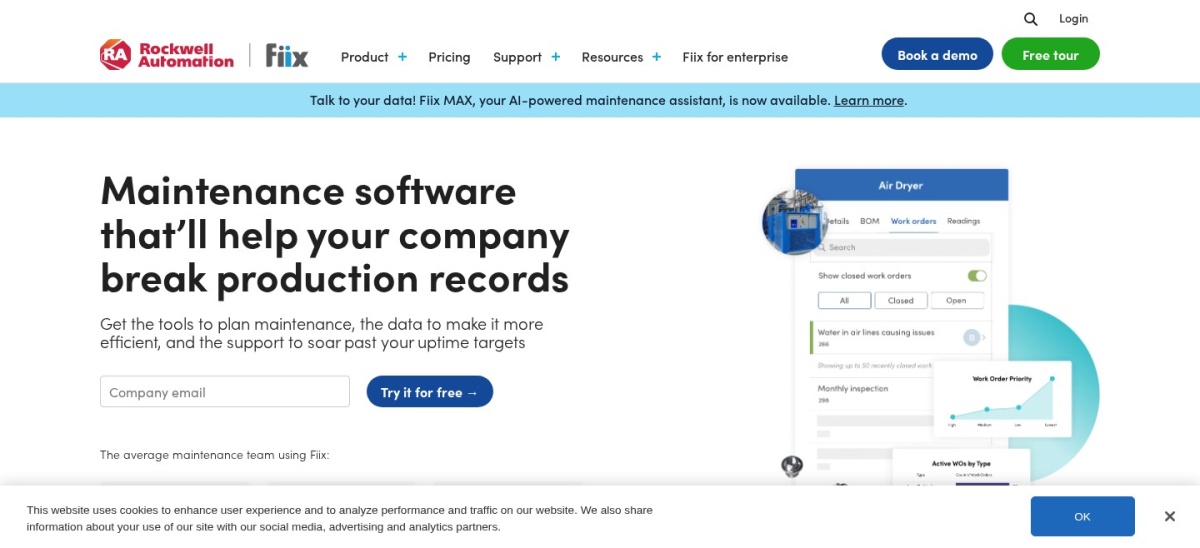
Fiix is a cloud CMMS from Rockwell Automation built around planning, tracking and analyzing maintenance, with asset hierarchies, meter and condition-based preventive maintenance, parts control and more than 100 standard reports. The free plan covers 25 active preventive maintenance schedules, and Basic costs $45 per user a month with unlimited PMs.
The trade off is that the deeper APM features sit higher up. Multi-site management, condition-based maintenance and the Foresight AI insights need the $75 Professional plan, and the AI assistant is a paid add-on. It suits manufacturing teams moving from spreadsheets to data-driven reliability work.
What we like
Genuinely free tier with 25 active PMs
Strong reporting with 100+ standard reports
Rockwell Automation backing and ERP integrations
Rated 4.6/5 on G2
Watch out for
Condition-based maintenance needs Professional
AI insights and assistant cost extra
Mobile app rates below the desktop product in reviews
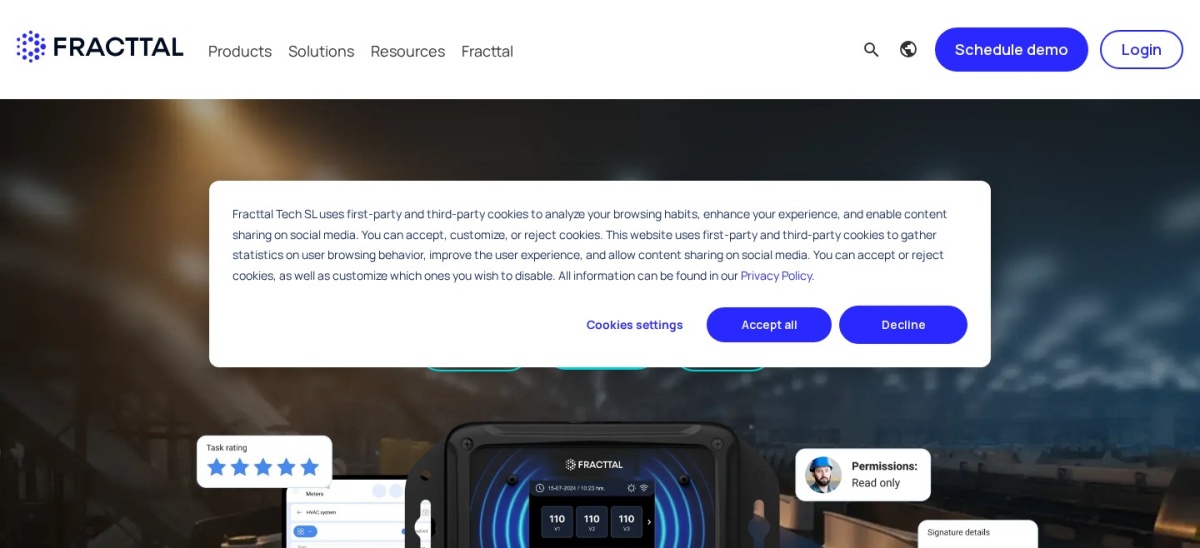
Fracttal One is a cloud-based APM and EAM platform with a visual, mobile-first design, covering work orders, asset hierarchies, teams and suppliers in one place. It adds predictive maintenance, sensor integrations and KPI dashboards, and implementation is measured in weeks rather than quarters.
The trade off is scale and reach. Paid plans are custom-quoted with no published per-user price, its North American ecosystem is smaller than Fiix or MaintainX, and advanced reliability features are still maturing. It suits teams that want modern APM without enterprise-suite weight, especially outside North America.
What we like
Rated 4.6/5 on G2 from 601 reviews
Visual, mobile-first design that teams adopt fast
IoT and AI integrations included
Free Community tier for evaluation
Watch out for
No published price; paid plans are quoted
Smaller North American presence and partner network
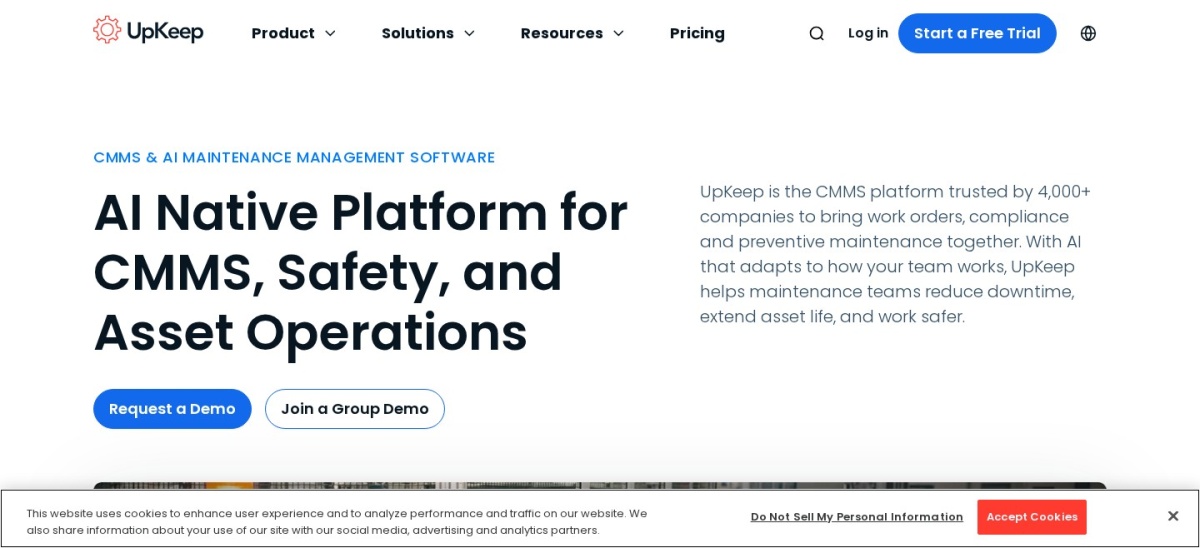
UpKeep is a mobile-first CMMS used by more than 4,000 companies, with work orders, preventive maintenance, asset tracking, parts and inventory, and native iOS and Android apps. The Essential plan costs $24 per user a month and includes unlimited work orders, unlimited locations and Nova AI credits, while requester seats are free.
The trade off is gating. Preventive maintenance scheduling, parts and inventory and time tracking start at the $55 Premium plan, and offline mode, API access and multi-site support sit higher still. It suits field and facility teams that want fast setup and simple work orders.
What we like
Rated 4.5/5 on G2 from 1,099 reviews
Unlimited free requester seats
Simple setup with a strong mobile app
Nova AI included on every plan
Watch out for
No free plan, only a free trial
Preventive maintenance scheduling needs Premium
Per-user pricing is the most common complaint in reviews
Premium adds PM scheduling, parts, inventory and UpKeep StudioVisit upkeep.com
Free vs paid: what you give up
Free plans cover real maintenance work here. Fiix, MaintainX, Limble and Fracttal One all offer a free tier that handles work orders, assets and basic preventive schedules.
Paid plans mostly add depth and scale. Predictive analytics, condition-based triggers, parts purchasing, multi-site views and API access sit on paid tiers or quoted enterprise deals.
If your assets are critical and sensor-rich, a free tier will not predict failures for you. That work lives in the enterprise suites, where the first year often costs more than a small team's whole software budget.
For a team moving off spreadsheets, the first year of a paid plan often costs less than one unplanned outage. Our guide on premium plugin costs makes the same point about paying for the tier that matches the risk.
How we chose
We started from the established APM suites and the modern CMMS platforms that add reliability features, then kept nine tools with a verifiable public rating and a live product page.
Prices come from each vendor's pricing page or, where the vendor publishes no price, from G2 pricing data and published list-price reports, checked on 24 November 2026. Ratings and review counts come from G2 on the same day. Where a vendor shows a sale, the list shows the regular price.
We left out AVEVA APM because no APM-specific public G2 or Capterra rating could be verified for it, and Aspen Mtell because its G2 page holds a single review. No vendor paid for a place, and we do not claim to have used these tools ourselves.
How to choose asset performance management software
Start with whether you need prediction or execution, then match the platform to your assets.
Decide if you need APM or CMMS. If the problem is work orders and preventive schedules, pick MaintainX, Limble, Fiix or UpKeep. APM earns its keep when you have sensor data, critical assets and the maturity to act on predictions.
Match the platform to your industry. Energy and utilities should evaluate GE Vernova; SAP shops should look at SAP APM; asset-intensive enterprises of any stripe default to Maximo or Attune EAM.
Check the data plumbing before the demo. Ask how sensor, historian, ERP and existing CMMS data connect, and what a pilot needs. APM fails most often on data integration, not on algorithms.
Pilot on your worst assets. Run the shortlist against the equipment that actually fails, measure prediction accuracy and work-order quality, and confirm the annual cost in writing before you sign.
FAQ
What is the best asset performance management software?
IBM Maximo is the best pick for most asset-heavy organizations, rated 4.4 out of 5 on G2 from 632 reviews. GE Vernova APM leads for power and energy, while MaintainX is the best starting point for smaller teams.
What is the difference between APM, EAM and CMMS?
CMMS manages maintenance tasks like work orders and preventive schedules. EAM manages the full asset lifecycle from acquisition to retirement. APM focuses on reliability and risk through analytics and predictive models.
How much does asset performance management software cost?
Enterprise suites are quote-based and typically run into six figures a year including implementation. Modern platforms start at $20 to $45 per user a month, and Fiix, MaintainX, Limble and Fracttal One offer free tiers.
Is there free asset performance management software?
Fiix offers a free CMMS tier with 25 active preventive maintenance schedules, and MaintainX, Limble and Fracttal One have free tiers too. Full predictive APM is generally a paid, often quote-based, product.
Do I need sensors to use APM software?
Not to start. The modern platforms work from work orders, schedules and asset history alone. Predictive features need sensor or historian data, so sensor coverage decides how much of a suite's value you can actually use.
Which APM tool is best for small teams?
MaintainX is the best fit for small teams, rated 4.8 out of 5 on G2 from 1,601 reviews, with a free Basic plan and Essential at $20 per user a month billed annually. Limble is the closest alternative at the same rating.