Best API Security Platforms in 2026: 9 Tools Compared
WLWPLegible EditorsLast verified 22 Nov 2026How we rank14 min read
★ Short answer
Salt Security is the best API security platform for most teams, with discovery from live traffic, shadow API detection and runtime abuse detection in one product, and a 4.7 out of 5 G2 rating. Pick 42Crunch for design-time audit from $9 a month or Wallarm for WAF and API protection in one.
How we make this list: we compare pricing pages, product documentation and public user reviews, then re-check every price before each update. No product paid for a place. Disclosure.
Salt Security leads on discovery and runtime abuse detection, with a 4.7 out of 5 G2 rating and no published price.
Six of the nine platforms are quote-only, so budget a sales call before you compare them on price.
42Crunch is the cheapest published price here, from $9 a month for design-time audit and conformance scoring.
APIsec is the only platform with a published per-endpoint price, at $690 a month per 100 endpoints.
Snyk is the affordable developer-first pick at $25 a month, but it is not a dedicated API security platform.
What an API security platform has to do
API security starts with a simple problem: most teams do not know how many APIs they have. Shadow APIs and zombie APIs, old endpoints that nobody owns, are the main risk, since an endpoint nobody patches is an endpoint nobody protects. Discovery comes first, before any blocking.
The tools split into two views. Runtime tools such as Salt, Traceable and Cequence watch live traffic for abuse, while design-time tools such as 42Crunch audit the OpenAPI spec before the API ships. A tool that only scans code will miss runtime abuse, while a tool that only watches traffic will miss design flaws, so most teams need both views.
Pricing is the hardest part of this category. No vendor in this comparison publishes a list price for the full platform, so every quote comes from a sales conversation. Only 42Crunch, APIsec and Snyk publish a starting price, which is why they lead the affordable picks.
Start with the flaw that worries you most. Broken object level authorisation, or BOLA, is the most common API flaw, and it needs runtime analysis rather than a one-time scan. Pick the runtime tool for BOLA, and add a design-time audit for the spec.
Best for API discovery and runtime abuse detection
Entry paid planQuote-only, no published starting price
Free planNo free plan
G2 rating4.7 out of 5 from 12 reviews
Standout featureAgentic Security Graph and shadow API discovery
salt.security
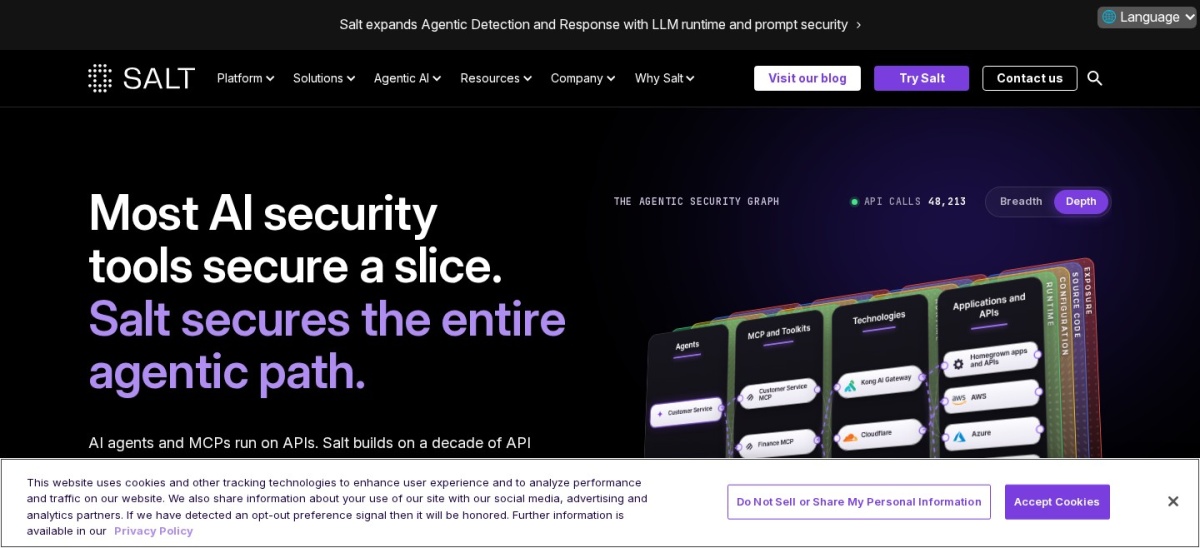
Salt Security homepage, captured Nov 2026.
Salt Security is an API security platform that builds its API inventory from traffic rather than from documentation, which is why it finds shadow APIs and zombie APIs that no other tool in the estate knows about. It watches how each endpoint is used, learns the normal pattern for each caller, and flags abuse such as credential stuffing, token theft and broken object level authorisation, mapping findings to the OWASP API Security Top 10.
The trade off is price transparency and deployment. Salt does not publish a list price, so the figure reflects the number of APIs and traffic volume, and the platform needs access to API traffic through a sensor or gateway integration. It suits teams that want the most complete discovery and runtime detection in one product.
What we like
Finds shadow and zombie APIs from live traffic
Strong detection of BOLA and abuse patterns
Maps findings to the OWASP API Security Top 10
Highest editorial rating in this list at 4.7 out of 5
Watch out for
No public list price, quote-only
Needs traffic access to build the full inventory
No web application firewall included
Paid plans are quoted per firm, based on APIs and traffic volume.Visit salt.security
02
Traceable
4.7/5on G2 (23 reviews, checked Nov 2026)
PricingCustom/yr
Best for end-to-end API security with distributed tracing
Entry paid planQuote-only, no published starting price
Free planNo free plan
G2 rating4.7 out of 5 from 23 reviews
Standout featureDistributed tracing across services
traceable.ai
Traceable homepage, captured Nov 2026.
Traceable is an API security platform that combines discovery, posture checks and runtime protection with distributed tracing. That tracing view links an API call to the service and the business transaction behind it, so an alert shows which service called which API and what data moved. It discovers APIs from traffic and code and checks them against the OWASP API Security Top 10.
The trade off is price transparency and setup effort. Traceable does not publish a list price, and the tracing features need instrumentation in the application. It suits teams that want API security tied to real request traces, and it now sits inside Harness as part of its web application and API protection.
What we like
Distributed tracing links API calls to business risk
Covers discovery, posture and runtime in one console
Threat hunting analytics from real traces
Strong fit for teams with complex service maps
Watch out for
No public list price, quote-only
Tracing setup adds work for a small team
Broad platform that small teams may only partly use
Entry paid planQuote-only, no published starting price
Free planNo free plan
G2 rating3.6 out of 5 from 2 reviews
Standout featureEdge blocking before traffic hits origin
akamai.com
Akamai API Security homepage, captured Nov 2026.
Akamai API Security is an edge API security platform built on the former Noname Security product. It runs at the Akamai edge, which means it sees API traffic before that traffic reaches the origin server. It discovers APIs from traffic, profiles normal behaviour for each endpoint and flags abuse such as data scraping, account takeover and broken authorisation, with bot management and rate controls in the same place.
The trade off is price transparency and fit. Akamai does not publish a list price for API Security, so the team must request a quote, and the value is highest for teams already on Akamai. It suits teams with public APIs behind Akamai that want edge blocking and discovery in one product.
What we like
Edge deployment sees traffic before it reaches origin
Strong bot and abuse controls
Discovery from traffic, code and cloud metadata
200 plus API security tests in CI and CD
Watch out for
No public list price, quote-only
Best value comes with wider Akamai adoption
Aimed at larger estates, not small internal APIs
Paid plans are quoted per firm; built on the Noname platform.Visit akamai.com
04
42Crunch
4.5/5on G2 (35 reviews, checked Nov 2026)
Paid from$9/mo
Best for API design audit and conformance scoring
Entry paid planIndividual, $9 a month
Free planFree tier with IDE audit
G2 rating4.5 out of 5 from 35 reviews
Standout featureOpenAPI conformance score with line fixes
42crunch.com
42Crunch homepage, captured Nov 2026.
42Crunch is a design-time API security tool that audits API designs against the OpenAPI specification and a large set of security checks, then gives each API a conformance score with specific fixes. That design-time focus matters because many API flaws, such as missing authentication on an endpoint, are cheapest to fix before the API ships. The free tier covers IDE audit, and Individual starts at $9 a month.
The trade off is runtime depth. 42Crunch is stronger on design audit than on live abuse detection, so a team that needs bot management or credential stuffing defence will pair it with a runtime tool. It suits teams that want to fix API security at design time, for the lowest published price in this list.
What we like
Deep OpenAPI audit with a clear conformance score
Catches design flaws before deploy
Free tier with IDE audit included
Cheapest published price in this list at $9 a month
Watch out for
Focused on design rather than live runtime abuse
Free tier covers IDE audit only
Runtime protection is a separate firewall product
TEAM 10 at $349 a month adds team audit and firewall features.Visit 42crunch.com
05
Cequence
4.6/5on G2 (55 reviews, checked Nov 2026)
PricingCustom/yr
Best for bot and abuse defence for public APIs
Entry paid planQuote-only, no published starting price
Free planNo free plan
G2 rating4.6 out of 5 from 55 reviews
Standout featureBot management and 250 plus risk rules
cequence.ai
Cequence homepage, captured Nov 2026.
Cequence is a runtime API security platform that focuses on the abuse side of API security. It discovers APIs from traffic, then watches for automated attacks such as credential stuffing, account takeover, inventory hoarding and content scraping. Its bot management distinguishes real users from automated clients, which matters for public APIs where bots can drain inventory or hammer login endpoints, and it maps findings to the OWASP API Security Top 10.
The trade off is price transparency and design coverage. Cequence does not publish a list price, so the team must request a quote, and it is stronger on runtime abuse than on design-time audit. It suits teams whose public APIs face constant automated abuse.
What we like
Strong bot management and abuse prevention
API discovery from traffic
250 plus risk rules mapped to 25 frameworks
Unified mitigation for bots and API abuse
Watch out for
No public list price, quote-only
Less focus on design-time API audit
Needs traffic access to work well
Paid plans are quoted per firm, based on APIs and traffic.Visit cequence.ai
06
Wallarm
4.7/5on G2 (97 reviews, checked Nov 2026)
PricingCustom/yr
Best for WAF plus API protection in one product
Entry paid planQuote-only, no published starting price
Free planAPI Attack Surface plan at signup
G2 rating4.7 out of 5 from 97 reviews
CoverageREST, GraphQL, gRPC, SOAP, WebSocket
wallarm.com
Wallarm homepage, captured Nov 2026.
Wallarm is a web application firewall with API security built in, which suits teams that want one product to guard both the website and the API. It discovers APIs from traffic, checks them against the OWASP API Security Top 10, and blocks attacks such as injection, credential stuffing and bot abuse in real time, with inline blocking for REST, GraphQL, gRPC, SOAP and WebSocket. Its API Attack Surface plan is available at signup.
The trade off is price transparency and tuning. Wallarm does not publish a list price, so the team must request a quote, and a WAF needs tuning, since a rule that is too strict will block legitimate users. It suits teams that need a WAF and API protection together.
What we like
Combines WAF, API discovery and abuse detection
Inline blocking for five API protocols
API Attack Surface plan available at signup
Specification testing finds endpoints missing from the spec
Watch out for
No public list price, quote-only
WAF tuning takes time to avoid false positives
Less focused on deep API inventory than Salt
WAAP plans are quoted by sales after the trial or free plan.Visit wallarm.com
07
Escape
4.9/5on G2 (10 reviews, checked Nov 2026)
PricingCustom/yr
Best for schema-aware dynamic API testing
Entry paid planCustom enterprise pricing
Free planNo free plan
G2 rating4.9 out of 5 from 10 reviews
TestingSchema-aware DAST for GraphQL and REST
escape.tech
Escape homepage, captured Nov 2026.
Escape is a schema-aware dynamic testing tool for GraphQL and REST APIs that finds business-logic flaws, not just known vulnerability patterns. It tests the live API against its schema, probes for broken authorisation and data exposure, and reports findings with reproduction steps, so developers can fix them fast. It integrates with CI pipelines, so testing runs on every deploy.
The trade off is that Escape is a testing tool rather than a full runtime platform, so it does not watch live traffic for abuse, and its enterprise pricing is custom. It suits teams that want deep dynamic testing of their APIs in CI, alongside a runtime tool for live protection.
What we like
Schema-aware DAST for GraphQL and REST
Finds business-logic flaws, not just known patterns
CI integration for testing on every deploy
Clear reproduction steps for each finding
Watch out for
No public list price, custom enterprise pricing
Testing only, no live runtime protection
Smaller vendor with a younger platform
Enterprise pricing is custom, based on APIs and testing volume.Visit escape.tech
08
APIsec
4.7/5on G2 (229 reviews, checked Nov 2026)
Paid from$690/mo
Best for continuous API pentesting with a published price
Entry paid planStandard, $690 a month per 100 endpoints
Free planFree tier for basic scanning
G2 rating4.7 out of 5 from 229 reviews
TestingAutomated logic and BOLA testing
apisec.ai
APIsec homepage, captured Nov 2026.
APIsec is a continuous API security testing platform that runs automated tests behaving like a pentest, probing for broken object level authorisation and other logic flaws on a schedule rather than once a year. Its free tier covers basic scanning, and Standard starts at $690 a month per 100 endpoints, or $8,275 a year, with Pro at $2,750 a month for larger estates. It is the only platform here with a published per-endpoint price.
The trade off is the price. $690 a month per 100 endpoints adds up fast for large API estates, and the free tier is limited. It suits teams that want continuous, pentest-style testing with a price they can budget before a sales call.
What we like
Continuous pentest-style API testing
Published per-endpoint price, rare in this category
Free tier for basic scanning
Automated BOLA and logic flaw testing
Watch out for
$690 a month per 100 endpoints adds up fast
Free tier is limited to basic scanning
Testing only, no live runtime blocking
Pro at $2,750 a month covers larger estates with more endpoints.Visit apisec.ai
09
Snyk
4.5/5on G2 (135 reviews, checked Nov 2026)
Paid from$25/mo
Best for developer-first security on a small budget
Entry paid planTeam, $25 a month per contributing developer
Free planFree plan for basic scanning
G2 rating4.5 out of 5 from 135 reviews
CoverageCode, dependencies and API and Web scans
snyk.io
Snyk homepage, captured Nov 2026.
Snyk is a developer security platform rather than a dedicated API security tool, but its API and Web scans include BOLA testing, which makes it a useful affordable pick for startups. It integrates into the development workflow, scans code and open-source dependencies, and catches issues early, before they reach production. The free plan covers basic scanning, and Team starts at $25 a month per contributing developer.
The trade off is that Snyk does not provide dedicated runtime API protection or discovery, so teams that need those pair it with a runtime tool. It suits startups that prioritise developer-first security and want to catch vulnerabilities during development rather than after deploy.
What we like
Integrates into development workflows
Catches issues early, before deploy
Free plan for basic scanning
Cheapest team plan among the affordable picks
Watch out for
No verified user rating found for this list
No dedicated runtime API protection
May need setup for full API coverage
Team at $25 a month per contributing developer.Visit snyk.io
Runtime protection or design-time audit?
Runtime protection watches live traffic, learns the normal pattern for each endpoint and caller, and flags abuse such as credential stuffing, token theft and broken object level authorisation. Salt, Traceable, Cequence and Wallarm work this way, and they need access to API traffic to build their inventory.
Design-time audit checks the OpenAPI spec against a large set of security rules and gives each API a conformance score with specific fixes. 42Crunch works this way, and it catches flaws such as missing authentication on an endpoint before the API ships.
Most teams need both views. A design flaw that ships without an audit becomes a runtime attack, and a runtime tool cannot fix a spec that was wrong from the start. Budget for one of each, not two of one.
How we chose
We compared nine API security platforms on four things: whether they discover shadow and zombie APIs, whether they cover the OWASP API Security Top 10, whether they watch live traffic for abuse, and whether the price is published or quote-only. Prices and ratings were read from vendor pages, roundups and G2, dated October to November 2026.
We gave more weight to runtime protection and to discovery from live traffic, since those catch the flaws that matter most, and to published pricing, since quote-only tools are harder to budget. Salt leads on discovery and runtime detection, but the affordable picks are close for teams that only need one view.
No vendor paid for a place, and this list is based on pricing, docs and reviews, not on using the tools ourselves.
How to choose an API security platform
Start with the flaw that worries you most, then check discovery and price.
Check discovery first. Pick a tool that finds shadow and zombie APIs from live traffic, since an endpoint nobody knows about is an endpoint nobody patches.
Decide runtime or design-time. Runtime tools catch BOLA and abuse in live traffic, while design-time tools catch spec flaws before deploy, and most teams need one of each.
Ask for the price in writing. Most platforms are quote-only, so ask what the quote covers, how it scales with APIs and traffic, and whether the free tier or trial is real.
Confirm the deployment model. Some tools need a sensor or gateway integration to see traffic, which takes planning on a small team, so confirm the setup effort before you commit.
FAQ
What is the best API security platform?
Salt Security is the best pick for most teams, with discovery from live traffic, shadow API detection and runtime abuse detection, plus a 4.7 out of 5 G2 rating. 42Crunch is the best affordable option, from $9 a month.
How much does API security cost?
Most platforms are quote-only, with no published list price. 42Crunch starts at $9 a month, APIsec starts at $690 a month per 100 endpoints, and Snyk Team starts at $25 a month per developer.
Is there a free API security tool?
Yes, in part. 42Crunch has a free tier with IDE audit, APIsec has a free tier, Snyk has a free plan, and Wallarm's API Attack Surface plan is available at signup. Full runtime protection is paid on every platform here.
What is BOLA and why does it matter?
BOLA, broken object level authorisation, is when one user reads another user's records by changing an ID in the request. It is the most common API flaw, and it needs runtime analysis rather than a one-time scan.
Which tool is best for API testing?
42Crunch is the best for design-time audit, with a conformance score and specific fixes for each API. Escape and APIsec are the best for dynamic testing, with schema-aware scans that find business-logic flaws.
Is Snyk an API security tool?
Snyk is a developer security platform rather than a dedicated API security tool. Its API and Web scans include BOLA testing, which makes it a useful affordable pick for startups, but it does not provide dedicated runtime API protection.