Postman is the best API generation software for most teams: its free plan covers one user, Solo starts at $9 a month billed annually, and it turns collections and specs into docs, mocks and SDKs. Pick Apidog for the same $9 start with a stronger all-in-one design flow, or Speakeasy for polished multi-language SDKs.
How we make this list: we compare pricing pages, product documentation and public user reviews, then re-check every price before each update. No product paid for a place. Disclosure.
Postman and Apidog both start at $9 a month, the lowest paid entry in this list.
Apidog has the highest G2 rating here at 4.8 out of 5 from 236 reviews.
SwaggerHub generates client SDKs and server stubs in more than 30 languages from OpenAPI.
Speakeasy and Fern are the dedicated SDK generators; Speakeasy charges $250 a month per language.
Scalar is the only open-source pick, with one free SDK for APIs up to 25 endpoints.
What API generation software should do
API generation software turns an API definition, usually an OpenAPI spec, into things developers can use: client SDKs, reference docs, mock servers, code samples and CLIs. The point is to stop hand-writing a client library every time the API changes.
The tools split into two groups. All-in-one platforms such as Postman and Apidog cover design, testing, mocks and docs, and generate SDKs as one part of that. Dedicated generators such as Speakeasy and Fern focus on SDK quality and publishing.
Start from the spec you already keep. If your team writes OpenAPI first, a design-led tool fits. If you already work in Postman collections, generation from collections matters more. Our guide on how to use the WordPress REST API shows the same spec-first idea in a smaller setting.
Watch how the price scales. Some tools charge per user, some per language, and some per SDK. A $9 per user plan and a $250 per language plan can end up far apart once a team ships three languages.
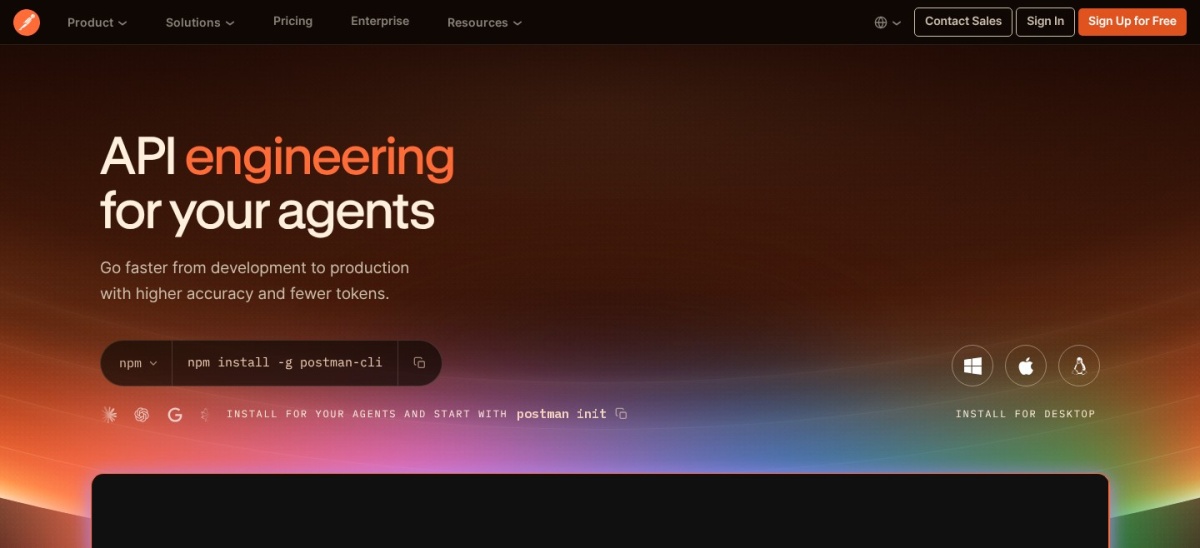
Postman is the API platform most teams already open every day. Collections, specs, tests and docs sit in shared workspaces, and Postman turns them into published docs, mock servers and generated SDKs. The free plan covers 1 user, and Solo starts at $9 a month billed annually.
The trade off is that the deeper controls cost more. Governance rules, the API catalog, the private API network and audit logs sit on Enterprise, which is priced by quote. It suits teams that already live in Postman and want generation where the work happens.
What we like
Rated 4.6 out of 5 on G2 from 1,795 reviews
Largest user base in this list by far
Free plan for a single user
Collections double as docs, mocks and tests
Watch out for
Full governance needs the quote-priced Enterprise plan
Free plan covers one user and cannot create a team
Enterprise adds governance rules, catalog and audit logsVisit postman.com
02
Apidog
4.8/5on G2 (236 reviews, checked Nov 2026)
Paid from$9/mo
Best all-in-one API platform for small teams
Generates fromOpenAPI, Postman and Swagger files
Mock serversYes
Free planUp to 4 users
Paid planBasic, $9/user/mo
apidog.com
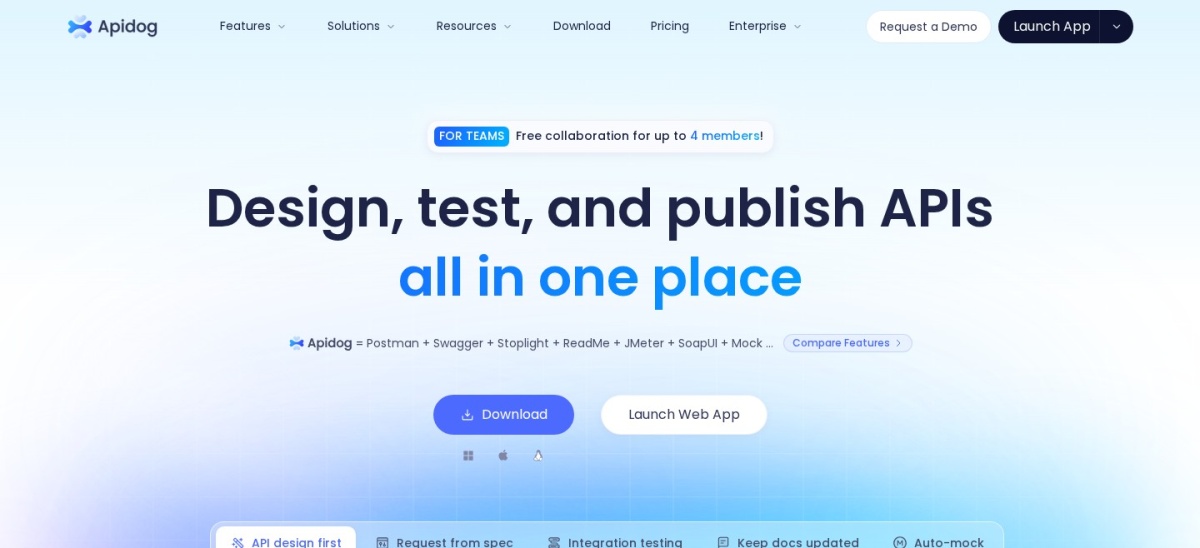
Apidog homepage, captured Nov 2026.
Apidog is an all-in-one API platform that covers design, testing, mocking and docs from one spec. It generates client SDKs and documentation, runs mock servers, and imports OpenAPI, Postman and Swagger files. The free plan covers up to 4 users, and Basic starts at $9 per user a month.
The trade off is per-seat pricing. A team of 10 on Basic pays $90 a month, and the security and governance controls need Enterprise at $27 per user a month. It suits small teams that want one tool for the whole API workflow at a low entry price.
What we like
Highest G2 rating in this list at 4.8 out of 5
Free plan covers up to 4 users
Imports OpenAPI, Postman and Swagger files
Lowest paid entry, tied with Postman
Watch out for
Per-user price adds up as the team grows
Smaller review base than Postman
Enterprise adds security policies, SSO and audit logsVisit apidog.com
03
SwaggerHub
4.2/5on G2 (218 reviews, checked Nov 2026)
Paid from$22.80/mo
Best for teams standardized on OpenAPI
Generates fromOpenAPI specs
SDK languages30+ client and server targets
Free plan1 user, 3 hosted APIs
Paid planIndividual, $22.80/user/mo
swagger.io
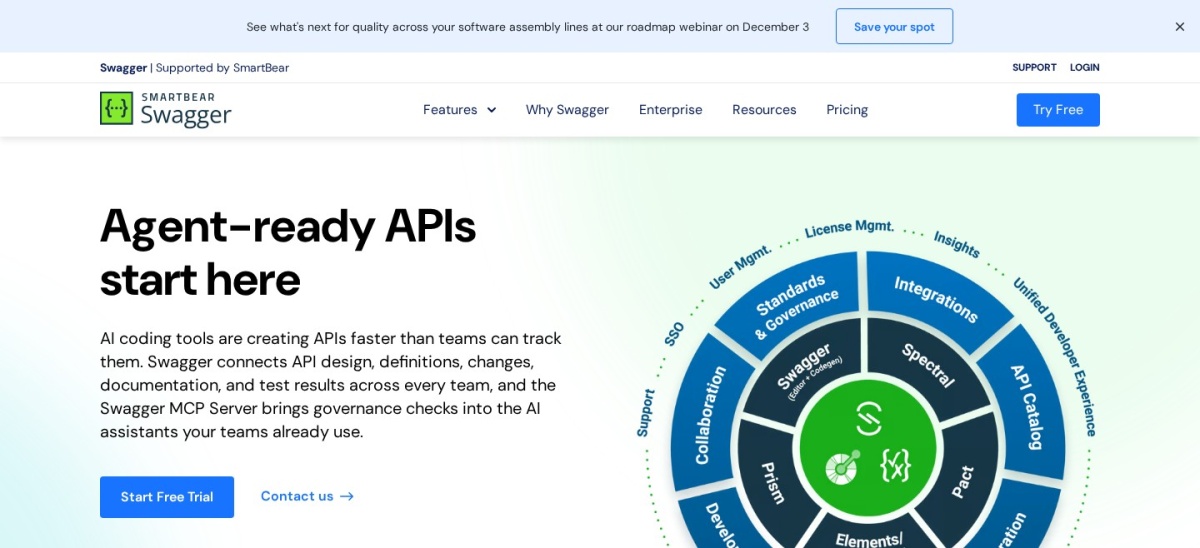
SwaggerHub homepage, captured Nov 2026.
SwaggerHub is SmartBear's hosted platform for designing APIs in OpenAPI, now sold under the Swagger name. Its visual editor, reusable domains and style rules feed client SDK and server stub generation in more than 30 languages. The free tier covers 1 user and 3 hosted APIs, and Individual starts at $22.80 per user a month billed annually.
The trade off is the per-user bill and the extras. The branded portal is a paid add-on, and the price climbs to $58.80 per user a month on Enterprise. It suits teams already standardized on OpenAPI and the Swagger toolchain.
What we like
Widest generator coverage in this list
Visual and form-based OpenAPI editors
Git sync with GitHub, GitLab and Bitbucket
Style rules shared across APIs
Watch out for
Branded portal costs extra as an add-on
Recent rebrand to API Hub adds confusion
Team and Enterprise add more APIs, domains and portal productsVisit swagger.io
04
Stoplight
4.4/5on G2 (342 reviews, checked Nov 2026)
Paid from$44/mo
Best for design-first API teams
Generates fromOpenAPI specs
Mock serversYes
Free plan1 user, 1 project
Paid planBasic, $44/mo
stoplight.io
Stoplight homepage, captured Nov 2026.
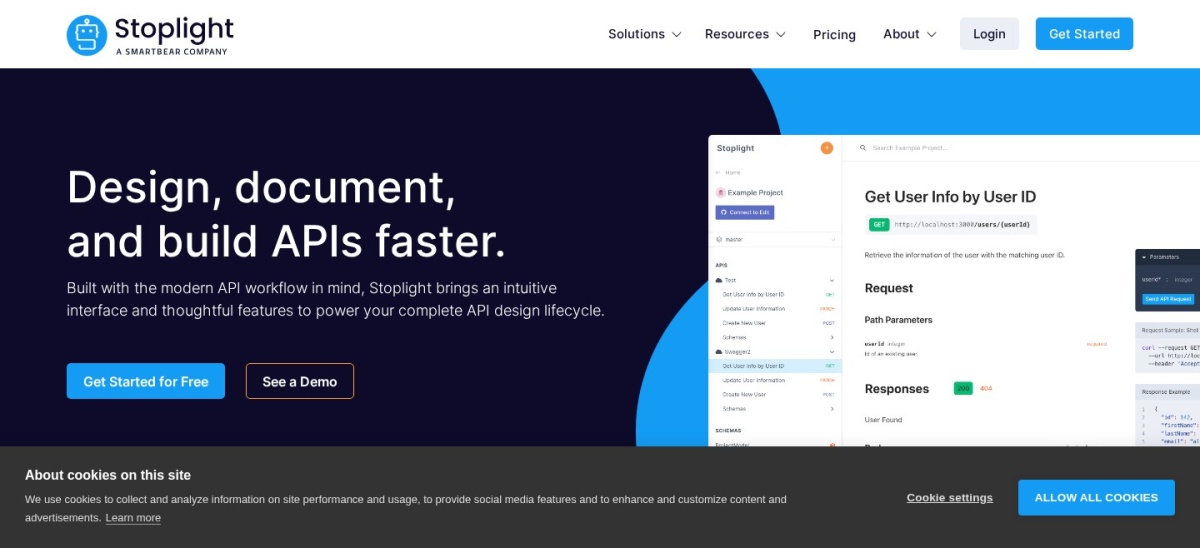
Stoplight is a design-first platform for shaping an API contract before code starts. Its visual editor builds OpenAPI specs, Spectral rules check naming and structure, and the same spec feeds mock servers and hosted docs. The free plan covers 1 user and 1 project, and Basic starts at $44 a month billed annually for the first 3 users.
The trade off is private projects. They need Startup at $113 a month billed annually, and shared style guides and SSO need Pro Team at $362 a month. It suits design-led teams that want linting, mocks and docs in one workflow.
What we like
Rated 4.4 out of 5 on G2 from 342 reviews
Spectral linting enforces a house style
Mock servers generated from the spec
Git sync keeps specs in version control
Watch out for
Private projects need the $113 Startup plan
Desktop Studio app no longer updated
Startup adds private projects; Pro Team adds SSO and shared style guidesVisit stoplight.io
05
Speakeasy
4.6/5on G2 (4 reviews, checked Nov 2026)
Paid from$250/mo
Best for polished multi-language SDKs
Generates fromOpenAPI specs
SDK languages10, incl. TypeScript and Python
Free plan1 language
Paid planScale-up, $250/mo per language
speakeasy.com
Speakeasy homepage, captured Nov 2026.
Speakeasy is a dedicated SDK generator that turns an OpenAPI spec into idiomatic client libraries, Terraform providers and MCP servers. It supports 10 languages, including TypeScript, Python, Go, Java and C#, and ships generated SDKs to package registries. The free plan covers one language, and Scale-up starts at $250 a month per language.
The trade off is per-language pricing. A team shipping TypeScript, Python and Go SDKs pays $750 a month on Scale-up, so the bill grows with every language. It suits API-first companies where SDK quality drives adoption.
What we like
Idiomatic SDKs, not generic generated code
Ships SDKs to registries automatically
Also generates Terraform providers and MCP servers
CLI runs offline for air-gapped use
Watch out for
Per-language pricing gets costly fast
G2 rating rests on only 4 reviews
Business adds OAuth, webhooks and more operations per languageVisit speakeasy.com
06
Fern
5/5on G2 (1 reviews, checked Nov 2026)
PricingCustom/yr
Best for SDKs and docs published together
Generates fromOpenAPI, AsyncAPI, gRPC, GraphQL
SDK languagesTypeScript and Python free; 10 on Enterprise
Free plan10 members, 1 site
Paid planEnterprise, custom price
buildwithfern.com
Fern homepage, captured Nov 2026.
Fern is a developer experience platform that generates SDKs, a docs site and a CLI from one API definition. It reads OpenAPI, AsyncAPI, gRPC and GraphQL specs, and its free plan covers 10 team members on one site. Fern was acquired by Postman in January 2026, and the product and brand are unchanged.
The trade off is pricing transparency. Paid SDK pricing is not published on the current pricing page, and larger setups go through Enterprise by quote. It suits teams that want polished SDKs and docs published together from one workflow.
Insomnia is Kong's lightweight desktop client for designing, debugging and testing APIs. It covers REST, GraphQL, gRPC, WebSocket and SOAP, generates code snippets from requests, and syncs collections through Git. The free Essentials plan covers unlimited local projects, and Pro starts at $12 per user a month.
The trade off is generation depth. Its docs and SDK output are thinner than Postman or Apidog, and mock server requests are capped at 1,000 a month on the free plan. It suits solo developers who want speed, offline use and strong GraphQL support.
What we like
Fast, light desktop client
Works offline with local storage
Strong GraphQL explorer
Git sync for versioned collections
Watch out for
Thinner docs and SDK generation than rivals
SSO needs the $45 Enterprise plan
Pro adds cloud sync and more mock requests; Enterprise adds SSOVisit insomnia.rest
08
Bump.sh
4.9/5on G2 (4 reviews, checked Nov 2026)
Starts at$50/mo
Best for docs with changelogs from spec diffs
Generates fromOpenAPI and AsyncAPI specs
ChangelogBuilt from spec diffs
Free planNo, 14-day trial on Pro
Paid planBasic, $50/mo
bump.sh
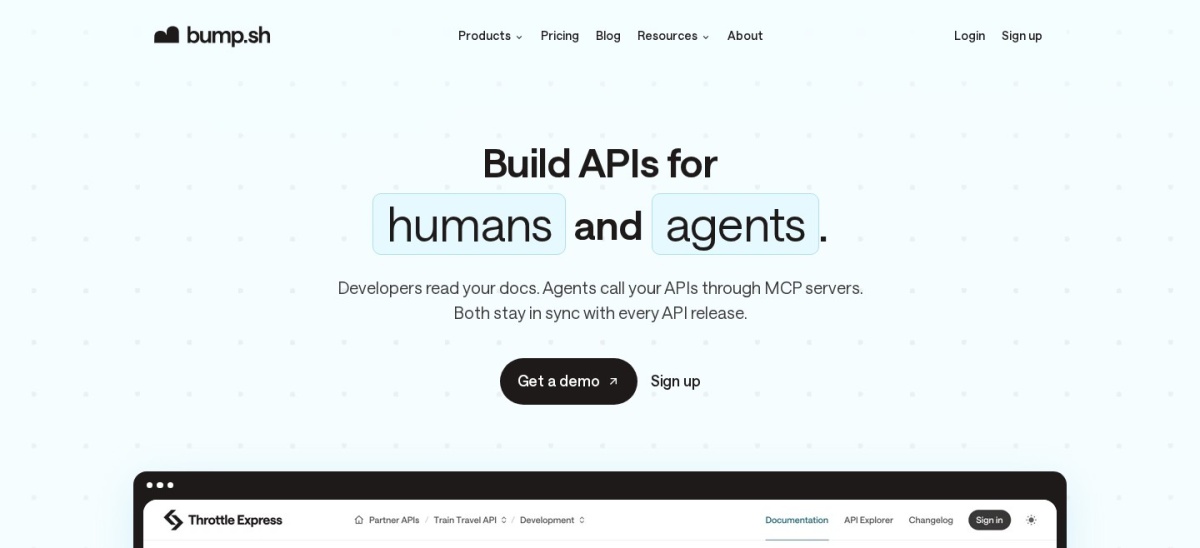
Bump.sh homepage, captured Nov 2026.
Bump.sh is a docs platform that turns an OpenAPI or AsyncAPI spec into a hosted docs site with an API explorer. It builds a changelog from spec diffs, so readers see what changed between versions, and it flags breaking changes. Basic starts at $50 a month, and Pro adds private docs and more MCP tools at $120 a month.
The trade off is scope. Bump.sh generates docs, not SDKs, and it has no testing or mocking tools of its own. It suits teams that want clear, versioned docs and changelogs from the spec they already keep.
What we like
Highest G2 rating in this list at 4.9 out of 5
Changelogs generated from spec diffs
Breaking-change detection built in
API explorer on every docs page
Watch out for
No free plan, only a 14-day trial
Generates docs, not SDKs
Pro adds private docs, API Explorer and MCP serversVisit bump.sh
09
Scalar
4.7/5on Product Hunt (3 reviews, checked Nov 2026)
Paid from$150/mo
Best open-source pick for docs and SDKs
Generates fromOpenAPI specs
Free SDKs1 SDK, APIs up to 25 endpoints
Docs hostingYes, hosted or self-hosted
Paid planPro, $150/mo
scalar.com
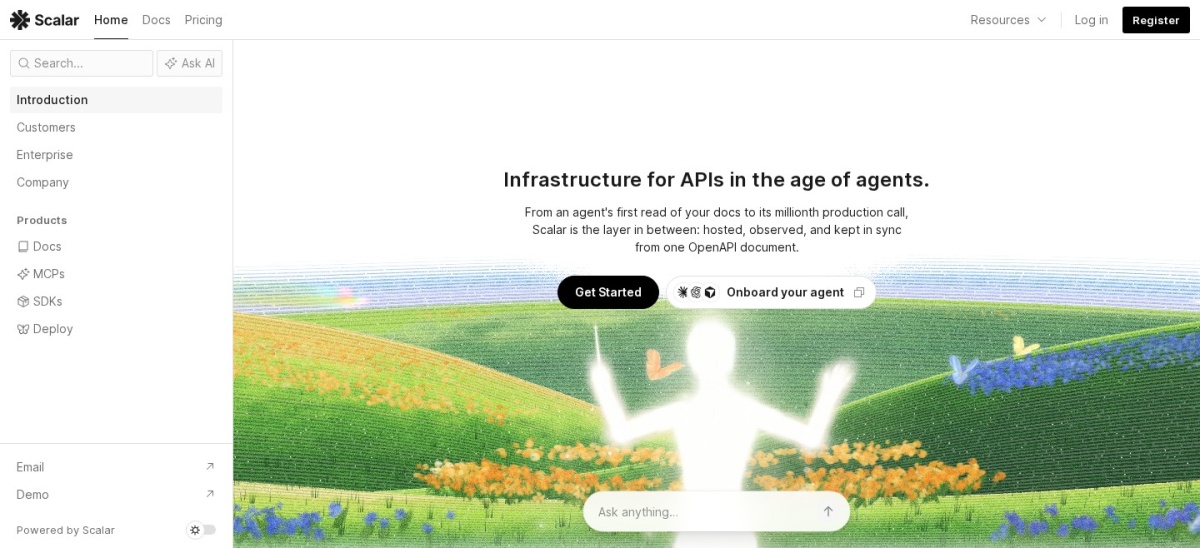
Scalar homepage, captured Nov 2026.
Scalar is an open-source API platform built around OpenAPI, with interactive references, an API client and SDK generation. Its hosted docs sync with Git, and the free plan includes one generated SDK for APIs up to 25 endpoints. Pro starts at $150 a month and adds more SDKs and a custom domain.
The trade off is maturity. Scalar has no G2 reviews yet, and its Product Hunt score of 4.7 rests on only 3 reviews. It suits open-source teams that want modern docs and one generated SDK without a large bill.
Dedicated generators such as Speakeasy and Fern put all their effort into SDK quality. The output reads like hand-written code, with pagination, retries and error types in each language.
All-in-one platforms such as Postman, Apidog and Stoplight generate SDKs as one feature among many. The SDKs work, but the platforms win on testing, mocks and collaboration rather than SDK polish.
If developers judge your API by its SDKs, start with a dedicated generator. If your team needs one place to design, test and document, start with a platform and check its SDK output against one language first.
How we chose
We started from the established API generation tools: dedicated SDK generators, OpenAPI design platforms and API clients that generate docs, mocks or SDKs from a spec.
Prices come from each vendor's pricing page or a pricing summary quoting it, checked on 24 November 2026. Ratings come from G2 on the same day, except Scalar, which has no G2 reviews and uses its Product Hunt score. Where a vendor shows a sale, the list shows the regular price.
We left out tools whose pricing or product had changed so much the facts could not be pinned down, including Stainless, whose site now only announces its move to Anthropic. No vendor paid for a place, and we do not claim hands-on testing for this list.
How to choose API generation software
Start from the spec you already keep, then match the tool to how your API is consumed.
Check what your spec looks like today. If you keep OpenAPI specs in Git, design-led tools fit. If you work in Postman collections, pick a tool that generates from collections.
Decide whether SDKs or docs matter more. Dedicated generators win on SDK quality. Platforms win when one team needs design, testing, mocks and docs together.
Model the real yearly bill. Per-user, per-language and per-SDK pricing scale very differently. Price three languages and your full team before you commit.
Generate one language and read the output. Check pagination, retries and error handling in the generated code. If it needs heavy edits, the generator is not saving time.
FAQ
What is the best API generation software?
Postman is the best pick for most teams. Its free plan covers one user, Solo starts at $9 a month billed annually, and it turns collections and specs into docs, mocks and SDKs. Apidog matches the $9 start with a stronger all-in-one design flow.
What is the cheapest API generation software?
Postman and Apidog tie at $9 a month for their cheapest paid plans. Scalar and Fern both have useful free plans, and OpenAPI design tools such as Stoplight start higher at $44 a month billed annually.
Do I need a dedicated SDK generator?
Not always. All-in-one platforms generate usable SDKs for most teams. A dedicated generator such as Speakeasy or Fern is worth it when developers judge your API by its SDKs, or when you ship official libraries in several languages.
Can API generation software replace hand-written SDKs?
For most APIs, yes, with review. Generated SDKs cover the standard calls, pagination and errors. Teams still review the output and add custom code for unusual auth flows or edge cases the generator does not model.
What is the difference between SwaggerHub and Stoplight?
Both design OpenAPI specs, but SwaggerHub leans on the Swagger toolchain with SDK generation in more than 30 languages, while Stoplight leans on design-first governance with Spectral linting, mock servers and hosted docs in one workflow.
Is there free API generation software?
Yes. Postman, Apidog, SwaggerHub, Stoplight, Speakeasy, Fern, Insomnia and Scalar all have free plans, though most limit users, projects or languages. Bump.sh is the only tool in this list with no free plan.
SaaS SEO and WordPress specialist with about 8 years of experience. Rakib compares WordPress plugins, themes, hosting and software using public pricing, documentation and user reviews. See how we rank.