WLWPLegible EditorsLast verified 24 Nov 2026How we rank11 min read
★ Short answer
Dynatrace is the best AIOps platform for most teams, with a 4.5 out of 5 G2 rating from 1,376 reviews and AI that traces problems to their root cause. Pick Datadog for the broadest integrations, or New Relic if you want a free tier with 100 GB of data a month.
How we make this list: we compare pricing pages, product documentation and public user reviews, then re-check every price before each update. No product paid for a place. Disclosure.
Dynatrace leads on ratings: 4.5 out of 5 from 1,376 G2 reviews, the largest review base in this list.
Datadog and Splunk both start at $15 per host a month, but Datadog charges extra for APM while Splunk bundles it at $60.
New Relic has the most generous free tier: 100 GB of data a month and one full platform user at no cost.
BigPanda and ServiceNow publish no prices; both are quote-only enterprise sales.
PagerDuty is the only pick where AIOps is a paid add-on, not part of the $21 per user plan.
What an AIOps platform should cover
AIOps platforms use machine learning to cut through alert noise. They group related alerts, find the likely root cause and, in some cases, start a fix on their own.
The core job is correlation. A good platform takes events from many monitoring tools and turns hundreds of alerts into a handful of incidents a team can act on.
Coverage matters as much as the AI. Our guide on monitoring a WordPress site shows the same idea at a smaller scale: one view of logs, metrics and traces beats three separate dashboards.
Pricing is hard to compare here. Some tools charge per host, others per user or per data volume, and the enterprise names are quote-only, so always model the bill on your own host and event counts.
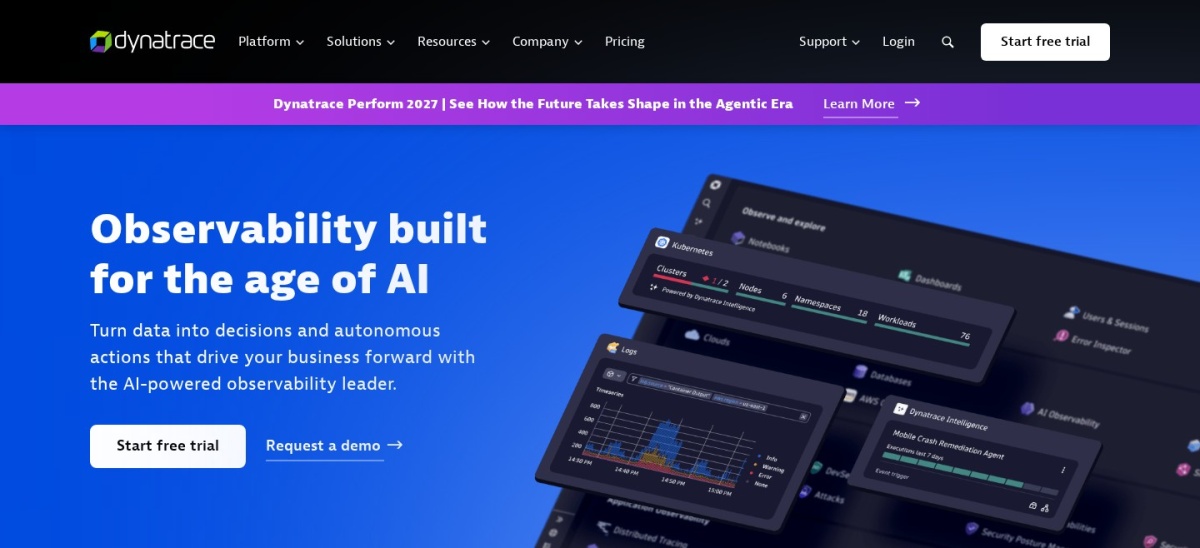
Dynatrace is an observability platform with AIOps built in, and its Davis AI engine traces problems to their root cause across apps, infrastructure and logs. The platform auto-discovers services and maps dependencies, so teams see the full chain behind an incident instead of a single alert.
The trade off is price structure. The $7 Foundation tier covers basic host health only, infrastructure monitoring is $29 a month per host, and full-stack monitoring with APM is $58 a month per 8 GiB host, all on an annual commitment. It suits large teams that want one platform for monitoring and AI-led incident analysis.
What we like
Highest G2 rating in this list at 4.5 out of 5
Automatic service discovery and dependency mapping
AI explains root cause instead of listing alerts
715+ supported technologies
Watch out for
Cheapest tier covers basic host health only
Full-stack price rises fast with host memory
G2 still lists older $21 and $69 rates, so quotes vary
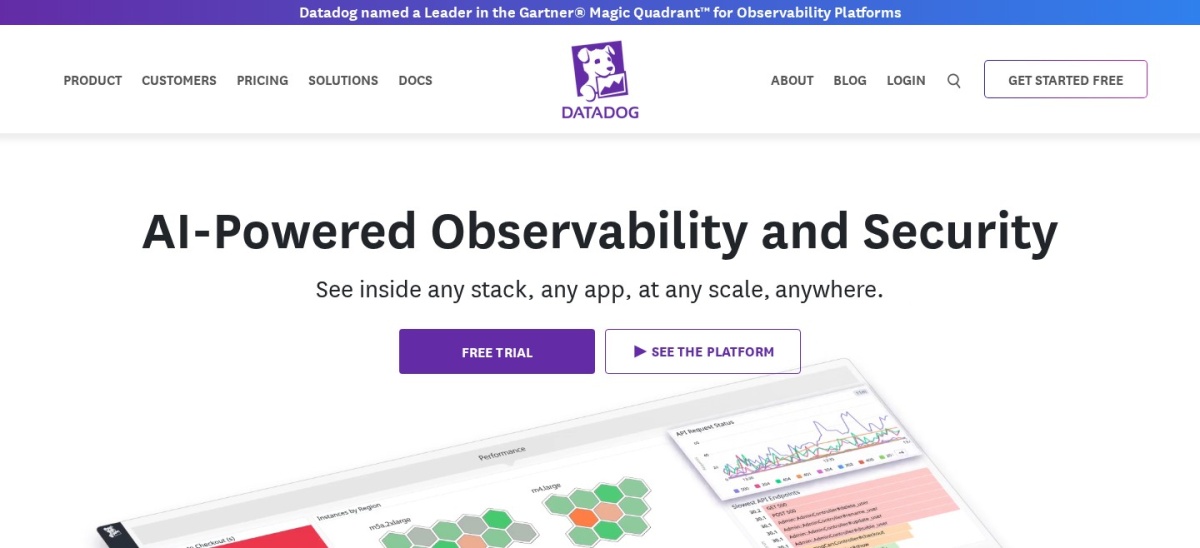
Datadog is a cloud observability platform that collects metrics, logs and traces in one place, with its Watchdog AI flagging anomalies and likely causes. Infrastructure Pro starts at $15 per host a month billed yearly, and the free tier covers up to 5 Basic hosts with 1-day metric retention.
The trade off is that almost every capability is a separate charge. APM starts at $31 per host a month, logs cost $0.10 per GB ingested, and bills can climb fast with data volume. It suits teams that want the widest integration library and are ready to watch usage closely.
New Relic is a full-stack observability platform that prices by data ingested and users, not by host, so short-lived containers cost nothing extra. The free tier includes 100 GB of data a month, one full platform user and access to 50+ capabilities, including its AIOps features.
The trade off is seat pricing. Standard costs $10 for the first full platform user but $99 for each additional user, capped at five, and Pro jumps to $349 per user on an annual commitment. It suits small teams that fit inside the free data allowance and want a real free tier.
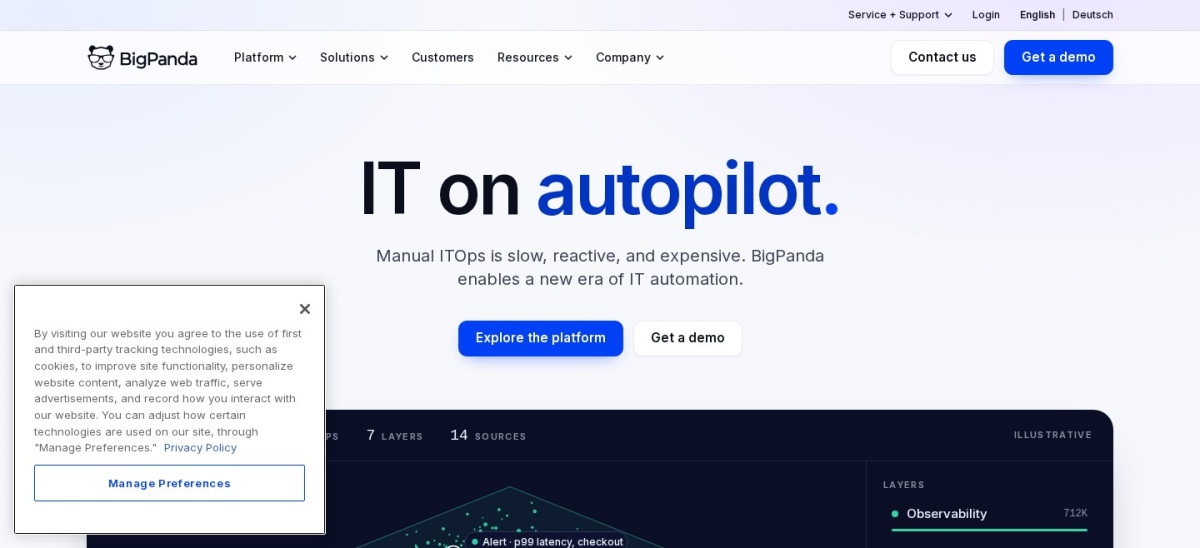
BigPanda is a pure AIOps platform that pulls alerts from monitoring, observability and ITSM tools, then uses machine learning to group them into incidents. Its Open Box approach shows the logic behind each grouping, and it now adds AI agents for triage and first-line response.
The trade off is price. BigPanda publishes no prices on its own site, and G2 lists a Basic edition at $6,000 per user a year, so buyers should expect an enterprise quote and a sales-led process. It suits large NOC teams drowning in alerts from many tools.
What we like
Strongest pure alert-correlation focus here
Explains why alerts were grouped
AI agents for triage and first response
Rated 4.5 out of 5 on G2
Watch out for
No published prices on its own site
Enterprise pricing fits large teams only
Needs several monitoring tools feeding it to shine
PagerDuty is an incident management platform that routes alerts from hundreds of monitoring tools to the right on-call engineer. The free plan covers up to 5 users, and Professional costs $21 per user a month billed yearly, with unlimited SMS and phone alerts.
The trade off is that AIOps is not included. Noise reduction, event intelligence and runbook automation are paid add-ons on Professional, and the newer Reliability Platform starts at $2,800 a year for 10 seats. It suits teams that need dependable paging first and AIOps second.
Splunk Observability Cloud homepage, captured Nov 2026.
Splunk Observability Cloud is Cisco's observability platform, built on streaming analytics that analyse data as it arrives instead of in batches. Infrastructure monitoring starts at $15 per host a month billed yearly, and a free edition covers up to 15 hosts.
The trade off is a thin review base and rising tiers. It holds 4.3 out of 5 on G2 from only 55 reviews, and full coverage costs $60 per host a month for APM plus infrastructure, or $75 for the end-to-end tier. It suits enterprises already running Splunk for logs or security.
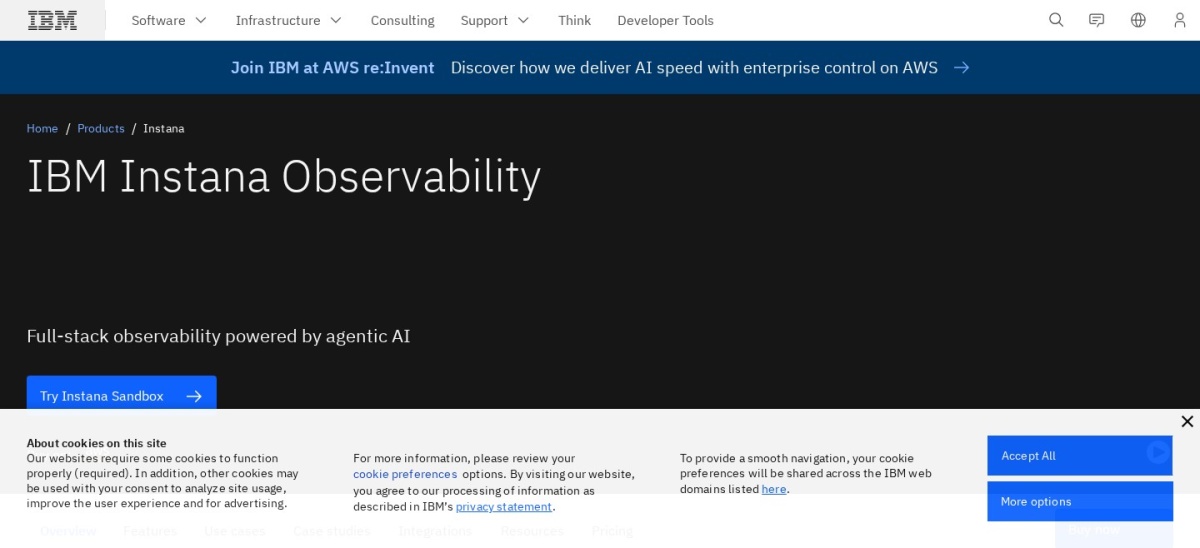
IBM Instana is an observability platform for cloud-native estates, with automatic discovery of services and real-time monitoring. It tracks requests across microservices and containers, and its AI links changes to performance problems as they happen.
The trade off is pricing transparency. IBM's own pricing page lists no prices, and the $18 a month Essentials figure comes from G2, with Standard at $75 and a 10-host minimum order. It suits IBM shops and Kubernetes-heavy teams that want deep tracing.
What we like
Automatic discovery with no manual setup
Real-time tracing across microservices
Strong Kubernetes and container coverage
Rated 4.4 out of 5 on G2
Watch out for
No prices on IBM's own pricing page
10-host minimum order
Per-host costs rise with large deployments
Standard adds APM, tracing and code-level viewsVisit ibm.com
08
ServiceNow IT Operations Management
4.4/5on G2 (518 reviews, checked Nov 2026)
PricingCustom/yr
Best for ServiceNow shops
Entry planCustom quote
Free planNo
IncludesDiscovery and service mapping
Time to implementAbout 5 months
servicenow.com
ServiceNow IT Operations Management homepage, captured Nov 2026.
ServiceNow IT Operations Management is a platform that combines discovery, service mapping, event management and AIOps in one place. It maps services to the infrastructure behind them, cuts alert noise with event correlation, and ties incidents straight into ServiceNow workflows.
The trade off is scale and setup. Pricing is quote-only, G2 reviewers report about 5 months to implement, and advanced modules such as AIOps add to the licence cost. It suits large enterprises already running ServiceNow for ITSM.
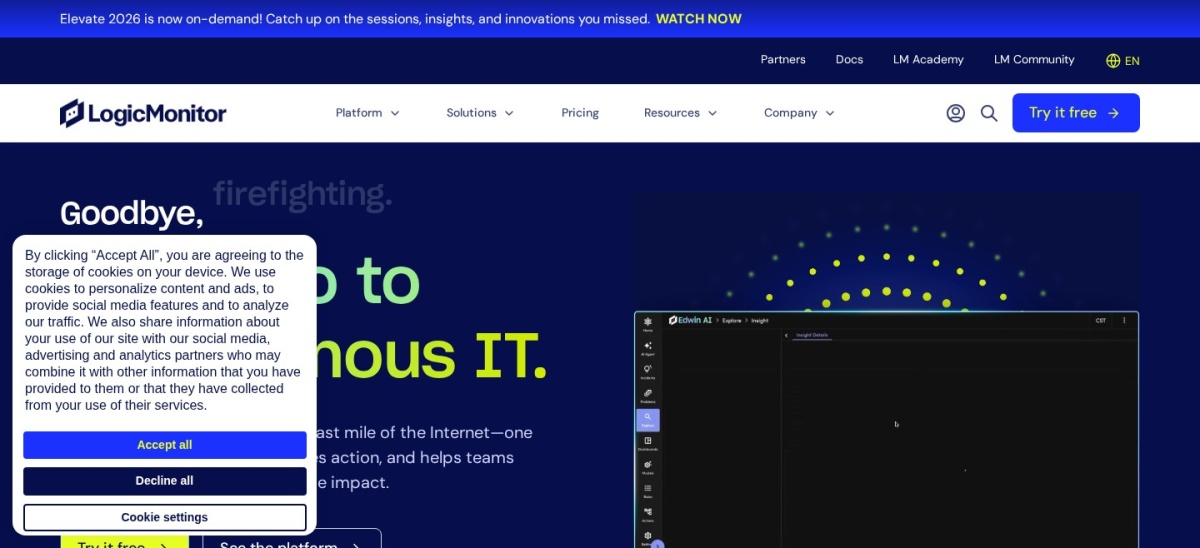
LogicMonitor is a hybrid observability platform that polls devices with an agentless collector instead of installing agents on every host. Essentials starts at $19 per Hybrid Unit a month, where one unit is roughly one monitored device, and it covers cloud, network and on-prem estates.
The trade off is that the AI stays in the top tier. Edwin AI, its AIOps layer, is bundled only in Signature at $50 per Hybrid Unit a month, or sold as an add-on, and G2 still shows the older $22 per-resource rate. It suits hybrid estates that want agentless monitoring first.
Per-host, per-user or quote-only: how the bill works
Most tools here charge per host. Datadog, Splunk and Dynatrace all bill by host or host memory, so the bill follows the size of your estate, not your team.
New Relic and PagerDuty charge per user instead. That suits small teams with large estates, but the seat count is the number to watch, and PagerDuty counts every user on the account.
BigPanda and ServiceNow are quote-only. Get a written quote that states the billing unit, the event or host count it covers, and what the AIOps features add, before comparing them with a list price.
Free tiers help only at small scale. Datadog covers 5 hosts, New Relic gives 100 GB of data a month, and Splunk covers 15 hosts, so a growing estate outgrows them fast.
How we chose
We started from the G2 AIOps Platforms grid and the best-known observability vendors, then kept nine established platforms with public ratings and a clear AIOps or observability focus.
Prices and ratings were checked on 24 November 2026. Prices come from each vendor's pricing page where one is published; where a vendor publishes no price, the list says Custom and the notes name the secondary figure. Ratings come from G2 on the same day.
We left out Moogsoft, now sold inside Dell as APEX AIOps with no standalone list price, and tools with too few reviews to judge. No vendor paid for a place, and we do not claim to have used these tools ourselves.
How to choose an AIOps platform
Start with where your alerts come from, then match the platform to that stack.
Count your alert sources first. If alerts come from five monitoring tools, a correlation-first platform such as BigPanda or PagerDuty matters more than another dashboard.
Pick the billing unit that fits your estate. Per-host pricing suits stable estates, per-user suits small teams with big estates, and quote-only tools need a written estimate before you shortlist them.
Check what the AI actually includes. Some platforms bundle correlation and root-cause analysis, while others sell AIOps as an add-on or reserve it for the top tier, as PagerDuty and LogicMonitor do.
Run a trial on real alert volume. Feed the trial your noisiest week of alerts and count how many incidents remain after correlation, instead of judging the demo data.
FAQ
What is the best AIOps platform?
Dynatrace is the best AIOps platform for most teams. It holds a 4.5 out of 5 G2 rating from 1,376 reviews, and its Davis AI traces incidents to their root cause across apps, infrastructure and logs.
What is the cheapest AIOps platform?
Dynatrace has the lowest list entry at $7 a month per host for basic monitoring, while Datadog and Splunk start at $15 per host a month. The cheapest real bill depends on host count, data volume and which AIOps features are included.
Is there a free AIOps platform?
No full AIOps platform here is free, but several have free tiers. New Relic gives 100 GB of data a month, Datadog covers 5 hosts, Splunk covers 15 hosts, and PagerDuty is free for up to 5 users.
Do I need AIOps if I already use Datadog or New Relic?
Often not as a separate purchase. Both include anomaly detection and root-cause features in their platforms, so a dedicated correlation tool only pays off when alerts from many tools still overwhelm the team.
Why are BigPanda and ServiceNow quote-only?
Both sell to large enterprises with custom estates, so the price depends on event volume, host count and modules. Ask for a written quote that states the billing unit and what the AIOps features add.
Which AIOps platform is best for small teams?
New Relic fits small teams best, thanks to its free tier with 100 GB of data a month and one full user. PagerDuty is the other low-cost start, free for up to 5 users, though its AIOps features cost extra.