Best Accounting Reconciliation Software for Automation in 2026: 9 Tools Compared
WLWPLegible EditorsLast verified 24 Nov 2026How we rank12 min read
★ Short answer
FloQast is the best accounting reconciliation software for automation for most teams, with AI matching and automated reconciliations on its Close AI package, rated 4.6/5 on G2. Pick Numeric for a published $30 per user monthly price, or Synder from $52 a month for sales and payout reconciliation.
How we make this list: we compare pricing pages, product documentation and public user reviews, then re-check every price before each update. No product paid for a place. Disclosure.
FloQast leads for most teams: close checklists plus AI matching and automated reconciliations, rated 4.6/5 on G2 from 1,417 reviews.
Numeric is the only tool with a published price: Essentials at $30 per user a month, rated 4.8/5 on G2.
Synder is the cheapest published start for sales teams at $52 a month billed yearly, covering 500 transactions.
Seven of the nine tools publish no prices, so budget for a quote and for implementation on top.
AutoRek and ReconArt have the thinnest public feedback: 1 and 5 G2 reviews each.
What reconciliation automation should do
Reconciliation automation means software that pulls transactions from banks, payment processors and ERPs, matches them against the ledger, and leaves only the exceptions for a person to review.
The tools in this list split into two groups. Close suites such as FloQast, BlackLine and Adra manage the whole month-end close, while focused tools such as Synder and ReconArt match transactions and stop there. Teams that reconcile card payouts can compare the payment side in our WooPayments vs Stripe guide.
Matching quality matters more than the number of features. Ask how a tool handles partial matches, many-to-many matches and breaks, and whether it keeps an audit trail with sign-offs for every reconciliation.
Price is the hardest thing to compare here. Seven of the nine tools publish no prices at all, so the ladder below shows two published prices and seven custom quotes. Budget for implementation as well as the subscription.
The 9 best accounting reconciliation software tools for automation
01
FloQast
4.6/5on G2 (1,417 reviews, checked Nov 2026)
PricingCustom/yr
Best close automation overall
AI matchingYes, Close AI
Automated reconciliationsYes, Close AI
ERP integrationsNetSuite, SAP, Workday
Entry packageClose Management, quote-based
floqast.com
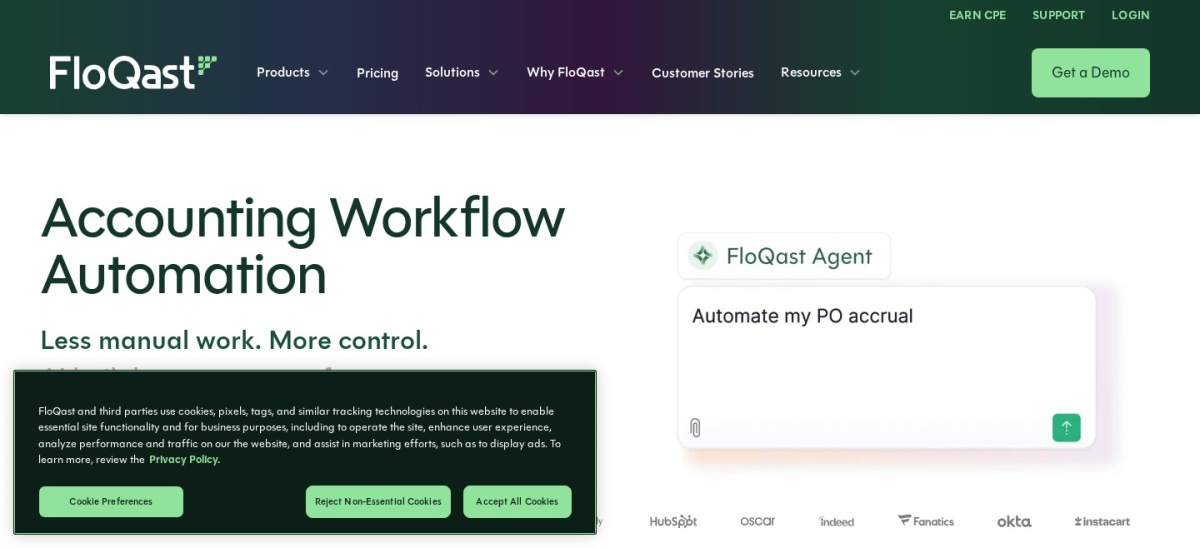
FloQast homepage, captured Nov 2026.
FloQast is a close management platform that puts every reconciliation, checklist task and sign-off in one place. Its Close Management package covers account reconciliations, close checklists and an AI assistant, and it connects to NetSuite, SAP, Workday and Sage Intacct. Close AI adds AI matching, automated reconciliations and automatic journal entry posting.
The trade off is price. FloQast publishes no prices and every package is quote-based, so budgeting means a sales conversation, and some features arrive as separate add-ons. It suits mid-market and enterprise teams whose main pain is close coordination rather than one matching job.
What we like
Largest review base in this list, 1,417 G2 reviews
AI matching and automated reconciliations on Close AI
No per-user fees
Works with major ERPs
Watch out for
No published prices, quote only
Some features sold as separate add-ons
Implementation typically takes 2 to 3 months
Close AI adds AI matching, automated reconciliations and journal postingVisit floqast.com
02
Numeric
4.8/5on G2 (65 reviews, checked Nov 2026)
Starts at$30/mo
Best AI-first close with clear pricing
Cash matchingUp to 95% of bank transactions
Flux analysisAI-drafted explanations
ERP supportNetSuite, QBO, Xero, Intacct
Entry planEssentials, $30/user/mo
numeric.io
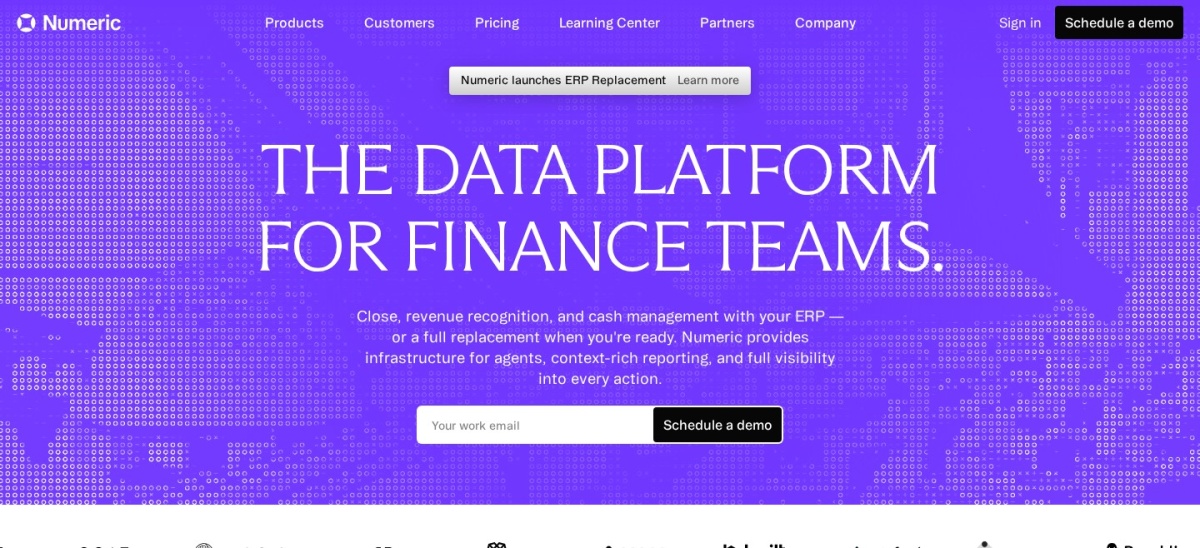
Numeric homepage, captured Nov 2026.
Numeric is an AI-native close platform that runs reconciliations, flux analysis and cash management on top of your ERP. Its Close Management module covers live ERP integrations, auto-reconciliations and transaction monitoring, and cash matching covers up to 95% of bank transactions. Essentials costs $30 per user per month, the only published price in this list.
The trade off is that the AI features that set Numeric apart sit on the Growth and Enterprise plans, which are custom-quoted, and the entry tier covers close management only. It suits lean, growing teams that want a fast start and a price they can see before the first sales call.
What we like
Only published price in this list
Highest G2 rating at 4.8/5
Cash matching covers up to 95% of bank transactions
Fast to start, live in under two weeks
Watch out for
AI features need custom-quoted Growth or Enterprise
Small review base, 65 G2 reviews
Entry tier is close management only
Growth and Enterprise add AI features and cash managementVisit numeric.io
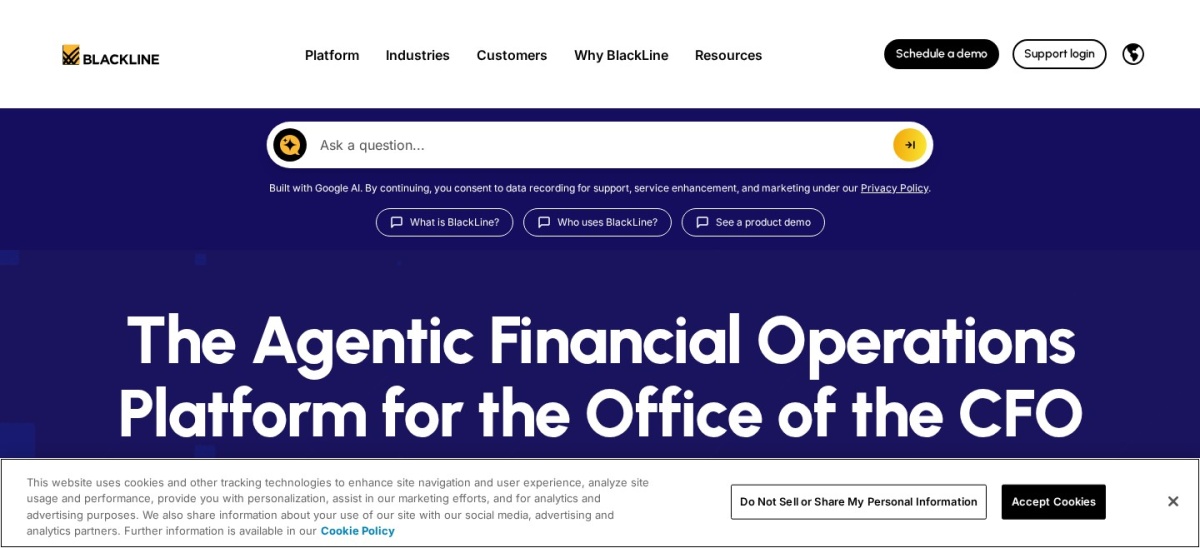
BlackLine is the enterprise standard for financial close automation, covering account reconciliations, transaction matching, journals and intercompany accounting. It matches bank, intercompany and PO-to-invoice transactions in one place and adds risk-based certification so low-risk accounts can auto-certify. It is built for large, multi-entity teams with audit-grade controls.
The trade off is cost and complexity. Pricing is quote-based with no published figures, and deployments are the heaviest in this list, so small teams pay for scale they do not need. It suits listed and multi-entity companies where auditors expect evidence, sign-offs and a full trail.
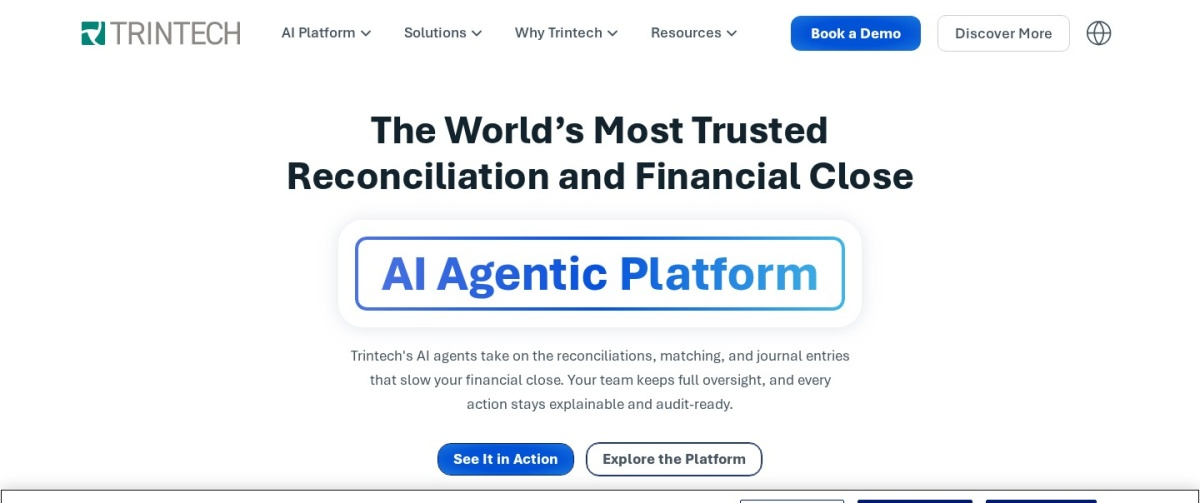
Adra by Trintech is a mid-market close suite made of Adra Balancer for balance sheet reconciliations, Adra Matcher for transaction matching, plus task management and journal entries. It connects to NetSuite, Microsoft Dynamics and Workday, and works from uploaded spreadsheets where no connector exists. Thresholds auto-reconcile low-risk accounts so reviewers focus on exceptions.
The trade off is that Adra publishes no prices, so every deal is a quote, and configuration changes can need Trintech support rather than being self-serve. It suits mid-market finance teams that want close automation without the weight of an enterprise platform.
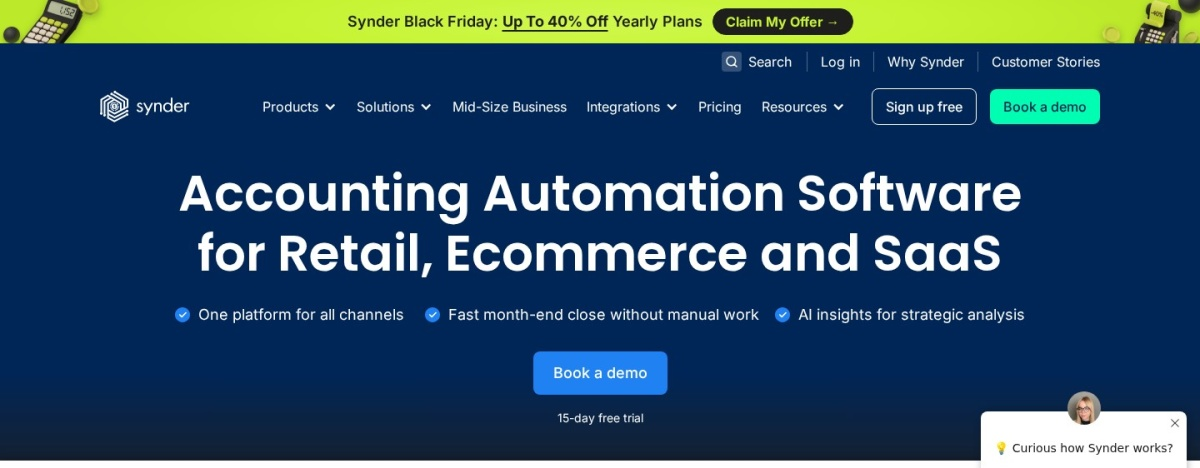
Synder is an accounting automation tool that syncs sales, fees and taxes from Stripe, Shopify, Amazon and 30-plus platforms into QuickBooks, Xero or NetSuite, then reconciles them. The Basic plan costs $52 a month billed yearly, covers 500 transactions a month with 2 integration slots, and includes a 15-day free trial.
The trade off is volume. The $52 plan caps at 500 transactions a month, so busier sellers move to Essential from $103 or Pro from $240 a month, and the monthly-billed Basic price is $65. It suits multichannel sellers and Stripe-billed SaaS teams that reconcile payouts every day.
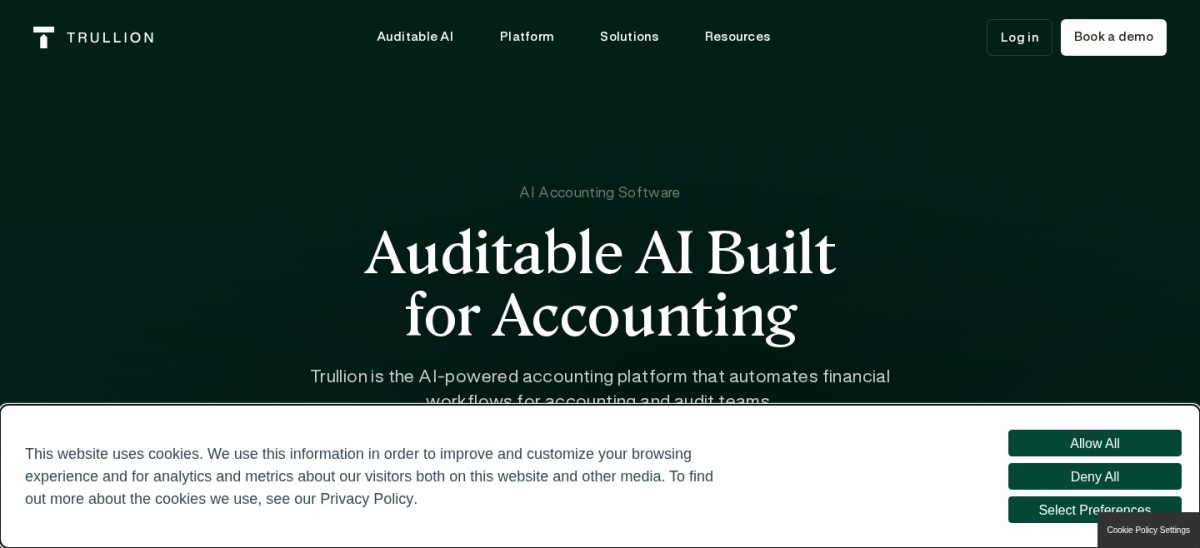
Trullion is an AI-powered accounting platform that reads PDF and Excel contracts with AI and OCR, then builds lease schedules, journal entries and disclosure reports under ASC 842, IFRS 16 and GASB 87. Every number links back to its source document, and its data matching checks records against each other for vouching and reconciliation.
The trade off is scope and price. Trullion is strongest on contract-heavy accounting and audit work rather than everyday bank matching, and pricing is a custom quote after a demo. It suits teams with stacks of lease contracts and auditors who ask to see the source of every figure.
What we like
Every figure links to its source document
Covers ASC 842, IFRS 16 and GASB 87
Rated 4.7/5 on G2
AI reads PDF and Excel contracts
Watch out for
Quote-based pricing
Best for contract-heavy work, not everyday bank matching
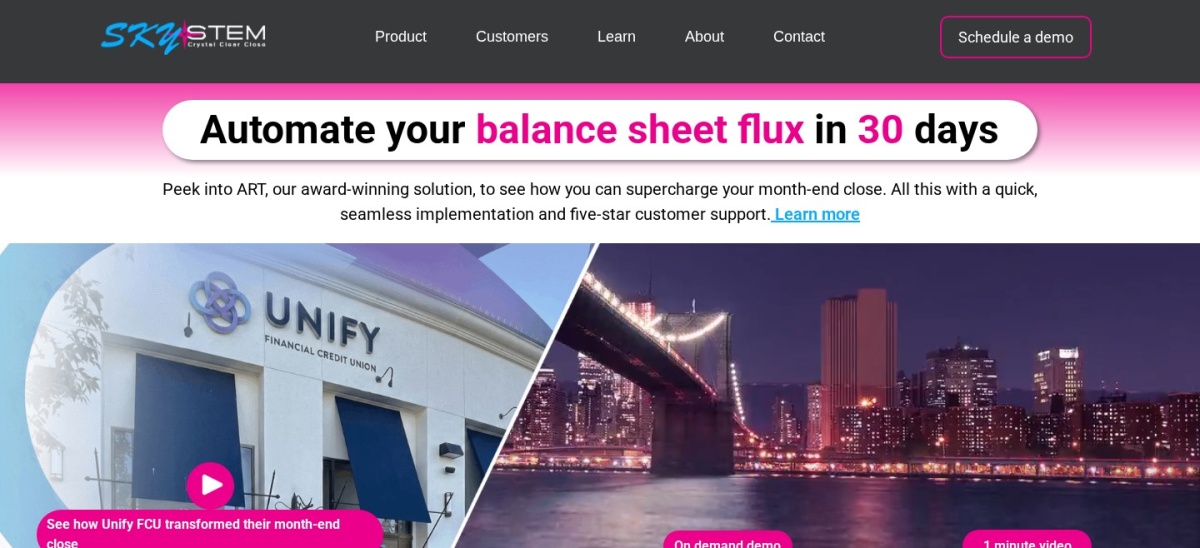
SkyStem ART is a dedicated account reconciliation and close platform that automates balance sheet reconciliations, variance analysis and close workflows. It uses standard reconciliation forms, supporting documents and sign-off workflows, and the vendor sets no limit on registered users or accounts. Support is included without a separate fee.
The trade off is price transparency. SkyStem publishes no prices and every deal is a quote, so budgeting needs a sales conversation, and directory listings that show a $0.01 starting price are placeholders, not real pricing. It suits mid-market teams that want a focused reconciliation tool rather than a full close suite.
What we like
No limit on users or accounts
Support included at no extra fee
Focused on reconciliation, not a sprawling suite
Rated 4.3/5 on Capterra from 150 reviews
Watch out for
No published prices
Narrower scope than full close suites
Directory price listings are placeholders, not real prices
Custom feeds and larger migrations add professional servicesVisit skystem.com
08
AutoRek
4/5on G2 (1 reviews, checked Nov 2026)
PricingCustom/yr
Best for high-volume financial services
AI assistantARIA, built in
Exception managementYes
Regulatory reportingYes
Entry packageQuote-based
autorek.com
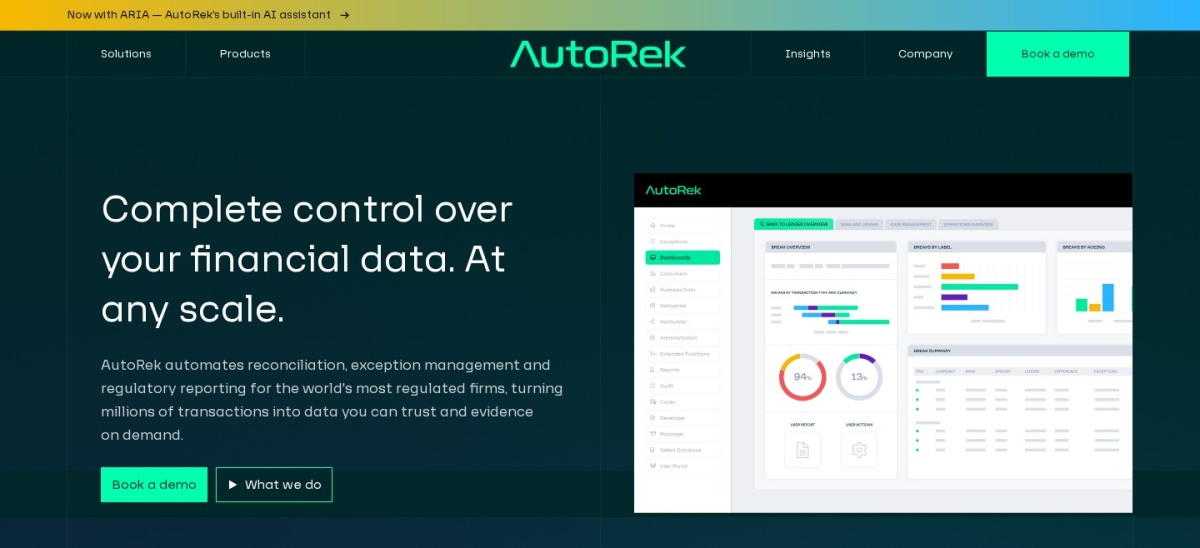
AutoRek homepage, captured Nov 2026.
AutoRek is a reconciliation platform built for banks, insurers, asset managers and payment firms that process millions of transactions. It automates reconciliation, exception management and regulatory reporting, and its built-in AI assistant ARIA helps teams work through breaks. It handles non-standard data formats that generic tools struggle with.
The trade off is evidence. AutoRek has only 1 review on G2, so public user feedback is almost non-existent, and pricing is quote-based. It suits regulated financial services teams whose volume and compliance load rule out lighter tools.
What we like
Built for millions of transactions
Exception management and regulatory reporting included
Handles non-standard data formats
Built-in AI assistant ARIA
Watch out for
Only 1 G2 review
Quote-based pricing
Aimed at financial services, not general accounting
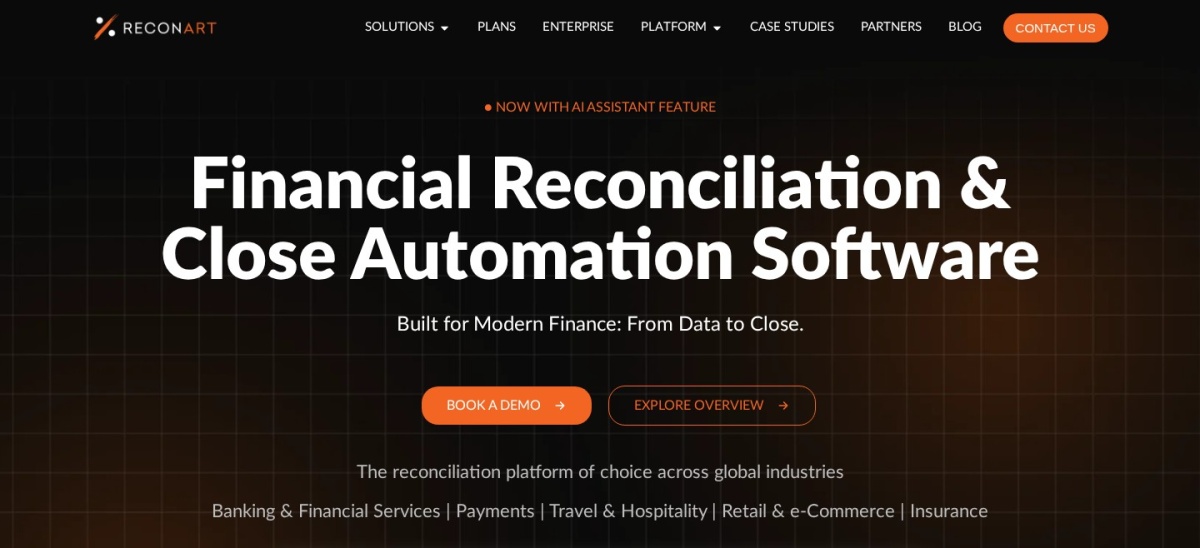
ReconArt is a standalone reconciliation and close automation platform used across banking, payments, travel, retail and insurance. It imports transactions automatically, applies configurable matching rules including 1-to-many and many-to-many matching, and certifies balance sheet accounts. A new AI assistant feature helps with routine reconciliation work.
The trade off is reputation. ReconArt holds the lowest rating in this list at 3.6 out of 5 from 5 G2 reviews, and pricing is quote-based. It suits teams that want one configurable matching engine across many reconciliation types rather than a close checklist suite.
Bring your own data to the demo. A vendor's sample file always matches cleanly, so ask them to run your messiest month instead.
Check the exception queue. Most of your team's time goes to breaks, so the queue, the reason codes and the re-match workflow matter more than the match rate.
Ask what happens at audit time. Sign-offs, attached evidence and a full history of who changed what are what auditors ask for first.
Confirm the ERP connection. Some tools sync live with NetSuite or SAP, while others work from uploaded spreadsheets, and that gap decides how much manual work remains.
How we chose
We started from the reconciliation and close platforms finance teams compare most often, then kept nine established tools that automate matching or reconciliation work rather than only organising checklists.
Prices come from each vendor's pricing page, checked on 24 November 2026. Seven vendors publish no prices, so those entries show a custom quote. Ratings come from G2, checked the same day, except SkyStem, which uses Capterra. Where a vendor shows a sale, the list shows the regular price.
We left out general ledgers and tools with no reconciliation automation. No vendor paid for a place, and we do not claim to have used these tools ourselves.
How to choose accounting reconciliation software for automation
Start with the volume and the messiest data you reconcile, then match the tool to that job.
Count what you reconcile each month. Volume decides the tool. A few hundred bank lines fit a focused matcher, while millions of transactions need a platform built for that load.
List the sources that must match. Bank feeds, payment processors, ERPs and spreadsheets all behave differently. Check each source connects live or uploads cleanly before you shortlist.
Ask for a demo on your own data. Sample data always matches. Run your messiest month through the tool and watch how the exception queue handles the breaks.
Get the full first-year cost in writing. Quotes rarely include implementation, and some features are add-ons. Ask what is included and what the renewal price is before you sign.
FAQ
What is the best accounting reconciliation software for automation?
FloQast is the best pick for most teams. Its Close AI package adds AI matching, automated reconciliations and automatic journal entry posting to its close checklists, and it is rated 4.6 out of 5 on G2 from more than 1,400 reviews.
How much does reconciliation automation software cost?
Prices range from $30 per user a month for Numeric and $52 a month for Synder to custom quotes for the other seven tools. Enterprise close suites usually cost tens of thousands a year, so get a written quote for your volume before budgeting.
Can reconciliation software replace accountants?
No. It matches routine transactions and flags exceptions, but people still review breaks, approve journals and sign off reconciliations. The gain is time: teams spend their hours on exceptions instead of ticking lines.
What is the difference between FloQast and BlackLine?
FloQast organises the close around checklists and reconciliations and suits mid-market teams, while BlackLine is a broader enterprise suite with intercompany accounting and risk-based certification. Both are quote-based, so the choice turns on team size and audit needs.
Do these tools work with QuickBooks or Xero?
Some do. Numeric, Synder and Adra connect to QuickBooks or Xero, while FloQast and BlackLine focus on larger ERPs such as NetSuite, SAP and Workday. Check the integration list for your ledger before shortlisting.
Is there a free reconciliation automation tool?
No tool in this list has a free plan. Synder offers a 15-day free trial, and the others are paid from the start or quote-based. Small teams with low volume can often use the bank reconciliation built into their ledger instead.