Skyvia is the best of these Airbyte alternatives for most teams, rated 4.8 out of 5 on G2 from 326 reviews, with a free tier and paid plans from $99 a month. Coupler.io is the cheapest paid start at $32 a month, while Fivetran suits teams that want the widest managed connector set.
How we make this list: we compare pricing pages, product documentation and public user reviews, then re-check every price before each update. No product paid for a place. Disclosure.
Skyvia tops the list at 4.8/5 on G2 from 326 reviews, with a free tier and paid plans from $99 a month.
Coupler.io is the cheapest paid start at $32 a month, while Weld and Skyvia both start at $99 a month.
Fivetran has the widest connector set at 700+, but its MAR billing is per connection, not pooled.
Estuary is the only real-time CDC pick here, from $0.50 per GB plus $100 per connector a month.
Integrate.io is the only flat-fee unlimited-volume plan, at $1,999 a month billed annually.
What should you look for in Airbyte alternatives?
Price is the first filter. Airbyte Core is free to self-host and Airbyte Cloud starts at $20 a month, so the cheapest managed alternatives here still cost more at the entry tier — Coupler.io at $32 a month and Skyvia at $99 a month. The real difference is the meter: rows, events, credits or gigabytes.
Open source is the second filter. None of these nine is a self-hosted open-source ELT tool like Airbyte Core. Estuary has an open-source core, but its managed Cloud is the product most teams buy, and the rest are closed SaaS platforms you rent, not software you run.
Connector depth decides shortlists fast. Fivetran lists 700+ connectors, Weld 300+, and Skyvia, Integrate.io and Estuary 200+ each, while Stitch covers 100+ sources — so check your exact sources before comparing prices, because a missing connector ends the evaluation.
Support and control matter once pipelines run daily. Prefer tools that expose sync logs, alerts and an API, so a failed pipeline is visible before the dashboard goes stale. Our WordPress REST API guide explains how APIs move data between systems, and the same visibility idea applies here.
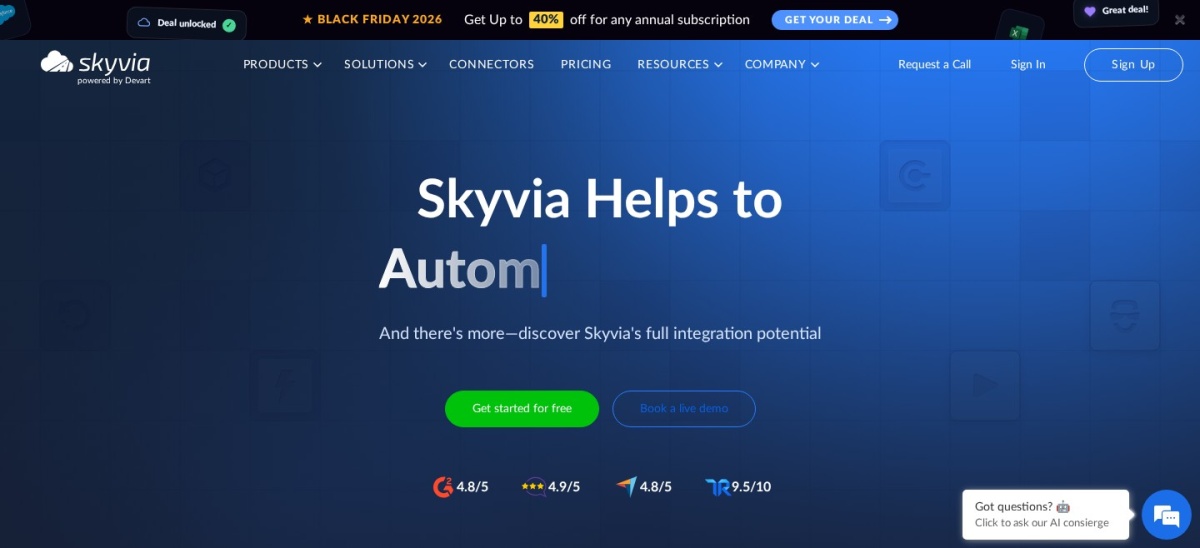
Skyvia is a no-code cloud data platform with 200+ connectors for replication, import, export and two-way sync. The free plan covers 10,000 records a month, and Data Integration Basic starts at $99 a month for 5 million records with daily runs.
The trade off is speed on the entry plan. Basic runs once a day, so hourly syncs need Standard at $199 a month billed monthly, and modules such as backup and automation are priced separately. It suits teams without a data engineer that want visual mapping and published prices.
What we like
No-code visual mapping
Free plan with 10,000 records a month
Published prices on every plan
Reverse ETL included
Watch out for
Basic runs once a day
Modules priced separately
Record overage adds up on Standard
Standard adds hourly runs and Data Flow at $199 a month billed monthlyVisit skyvia.com
02
Weld
4.8/5on G2 (110 reviews, checked Nov 2026)
Starts at$99/mo
Best flat-fee all-in-one alternative
Connectors300+
Basic plan$99/mo, 5M rows
Sync speedDaily on Basic
Reverse ETLIncluded
weld.app
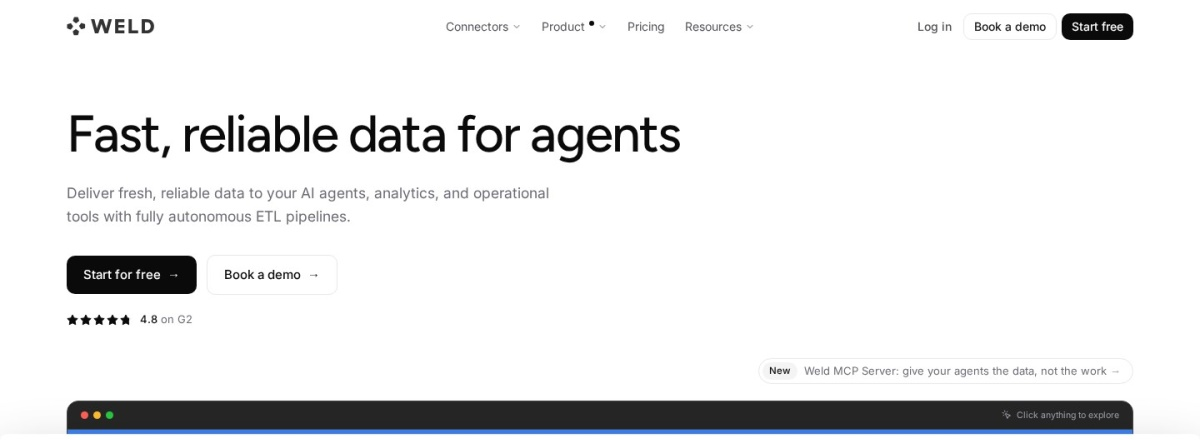
Weld homepage, captured Nov 2026.
Weld is a modular data platform that moves data from 300+ sources into BigQuery, Snowflake or another warehouse, models it with dbt or SQL and syncs results back into business tools. Basic starts at $99 a month billed yearly for 5 million rows, 2 connectors and daily syncs, with transformations and reverse ETL included.
The trade off is the connector cap. Basic covers only 2 connectors, so teams with more sources pay per extra connector or move to Premium from $389 a month billed yearly. It suits small teams that want one flat bill instead of a metered one.
What we like
Flat monthly tiers, no per-row meter
Reverse ETL and dbt included
300+ connectors built in-house
Free migration from Fivetran
Watch out for
Only 2 connectors on Basic
No permanent free plan, trial only
Cloud-only, no self-hosted option
Premium adds hourly syncs, 6 connectors and dbt orchestrationVisit weld.app
03
Coupler.io
4.8/5on G2 (104 reviews, checked Nov 2026)
Paid from$32/mo
Best value for analysts and small teams
Sources400+
Free plan1 source, 100 rows/run
Starter plan$32/mo, daily refresh
DestinationsSheets, BI, warehouses
coupler.io
Coupler.io homepage, captured Nov 2026.
Coupler.io is a no-code data integration platform that moves data from 400+ sources into Google Sheets, Excel, Power BI, Looker Studio and warehouses. The free plan covers 1 source and 100 rows per run, and Starter costs $32 a month billed monthly for 3 accounts, daily refresh and 5,000 rows per run.
The trade off is depth. Coupler.io is built for analysts moving business data into reports, not for heavy database replication or CDC, and hourly refresh needs the Pro plan. It suits marketing, finance and ops teams that live in spreadsheets and dashboards.
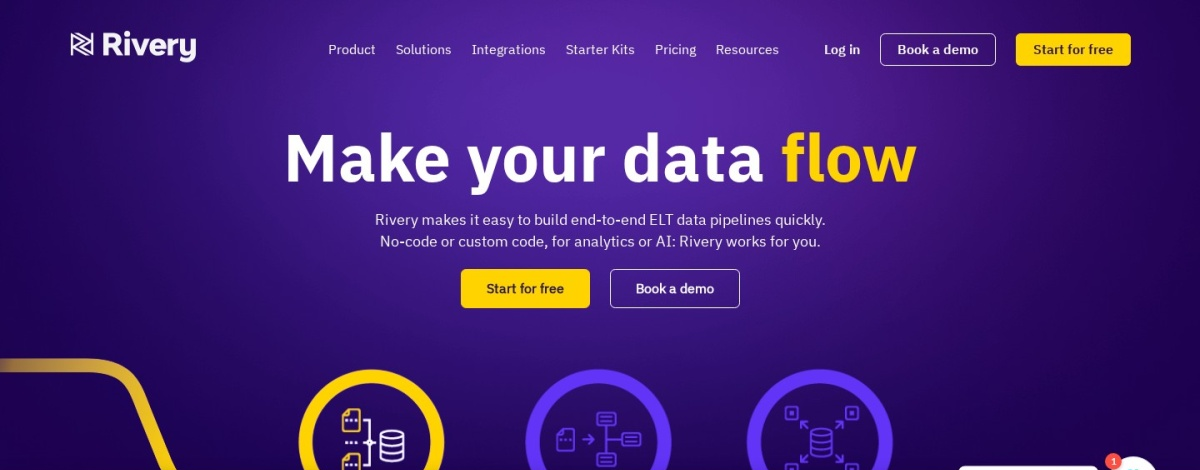
Rivery is a cloud-native data integration platform that bundles ELT ingestion, workflow orchestration and reverse ETL into one product with one credit meter. The Base plan charges $0.90 per BDU credit, covers 2 users and 1 environment, and new accounts get 1,000 free usage credits to try it.
The trade off is ownership. Boomi acquired Rivery in December 2024 and rebranded it Boomi Data Integration, so the roadmap now sits with Boomi, and credit-based pricing is hard to predict without modelling real volumes. It suits small-to-mid data teams that want orchestration without a second tool.
What we like
ELT, orchestration and reverse ETL in one
Built-in PII detection and masking
Rated 4.7 out of 5 by 120 G2 reviewers
Python and SQL transformations
Watch out for
Credit pricing is hard to forecast
Base plan limited to 2 users
Acquired by Boomi in late 2024
Higher tiers add environments, SSO and high-frequency syncsVisit rivery.io
05
Estuary Flow
4.7/5on G2 (35 reviews, checked Nov 2026)
PriceFree
Best for real-time CDC into a warehouse
Connectors200+
Free tier10 GB/mo, 2 connectors
Cloud price$0.50/GB + $100/connector
SyncReal-time, log-based CDC
estuary.dev
Estuary Flow homepage, captured Nov 2026.
Estuary Flow is a managed streaming platform that unifies CDC, streaming and batch ELT in one place. It captures changes from databases such as Postgres and MongoDB and lands them in warehouses in under 100 milliseconds, with more than 200 source and destination connectors.
The trade off is the meter. Cloud costs $0.50 per GB plus $100 per connector instance a month, and the GB meter runs at capture and again at each materialization, so one destination bills roughly twice the changed data. It suits teams whose main job is CDC into a warehouse.
What we like
Real-time log-based CDC
Free tier covers 10 GB a month
Cheap at high volume: $0.50 per GB
Open-source core
Watch out for
Connector fees add to the per-GB price
Built for engineers, not analysts
GB meter runs twice per destination
Enterprise adds SOC 2, HIPAA and private cloud deploymentVisit estuary.dev
06
Hevo Data
4.4/5on G2 (292 reviews, checked Nov 2026)
Paid from$299/mo
Best no-code pick for mid-market teams
Connectors150+
Free tier1M events/mo, 5 users
Starter plan$299/mo, 5M events
SyncHourly on Starter
hevodata.com
Hevo Data homepage, captured Nov 2026.
Hevo Data is a no-code ELT platform that copies data from 150+ databases, SaaS apps and files into a warehouse without pipeline code. The free tier covers 1 million events a month, and Starter costs $299 a month billed monthly for 5 million events, 10 users and the full connector library.
The trade off is the event meter. Every insert, update and delete counts as a billable event, so high-change tables can burn through the allowance, and streaming pipelines need the custom Enterprise plan. It suits small and mid-market teams that want fast setup and strong support.
What we like
Fast setup, most connectors live in minutes
Responsive support praised in G2 reviews
dbt integration on Starter
Transparent event-based pricing
Watch out for
Event-based billing can spike at scale
Hourly scheduling only on Starter
Streaming pipelines need Enterprise
Professional adds more events and unlimited users at $849 a monthVisit hevodata.com
07
Integrate.io
4.4/5on G2 (213 reviews, checked Nov 2026)
Starts at$1,999/mo
Best for predictable flat-fee enterprise ETL
Connectors200+
Core plan$1,999/mo billed annually
VolumeUnlimited rows and pipelines
SyncDown to 60 seconds
integrate.io
Integrate.io homepage, captured Nov 2026.
Integrate.io is a cloud data integration platform covering ETL, ELT, change data capture, reverse ETL and API generation across 200+ connectors. Its published Core plan starts at $1,999 per month billed annually and includes unlimited data volume, unlimited pipelines, unlimited connectors and 30-day onboarding.
The trade off is the $1,999 per month entry price and lack of a permanent free tier beyond a 14-day trial, while role-based access control and HIPAA readiness sit in a quote-based tier. It suits mid-market and enterprise teams that want one flat bill for heavy volumes.
What we like
Flat fee with unlimited volume
ETL, ELT, CDC and reverse ETL in one
Syncs down to 60 seconds
30-day onboarding included
Watch out for
Highest entry price in this list
No permanent free plan
RBAC and HIPAA need a custom plan
Higher tiers add role-based access control and HIPAA readinessVisit integrate.io
08
Stitch
4.4/5on G2 (68 reviews, checked Nov 2026)
Starts at$100/mo
Best simple row-based ELT
Sources100+
Standard plan$100/mo, 5M rows
Destinations1 on Standard
Free trial14 days
stitchdata.com
Stitch homepage, captured Nov 2026.
Stitch is a simple cloud ELT service from Qlik that replicates data from more than 100 sources into a warehouse. Standard starts at $100 a month for 5 million rows, covers 1 destination and 10 standard sources, and every plan includes a 14-day free trial.
The trade off is scope. Stitch only extracts and loads, so transformation needs dbt or another tool, and row-based pricing climbs steeply past 5 million rows a month. It suits small teams that want the simplest possible managed ELT.
Fivetran is a fully managed ELT platform that moves data from 700+ sources into Snowflake, BigQuery, Redshift, Databricks and other destinations with little ongoing maintenance. The free plan covers 500,000 monthly active rows, and Standard bills $500 per 1 million MAR with a $5 minimum per connection.
The trade off is the meter. Monthly active rows are counted per connection, not pooled, so many small sources cost more than one large source at the same total volume, and annual contracts start at $12,000. It suits teams that want the deepest connector catalogue and hands-off sync.
How the meters differ: rows, events, credits and gigabytes
Fivetran counts monthly active rows per connection, Hevo counts events, Stitch counts rows, Rivery counts credits and Estuary counts gigabytes, so the same 10 sources can cost tens of dollars or thousands a month depending on the meter.
Flat-fee plans remove the surprise. Weld charges $99 a month for a tier of rows and connectors, Integrate.io charges $1,999 a month for unlimited volume, and Skyvia prices by records and refresh speed.
Model your real volumes before signing. Count rows, events or gigabytes for a typical month, then price the same month on two or three meters before you commit.
How we chose
We started from the ELT tools most often named as Airbyte replacements in G2 comparisons and vendor migration pages, then kept the nine with a published G2 rating and a public price.
Prices come from each vendor's pricing page or G2 pricing listing, checked on 29 November 2026. Ratings and review counts come from G2 on the same day. Where a vendor shows an annual rate, the list shows the monthly-billed regular price.
We left out tools with quote-only pricing, such as Talend, Informatica and Matillion, and tools with no G2 rating, such as Portable. No vendor paid for a place, and we do not claim hands-on testing for this list.
How to choose an Airbyte alternative
Start with the meter, then check your sources, then trial the top two.
Count what you will be billed for. Pull a typical month of rows, events or gigabytes from your current pipelines, then price that month on each meter before comparing headline prices.
Check your exact sources. A tool with 700 connectors still fails if your one niche source is missing. Confirm every source and destination on the vendor's connector page.
Trial the top two side by side. Use the free tiers and trials to sync the same source into the same warehouse, then compare sync speed, logs and failure alerts.
Plan the exit before you sign. Confirm you can export pipeline definitions and history, and check what happens to pricing when volume doubles.
FAQ
What is the best Airbyte alternative in 2026?
Skyvia is the best Airbyte alternative for most teams in 2026. It is rated 4.8 out of 5 on G2 from 326 reviews, has a free tier covering 10,000 records a month, and paid plans start at $99 a month.
What is the cheapest Airbyte alternative?
Coupler.io is the cheapest paid start in this list at $32 a month billed monthly, with a free plan for 1 source. Skyvia and Weld both start at $99 a month, while Fivetran's free plan covers 500,000 monthly active rows.
Is there a free alternative to Airbyte?
Yes. Airbyte Core itself is free to self-host, and among managed tools Skyvia, Coupler.io, Hevo Data, Estuary and Fivetran all offer free tiers. Free tiers are capped by records, events, gigabytes or rows, so check the limit against your volume.
Which Airbyte alternative is best for small teams?
Coupler.io suits analysts and small teams that work in spreadsheets and dashboards, while Stitch suits small teams that want the simplest managed ELT at $100 a month. Weld is the better pick when the team also needs transformations and reverse ETL in one plan.
Skyvia vs Fivetran: which is better?
Skyvia wins on price and simplicity, with published plans from $99 a month and a 4.8 out of 5 G2 rating. Fivetran wins on connector depth with 700+ sources and hands-off sync, but its per-connection MAR billing costs more at scale.
Do any Airbyte alternatives offer real-time sync?
Estuary Flow offers real-time log-based CDC with sub-100-millisecond latency from $0.50 per GB. Weld syncs in under a minute on higher tiers, and Integrate.io syncs down to 60 seconds, while most others run on hourly or daily schedules.
SaaS SEO and WordPress specialist with about 8 years of experience. Rakib compares WordPress plugins, themes, hosting and software using public pricing, documentation and user reviews. See how we rank.